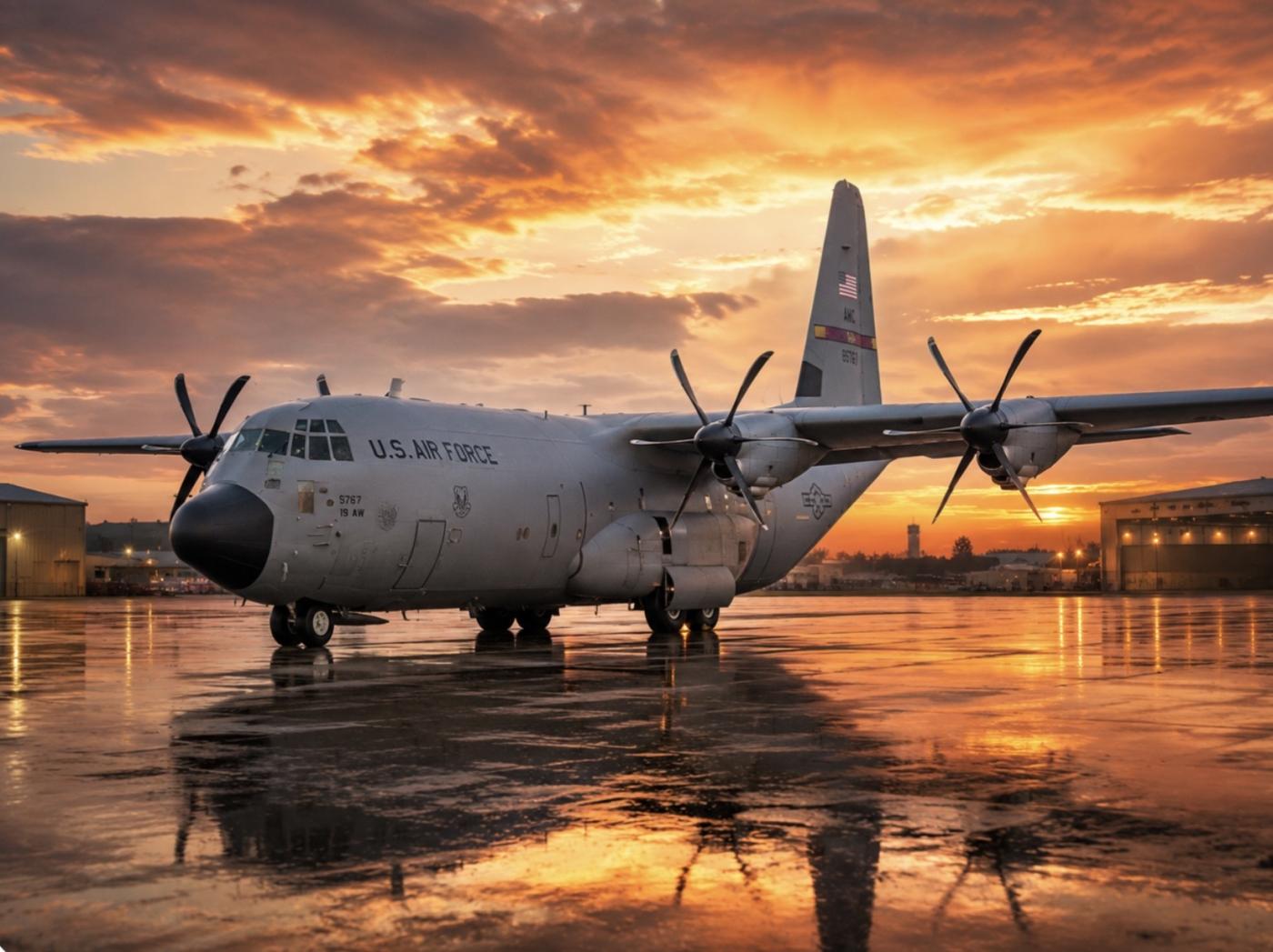
C-130 Hercules
The Lockheed C-130 Hercules is one of those aircraft that seems almost too useful to grow old. It was designed in the early Cold War, born from the hard lessons of Korea, yet more than seventy years later it is still flying into war zones, disaster areas, desert strips, snowfields and remote landing zones across the world. Few aircraft have served so many nations in so many roles, and even fewer have earned such affection from the soldiers who have jumped from them, the crews who have flown them, and the armies that have depended on them.
The story began in 1951, when the United States Air Force wanted a new tactical transport aircraft. It needed something tougher and more flexible than the older piston-engined transports then in service. The requirement was simple in words but difficult in engineering: carry troops, vehicles and cargo; operate from short, rough strips; fly at useful speed and range; and be strong enough to survive military use close to the front line. Lockheed Aircraft Corporation answered that challenge with a design led by Willis M. Hawkins, one of the company’s most important engineers. His team produced an aircraft that looked almost plain compared with sleek fighters and bombers, but its genius was in its practicality.
The first YC-130 prototype flew on 23 August 1954 from Lockheed’s plant at Burbank, California. Even on that first flight the aircraft showed the qualities that would make it famous. It had a high wing, a strong box-like fuselage, a rear loading ramp, large flaps, powerful turboprop engines and rugged landing gear. It was not designed to look graceful; it was designed to work. Production moved to Marietta, Georgia, where the Hercules became one of the great long-running aircraft production stories in aviation history. The C-130A entered United States Air Force service in 1956, and remarkably, modern versions of the Hercules family are still being built today.
The early C-130A was powered by four Allison T56 turboprop engines. Later C-130E and C-130H models continued with improved versions of the T56. The modern C-130J Super Hercules uses four Rolls-Royce AE 2100D3 turboprops driving six-bladed composite propellers. That choice of turboprop power is one of the secrets behind the aircraft’s success. A turboprop gives strong low-speed pulling power, good fuel efficiency at tactical transport speeds, and the ability to operate safely from shorter and rougher airstrips than many pure jet transports. The Hercules was never meant to be the fastest aircraft in the sky. Its strength was that it could get into places where other aircraft could not go, unload quickly, and get out again.
The layout of the aircraft made it ideal for soldiers. The high wing kept the engines and propellers clear of loose stones and debris on rough strips, while the cargo floor sat low enough for vehicles, pallets and guns to be loaded through the rear ramp. The rear door could be opened for air drops, and paratroopers could exit from side doors or the rear depending on the mission and equipment. Inside, the Hercules could be quickly changed from a troop carrier to a cargo aircraft, ambulance aircraft, parachute platform or special mission machine. A standard C-130 could carry around 92 passengers, about 64 fully equipped paratroopers, or six cargo pallets. Depending on version and configuration, it could carry roughly 42,000 lb of cargo, while later C-130J models can lift around 44,000 to 46,700 lb.
For airborne forces, the Hercules became one of the most important aircraft ever built. To paratroopers it was not glamorous, but it was dependable. It could carry a full stick of soldiers with their parachutes, weapons, radios, bergens and heavy equipment, and it could drop them at low level over a marked drop zone. It could also drop supplies, artillery, light vehicles and container delivery loads, which made it invaluable for airborne operations where men on the ground needed ammunition, rations, water and heavier kit quickly. British, American and many allied parachute forces became closely associated with the Hercules. For many soldiers, the sound of its engines and the red light turning green became part of the memory of military life.
Its performance gave commanders options. Exact distances depend on weight, temperature, altitude and runway condition, but the Hercules was designed around short take-off and landing ability. A C-130J can use roughly 3,000 feet for landing at certain operating weights, and around 3,000 to 3,500 feet for take-off in typical tactical figures, though heavier loads and hotter conditions require more. Earlier versions were also famous for getting in and out of short strips that would defeat larger transports. The first prototype itself lifted off in a surprisingly short distance, proving that this big, blunt transport had exceptional low-speed lift.
Range also depends heavily on payload and fuel load. A modern C-130J-30 can fly around 2,100 nautical miles with its maximum normal payload, and around 2,390 nautical miles with a 40,000 lb payload. Lighter loads, external tanks and air-to-air refuelling can extend mission reach considerably. That range made the Hercules useful not only for battlefield drops, but also for long-distance movement between theatres, relief operations and special forces work deep behind enemy lines.
Over time, the basic design became almost a flying toolbox. The C-130A was the first main production version, followed by improved B, E and H models with better engines, avionics, fuel capacity and structural improvements. The C-130H became one of the most widely used versions around the world. The stretched C-130J-30 added extra fuselage length, giving more room for cargo, pallets or troops. The KC-130 became an aerial refuelling tanker, especially important to the United States Marine Corps, able to refuel aircraft and helicopters while still retaining transport usefulness. The HC-130 served in search and rescue and special operations support. The MC-130 family became a shadowy special operations workhorse, flying low-level infiltration, resupply and refuelling missions for special forces.
One of the most famous and fearsome variants is the AC-130 gunship. Instead of simply carrying cargo, the AC-130 was turned into a heavily armed flying fire-support platform. First used during the Vietnam War, it carried side-firing weapons and sensors, circling above the battlefield and pouring accurate fire onto enemy positions. Later versions such as the Spectre, Spooky and Ghostrider carried combinations of cannon, precision-guided weapons and advanced night sensors. The modern AC-130J Ghostrider is one of the most heavily armed aircraft of its kind, designed not to fight like a fighter, but to remain overhead and support troops on the ground with devastating accuracy.
Other variants show just how adaptable the aircraft became. There have been weather reconnaissance Hercules aircraft flying into storms, ski-equipped aircraft operating in Arctic and Antarctic conditions, electronic warfare versions, maritime patrol versions, firefighting aircraft dropping retardant over wildfires, and civilian L-100 Hercules transports used by commercial operators. The same basic airframe has carried troops into combat, evacuated wounded soldiers, delivered famine relief, recovered spacecraft capsules, supported scientific stations and moved everything from vehicles to helicopters.
The Hercules has been operated by more than 70 nations, which makes it one of the most widely used military transport aircraft in history. It has served with the United States, United Kingdom, Australia, Canada, India, New Zealand, France, Germany, Japan, South Korea, Israel, Egypt, Norway, Denmark, Turkey, Greece, Pakistan and many others. Some countries bought new aircraft, while others acquired upgraded or second-hand examples. Its global success came from one simple fact: nearly every air force needs a tough medium transport that can carry useful loads without needing perfect runways.
The British connection with the Hercules was especially strong. The Royal Air Force used the type for decades, including the C-130K and later C-130J. For British airborne forces, it became a familiar jump platform and tactical transport. It carried paratroopers, vehicles and supplies in training and operations, and it was valued because it could do the rough, practical work that airborne and special forces operations demand. Although the RAF retired its Hercules fleet in 2023, the aircraft left behind a huge reputation among those who had served around it.
The Hercules has seen service in Vietnam, the Falklands era, the Gulf War, Afghanistan, Iraq and countless smaller operations. It has landed on rough strips in Africa, flown into besieged airfields, dropped supplies to isolated troops, and carried humanitarian aid after earthquakes, floods and storms. Its military value is not only measured in firepower or speed, but in reliability. Wars are not won by glamorous aircraft alone. They are won by moving men, ammunition, fuel, food, vehicles and medical support to the right place at the right time, and that is exactly what the C-130 was built to do.
One of the most interesting things about the Hercules is that it was never a delicate machine. Crews could load it hard, fly it low, land it rough and send it out again. Its cargo bay was functional rather than comfortable. Paratroopers sat shoulder to shoulder in webbing seats, often packed with kit, waiting for the jumpmaster’s signals. The aircraft was noisy, draughty and uncomfortable on long flights, but it was trusted. That trust matters in military aviation. Men will forgive discomfort if the aircraft gets them there and brings them home.
The reason the C-130 has lasted so long is that the original design was right. It had enough size to be useful, but not so much that it became restricted to major airfields. It had enough power to lift heavy loads, but it remained economical enough to operate widely. It could be maintained in difficult places, adapted to new missions and modernised with new engines, avionics and defensive systems. Many aircraft are designed for one job and become outdated when that job changes. The Hercules was designed around usefulness, and usefulness never goes out of date.
Today, the C-130J Super Hercules continues the line with modern flight systems, stronger performance and improved reliability. It can fly with fewer crew than older versions, uses more efficient engines, and carries the Hercules name into the twenty-first century. New examples continue to be delivered, making the C-130 family one of the longest continuously produced military aircraft lines in history.