On this day in military history…
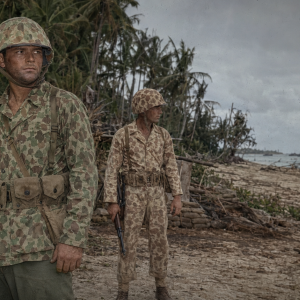
On 7th July 1944, during the final days of the Battle of Saipan, Japanese forces launched what became the largest banzai charge of the Pacific War. It was a desperate, terrifying and tragic attack, fought at close range in the darkness and early morning light, and it showed the brutal nature of the war being fought across the islands of the Pacific.
Saipan was not just another island. To the Americans it was one of the great prizes of the Mariana Islands, a place from which long-range B-29 bombers could eventually strike the Japanese home islands. To Japan it was part of the inner defensive ring of the empire, a barrier that had to be held if the war was to be kept away from Japan itself. When United States forces landed on Saipan on 15th June 1944, they were not simply fighting for ground; they were fighting for a position that could change the whole course of the war in the Pacific.
The battle was savage from the beginning. American Marines and Army troops had to fight through beaches, cane fields, caves, ridges, ravines and prepared Japanese positions. The Japanese defenders used the broken volcanic terrain to their advantage, hiding in caves and tunnels, launching sudden attacks, and forcing the Americans to clear the island yard by yard. By early July, however, the Japanese position was collapsing. Their units had been shattered, ammunition was running low, food and water were scarce, and thousands of wounded men were left with little hope of evacuation or proper treatment.
The Japanese commander, Lieutenant General Yoshitsugu Saito, knew that the battle was lost. Rather than surrender, he ordered a final attack. In the Japanese military code of the time, surrender was seen as dishonourable, and the idea of gyokusai, meaning to die honourably rather than be captured, shaped the terrible decision that followed. Men who could still walk were gathered together. Wounded soldiers were armed with rifles, bayonets, grenades, swords, bamboo spears and anything else that could be used as a weapon. Some could barely move, but they were still expected to take part in one last assault.
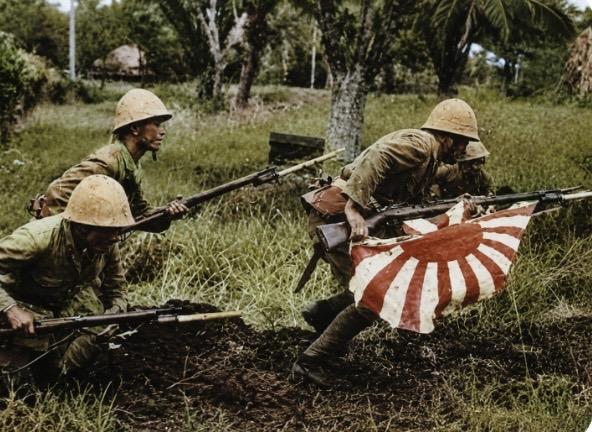
Before dawn on 7th July 1944, the Japanese force moved forward across the northern part of Saipan, near the Tanapag plain. Their main blow fell against positions held by the U.S. Army’s 105th Infantry Regiment of the 27th Infantry Division. The 1st and 2nd Battalions of the 105th were badly exposed, and the Japanese attack hit them with enormous force. It was not a neat military advance but a mass rush of desperate men, many shouting and firing as they came on, some wearing bandages, some half-starved, some already badly wounded. The cry of “Banzai” carried through the darkness as they drove into the American lines.
The first impact was devastating. Japanese troops overran forward positions, broke into aid stations, and crashed through parts of the American line. The fighting became hand-to-hand in places, with rifles, bayonets, knives, grenades and entrenching tools used at close range. Men fired until their weapons jammed or their ammunition ran out. Medics, clerks, cooks and wounded men were drawn into the battle because there was no rear area safe from the attack. It was one of those moments in war where every man present, whatever his normal duty, suddenly became part of the front line.
Among the most remarkable stories of that morning was that of Captain Ben L. Salomon, an Army dentist serving as a surgeon with the 105th Infantry Regiment. As Japanese troops broke into the aid station, Salomon helped wounded men escape and then fought to hold the attackers back. When his body was later found, he was surrounded by large numbers of Japanese dead. He had fought with extraordinary courage, using whatever weapons were available, and decades later he was awarded the Medal of Honor for his actions on Saipan. His story became one of the most powerful examples of individual bravery from the battle.
The banzai charge did not stop with the first wave. The Japanese kept coming, and the battle raged for hours. American artillery, machine guns, rifles and mortars poured fire into the attackers, but the sheer size and determination of the Japanese assault made it extremely difficult to contain. Some Japanese troops pushed deep into American positions before being killed. Others were cut down in open ground. The bodies piled up in front of defensive positions and along the routes of the attack. By the time the fighting finally faded, the ground was covered with the dead.
The cost was appalling. More than 4,000 Japanese troops were killed in the attack and its immediate aftermath, making it the largest banzai charge of the Pacific War. American losses were also severe, with nearly 1,000 killed and wounded. The 105th Infantry Regiment had taken the full weight of the assault and suffered heavily, but it had not broken. The attack was tactically doomed, but for the men who faced it, that did not make it any less terrifying. It was a final explosion of resistance from an army that had been cornered and ordered to die rather than surrender.
The charge also revealed the hopeless position of the Japanese defenders. It was not a counterattack that could retake Saipan or drive the Americans into the sea. By 7th July, Japan no longer had the strength on the island to change the result. The banzai charge was instead a final act of defiance, rooted in a military culture that demanded sacrifice even when victory was impossible. For the Americans, it confirmed the grim reality that many Japanese units would fight almost to the last man, making every island campaign costly and bitter.
The tragedy of Saipan did not end with soldiers. As the battle reached its final stage, many Japanese civilians on the island were caught in the collapse. Some had been told by propaganda that the Americans would torture or kill them if they surrendered. In the days around the end of the battle, civilians died in large numbers, with some jumping from cliffs rather than falling into American hands. Places later known as Suicide Cliff and Banzai Cliff became symbols of the human disaster that unfolded as the Japanese defence disintegrated.
On 9th July 1944, Saipan was declared secured. The island had fallen, and the consequences were enormous. The loss shocked Japan’s leadership and helped bring down the government of Prime Minister Hideki Tojo. For the United States, Saipan opened the way for air bases that would bring the Japanese home islands within range of sustained bombing. The battle also showed that the road to Japan would be far bloodier than many had imagined.