Dries Riphagen
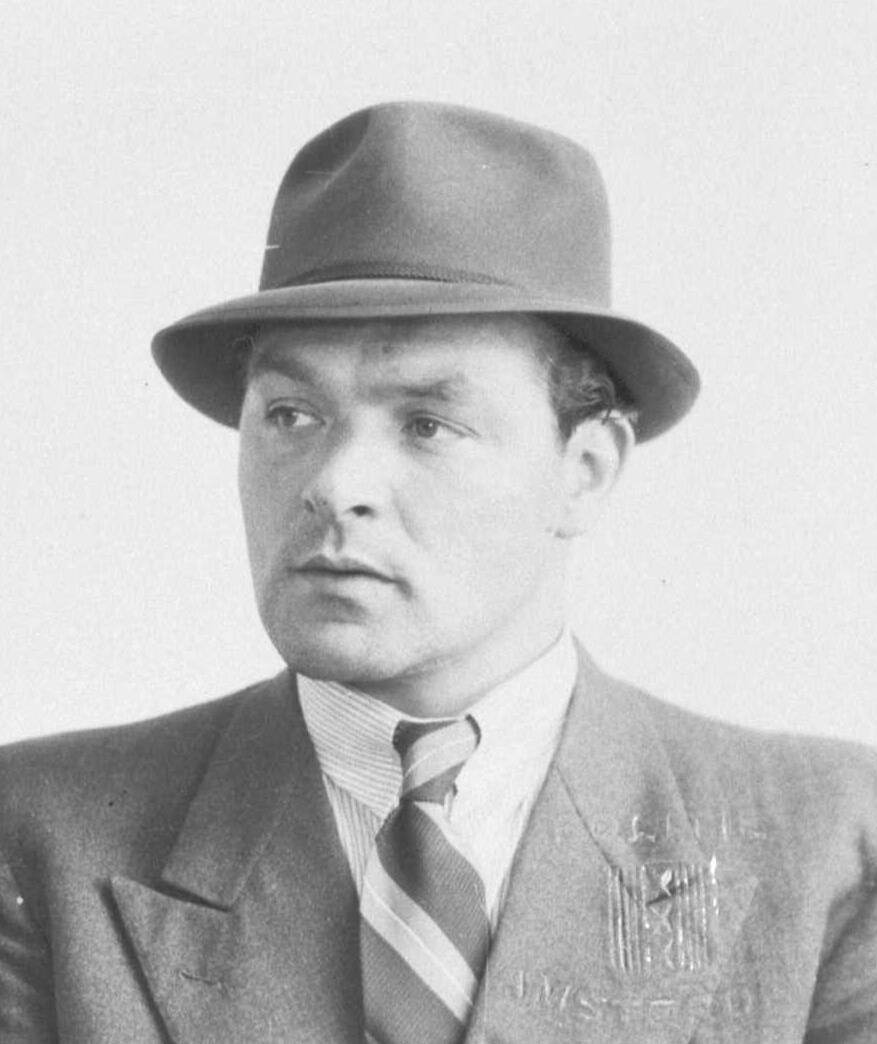
Dries Riphagen became one of the most notorious Dutch collaborators of the Second World War. He did not gain that reputation through political office, military rank or leadership of a mass movement. His influence came from the world he already knew before the war: the streets, the criminals, the hiding places and the fears of people who were trying to survive.
Before the occupation, Riphagen was already part of Amsterdam’s criminal world. During the war he used those contacts and that knowledge for the Germans and for himself. He became known as a man who hunted Jews, betrayed people in hiding, stole Jewish property and worked with the German security services. His story shows a dark part of the occupation: persecution was not only carried out by German officials in offices. It also depended on collaborators who knew where to look and who were willing to sell human lives for money.
Bernardus Andreas Riphagen, usually called Dries, was born in Amsterdam in 1909. He grew up in difficult circumstances. His mother died when he was still young, and poverty shaped much of his early life. His father struggled with alcoholism, which made his upbringing even more unstable. Riphagen first tried to follow a more ordinary path and went to sea, as his father had done before him. His years as a sailor brought him beyond the Netherlands. He spent time in the United States, where he worked for Standard Oil and came into contact with criminal circles. That period gave him both experience and a reputation. When he returned to Amsterdam, the step into the underworld became stronger. By the 1930s he was no longer just drifting at the edges of crime, but becoming part of it.
By the 1930s Riphagen had become a known figure in the Amsterdam underworld. He was connected with prostitution, gambling, black-market trade and stolen goods. He dealt in jewellery, watches, cars and other valuable items. He had become a man with contacts, money and influence in a city where the legal and illegal worlds often touched each other. This mattered when the Germans occupied the Netherlands in May 1940. The occupation did not create Riphagen’s criminal character. It gave him new opportunities. Before the war he had made money from people’s weaknesses, debts and secrets. During the war he could make money from persecution. The Germans needed people who knew the streets, the black market and the people who tried to disappear from official life. Riphagen knew exactly that world.
The persecution of Jews in the Netherlands became more violent and systematic after the German occupation. Jews were registered, isolated, robbed of rights and property, and later deported. Many were sent through Westerbork to camps in the east. Some tried to survive by going into hiding. That meant leaving normal life behind. A person in hiding needed false papers, food, money, trusted addresses and silence from neighbours. This created a world built on danger and suspicion. People in hiding depended on trust, but trust had become fragile. One careless word could lead to arrest, and one informer could destroy an entire network. The German occupier had power, but it did not know every attic, every back room or every false identity. For that, it needed Dutch collaborators.
Some of those collaborators turned persecution into a business. They were paid for finding Jews in hiding or for passing on information. Others stole money, jewellery, furniture or art. Many did both. The Nazis created the system of terror, but Dutch bounty hunters and informers helped bring that terror into ordinary homes, streets and hiding places.
Riphagen fitted into this world of hunting people, but he had his own methods. He did not always need to break down a door. Often his weapon was trust. He could present himself as someone who could help. He could tell desperate people that he had contacts, protection or safe routes. He could promise to keep money, jewellery or other valuables safe until after the war. This made him especially dangerous. Many Jews in hiding had already lost their homes, businesses and normal legal protection. If someone like Riphagen offered help, the offer could seem believable. He knew how to speak to people. He understood fear. He also understood greed.
Once valuables were in his hands, the promise could change. People who had trusted him could be betrayed to the Sicherheitsdienst, the German security service. Their money and jewellery could disappear, while they themselves were arrested. In this way Riphagen’s crimes were not only acts of collaboration. They were also acts of fraud. He sold hope, took payment, and then betrayed the people who had paid him.
Riphagen worked with the German security services as a trusted informant. This role gave him protection and status. It also gave him room to continue his own criminal business. The occupation blurred the line between police work, political persecution and organised crime. For a man like Riphagen, that was useful. He could pretend to serve the Germans while enriching himself.
Riphagen also betrayed people connected with the resistance. As the war continued, the difference between hunting Jews, hunting resistance members and hunting people with false papers became smaller. The same networks overlapped. People in hiding needed illegal identity cards. Resistance groups helped provide them. Criminals and informers tried to penetrate those networks. One betrayal could lead to several arrests.
When liberation came in 1945, many collaborators were arrested quickly. But Riphagen did not receive the punishment that many expected. He was wanted for treason and for the betrayal of Jews, and the Dutch authorities considered him responsible for the deaths of at least two hundred people. Instead of being handed over directly, he was kept under house arrest after making contact with Willem Evert Sanders, a former resistance fighter and police chief in Enschede. In return, Riphagen was expected to provide information about collaborators and pro-German networks.
In February 1946, Riphagen escaped. Stories later circulated that he had been smuggled across the border by criminal friends, hidden in a coffin inside a hearse. Later research pointed in a different direction. His escape appears to have been organised with help from people connected to the Bureau Nationale Veiligheid, the Dutch security service after the war. This made his story even more bitter. A man accused of helping send people to their deaths was not only able to escape; he escaped with help from inside the post-war security world.
From Belgium, Riphagen made his way through Europe and eventually reached Spain. He was briefly arrested there because he lacked proper papers, but he was released and managed to continue his flight. In 1948, when extradition to the Netherlands became a real threat, he left for Argentina. Dutch attempts to have him returned failed, partly because the case was built on lesser charges and partly because Riphagen had useful contacts.
In Argentina, Riphagen found protection and built a new life. He moved in circles close to power during the years of Juan Perón and was reportedly connected to people around the Argentine government. He lived in Buenos Aires, worked in photography and used his wartime experience in anti-communist circles. After Perón was overthrown, Riphagen returned to Europe and spent time in countries such as Spain, Germany and Switzerland. He died of cancer in Montreux in 1973. He never stood trial in the Netherlands for the crimes that made his name infamous.
Credit: Tom Dankers, Historian - Arnhems Oorlogsmuseum