Hermanns Bombs
The term “Hermann’s sledge” or “Hermann’s sledgehammer” was commonly used to describe one of the Luftwaffe’s heaviest and most feared demolition bombs. The nickname was a mocking reference to Hermann Göring, implying a crude but immensely powerful weapon that relied on brute force rather than accuracy. Among aircrews, ground staff, and later Allied commentators, the name captured the idea of a massive hammer blow delivered from the air, capable of smashing whole sections of a city with a single drop.
The SC designation came from Sprengbombe Cylindrisch, meaning a cylindrical high-explosive bomb. These weapons were deliberately thin-cased, which meant they produced an enormous blast rather than large quantities of lethal fragments. This design choice clearly shows their intended role. They were meant for demolition, not precision attacks. Their purpose was to destroy buildings, collapse streets, rupture water and gas mains, and spread disruption across densely populated urban areas.
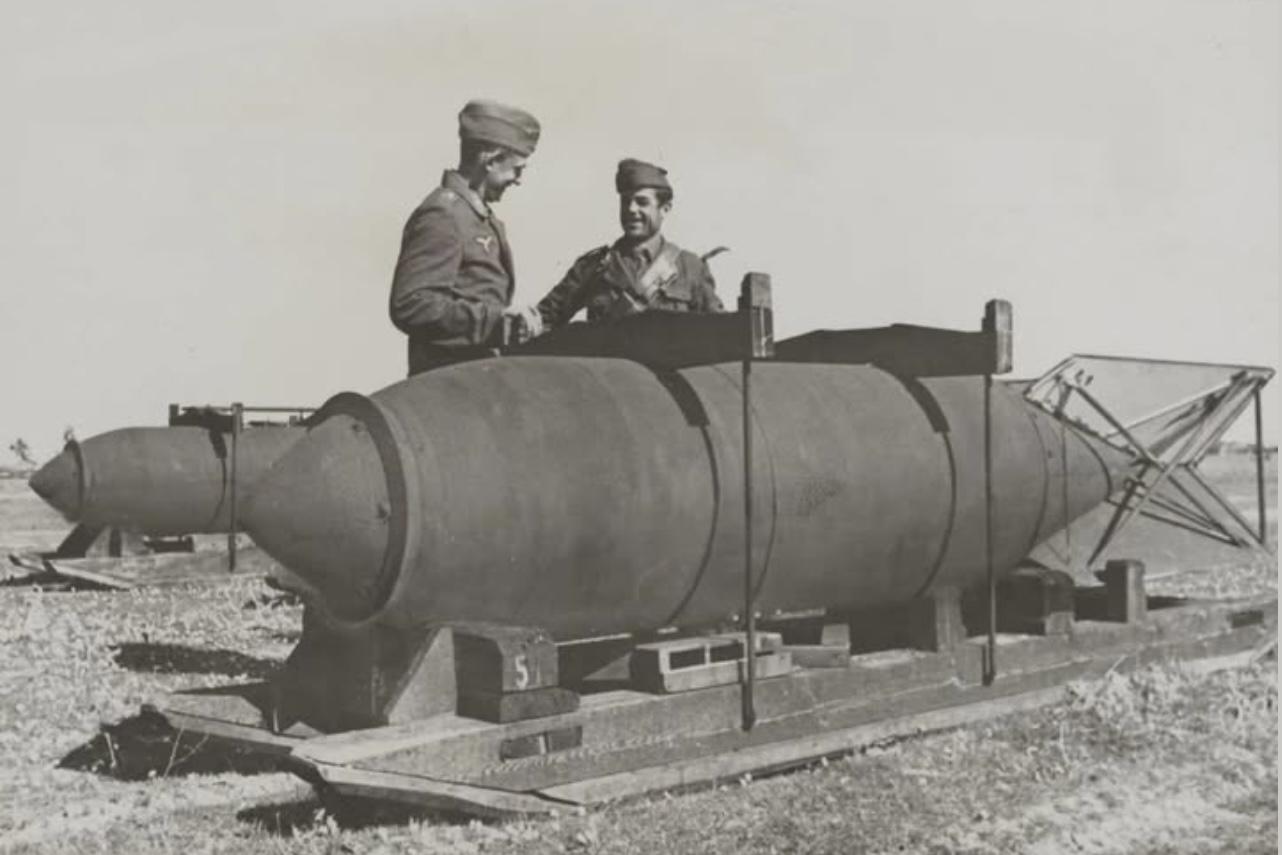
The one-ton class bomb at the centre of the “Hermann’s sledge” nickname weighed just over a metric ton and was already enormous by Second World War standards. Simply handling it on the ground was a major task. On airfields it was often moved and stored on low cradles or sled-like frames because lifting it was so difficult, which almost certainly reinforced the nickname. The bomb could be filled with different explosive mixtures depending on its intended target. Standard high-explosive fillings were common for city bombing, while more powerful Trialen mixtures were sometimes used for attacks on shipping, where blast and shock effect were especially destructive.
Although this weapon gained most of the public attention through its nickname, the largest SC bomb reliably documented as having been used operationally was the SC 2500, known as Max. This bomb weighed roughly two and a half tons and carried an immense explosive charge. Its sole purpose was to cause massive destruction with a single detonation. In some versions, aluminium was used in the bomb body to reduce weight and allow a greater proportion of explosive filling, again showing that blast effect mattered far more than penetration. During the later stages of the Blitz, bombs of this size were dropped in limited numbers against major British cities, where even one could devastate a wide area.
There is no well-known individual designer attached to the SC bombs. They were developed within the Luftwaffe’s ordnance system under the authority of the Reich Air Ministry. Specifications, testing, and approval were handled as part of an institutional process rather than being credited to a single engineer. Manufacturing followed the same pattern. Production was spread across German industry, with different factories responsible for bomb casings, fuzes, and explosive fillings, all coordinated under wartime controls. Individual bombs carried maker codes and markings, but most general histories focus on the weapon type rather than naming specific manufacturers.
The main purpose of these very large SC bombs was large-scale physical and psychological destruction. Their blast could demolish rows of houses, block streets with rubble, and cripple emergency services in a single moment. They were often used alongside smaller high-explosive bombs and incendiaries, helping to create conditions in which fires spread rapidly and rescue work became extremely difficult. Even when they failed to detonate, their sheer size and presence caused fear and disruption.
In terms of numbers dropped, the heavier the bomb, the fewer were used. The one-ton class demolition bomb was dropped in substantial quantities during the war and became a regular feature of major raids, something reflected today by how frequently unexploded examples are still discovered. The SC 2500, by contrast, was dropped only in small numbers, largely because few aircraft could carry it and because it was difficult and costly to handle.
One of the most striking legacies of these weapons is their long-term danger. Unexploded bombs of this size buried deep in the ground can remain lethal for decades. Even today, construction work across Europe can trigger the evacuation of tens of thousands of people when one is uncovered. What was once nicknamed “Hermann’s sledge” was not only a symbol of wartime destruction, but a physical threat whose effects continue long after the war itself ended.