Hawkins Pressure Mine
The Hawkins pressure mine was one of Britain’s more unusual anti-vehicle devices of the Second World War, created during a period of urgent improvisation following the threat of German invasion in 1940. Officially designated the Anti-Tank Mine No. 75, it was developed primarily by the British War Office in collaboration with the Ministry of Supply, with input from engineers connected to the MD1 research establishment, often referred to as “Churchill’s Toyshop.” Although not attributed to a single named designer, MD1 specialists such as Millis Jefferis influenced many of the unconventional weapons of the era, and the Hawkins mine carried the same hallmarks of rapid, practical design. Manufacture was carried out by various British contractors under Ministry of Supply oversight, including companies already producing munitions and explosive charges. Exact production figures were not centrally published, but surviving procurement records indicate that hundreds of thousands were manufactured between 1941 and 1944 due to their low cost, simplicity and wide tactical usefulness.
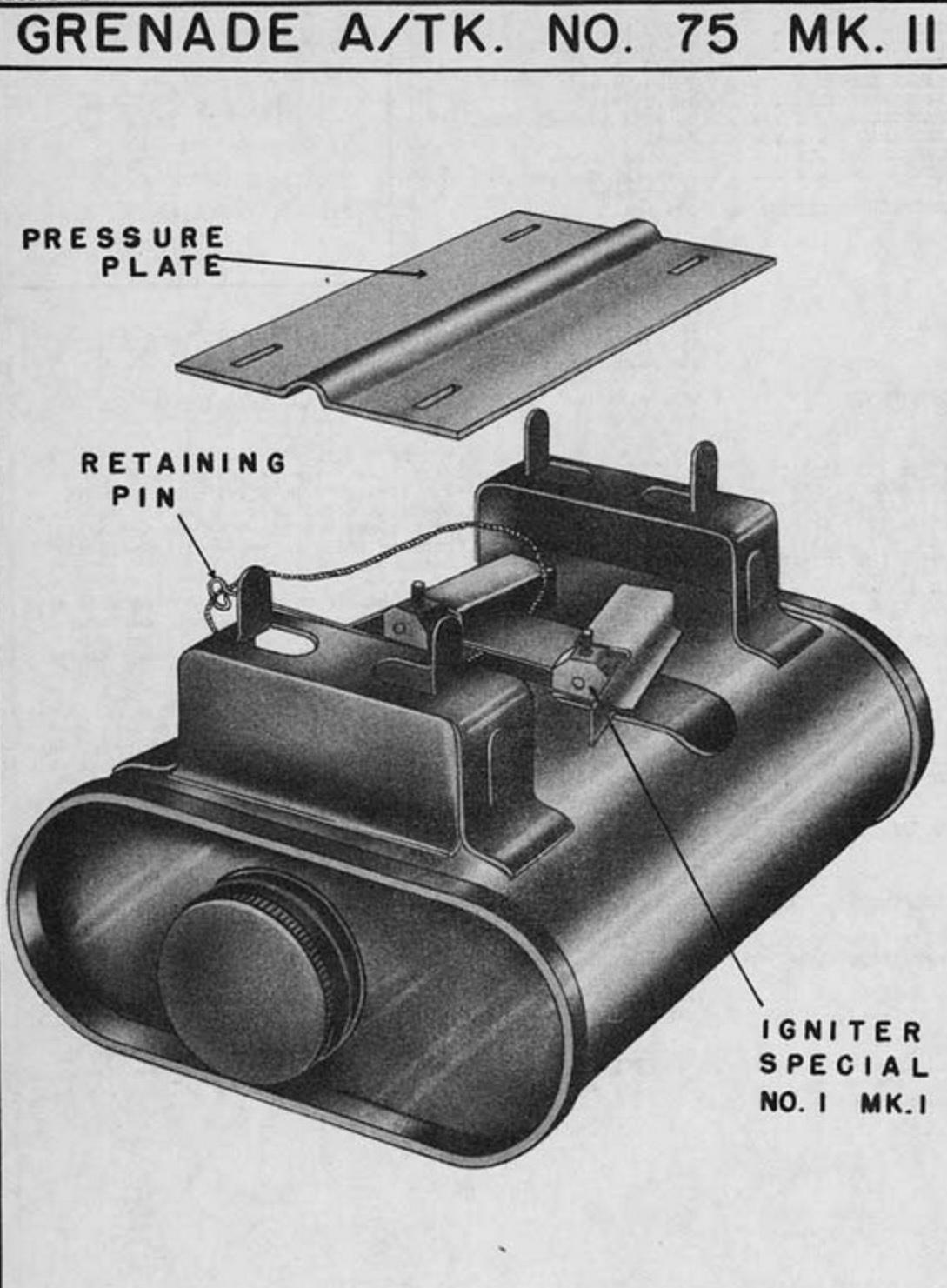
Unlike traditional buried anti-tank mines, the Hawkins mine was a flat rectangular block containing a fabric-wrapped explosive charge soaked in nitroglycerine-based gelignite, with a crush-pressure fuze set into its upper surface. The crucial feature was its operating principle: it was designed to activate only when a heavy load passed over it, not when stepped on by infantry. A typical triggering pressure was around 350 pounds (approximately 160 kilograms) or more, meaning it was primarily aimed at vehicles, especially light and medium armour. Soldiers could walk across it safely under normal circumstances, allowing it to be placed in roads, gateways or chokepoints without posing the same risks as standard anti-personnel mines.
This particular mine could be used in several ways. It could be buried shallowly under soil, laid openly on hard surfaces such as concrete or cobblestones, or wedged against tracks or tyres as a manual sabotage tool. Commandos often carried Hawkins mines to disable parked vehicles, especially during raids in North Africa and Europe. Engineers also used them as part of road denial obstacles, sometimes stacking several together to increase the destructive effect. Because the fuze operated on crushing pressure rather than penetration, the mine was effective even on paved surfaces where other mines might fail to activate.
When triggered under a vehicle, the mine produced enough blast to rupture tyres, snap suspension components, deform wheel hubs and in some cases blow off entire road wheels of lighter vehicles. Against armoured cars or half-tracks, the blast could damage steering linkages or immobilise the vehicle by destroying its running gear. While it was not powerful enough on its own to completely penetrate the belly armour of heavier tanks, the disruption it caused could leave them stranded and vulnerable to follow-up attacks. On softer ground, the blast could also gouge a crater beneath the vehicle, affecting balance and mobility.
One of the interesting characteristics of the Hawkins mine was its versatility in environments where burying mines was difficult. It could be laid quickly on roads during retreats or ambushes, and because it sat flat and had no protruding pressure plate, it could be concealed under thin debris, foliage or even sheets of paper. The mine could also be used as a demolition charge by removing the fuze, which made it a favourite among sabotage units. Due to its rectangular shape and sturdy casing, it could be stacked or aligned precisely, giving engineers a flexible general-purpose explosive that doubled as an anti-vehicle mine.
Although largely overshadowed after the war by more advanced anti-tank mines, the Hawkins mine remains notable for its simplicity, portability and dual-use capability. It stands as an example of wartime ingenuity, designed during Britain’s moment of greatest urgency and used across multiple theatres to impede enemy mobility.