Gurkha Knife
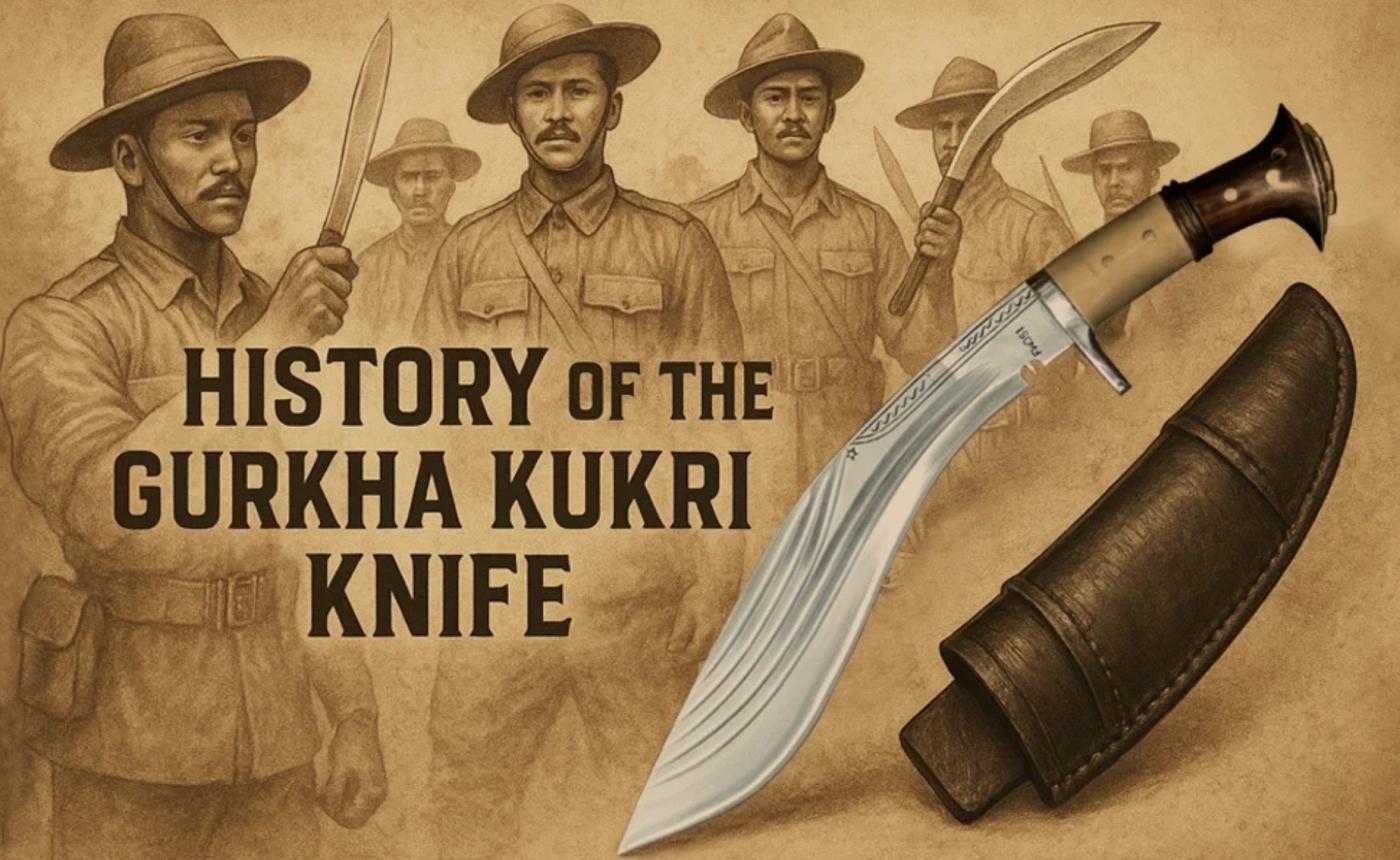
The Gurkha kukri knife is one of the most distinctive edged weapons in the world, instantly recognisable by its forward-curving blade and deep cultural association with the Gurkhas, the renowned Nepalese soldiers who have served for centuries in regional and international armies. The kukri is far more than a weapon; it is a working tool, a symbol of identity, and an object wrapped in tradition, ritual, and legend.
The origins of the kukri stretch back well over a thousand years. While its exact beginnings are debated, many historians believe it evolved from ancient curved blades used across South Asia, possibly influenced by early Greek kopis-style swords introduced during Alexander the Great’s campaigns. Over time, the blade became shorter, thicker, and more practical for daily use in the rugged hill regions of Nepal. By the time the British East India Company encountered the Gurkhas in the early nineteenth century, the kukri was already firmly established as an all-purpose blade carried by nearly every man in rural Nepal.
Traditionally, a kukri is made using high-carbon steel, often recycled from vehicle leaf springs or rail steel in more recent history. This type of steel is favoured because it can hold a sharp edge while remaining tough enough to withstand heavy chopping. The blade is typically forged by hand, hammered into shape while hot and then carefully ground and polished. The distinctive inward curve places more weight toward the front of the blade, giving it exceptional cutting power with relatively little effort. The spine of the blade is thick, sometimes exceeding 8 to 10 millimetres near the handle, tapering toward the tip to balance strength and agility.
The handle is usually made from hardwood, water buffalo horn, or occasionally bone or metal, shaped to fit securely into the hand. Traditional handles lack a guard, but they flare at the pommel to prevent slipping during powerful swings. At the base of the blade is a small notch known as the cho or kaudi. This feature has both practical and symbolic purposes: it helps prevent cracks from spreading up the blade, allows fluids like sap or blood to drip away from the handle, and is often said to represent religious symbols linked to Hindu beliefs.
In terms of size, most kukris fall between 38 and 45 centimetres in total length, with blades commonly measuring 25 to 30 centimetres. Military-issued kukris are often heavier and more robust, designed for durability and combat use, while civilian versions can range from lighter utility blades to large ceremonial pieces. The weight distribution makes even a modestly sized kukri feel powerful, allowing it to function like a small machete.
The uses of the kukri are incredibly varied. In everyday life, it serves as a farming and household tool, used for cutting wood, clearing vegetation, harvesting crops, preparing food, and even slaughtering livestock. In military contexts, it has long been carried as a close-combat weapon and a survival tool. Gurkha soldiers historically used the kukri for trench raids, jungle fighting, and practical tasks such as cutting firewood or opening ammunition crates. Its reputation in battle became legendary, reinforced by stories from both World Wars where the kukri was feared for its effectiveness in close quarters.
Sharpening a kukri is traditionally done by hand using stones rather than modern grinding wheels. Because of the blade’s curve, sharpening requires a rolling motion along the stone to maintain a consistent edge angle. Many kukris are sharpened with a convex edge rather than a flat bevel, which improves durability and cutting performance. In rural Nepal, it is not uncommon for blades to be sharpened on river stones or simple whetstones, with skill passed down through generations of blacksmiths known as kamis. A well-maintained kukri can be razor sharp, capable of cleanly slicing paper or delivering powerful chopping blows without chipping.
There are also cultural customs surrounding the kukri. One well-known belief holds that once a kukri is drawn in anger or for combat, it must draw blood before being sheathed, even if only symbolically. While often exaggerated, this reflects the deep respect and seriousness associated with the blade. Ceremonial kukris are still used in religious rituals, festivals, and formal military occasions.
Today, the kukri remains a powerful symbol of Nepalese heritage and Gurkha identity. While modern materials and manufacturing methods exist, traditional hand-forged kukris are still produced using age-old techniques. Whether viewed as a weapon, a tool, or a cultural artefact, the Gurkha kukri stands out as one of the most practical and historically rich blades ever made.