

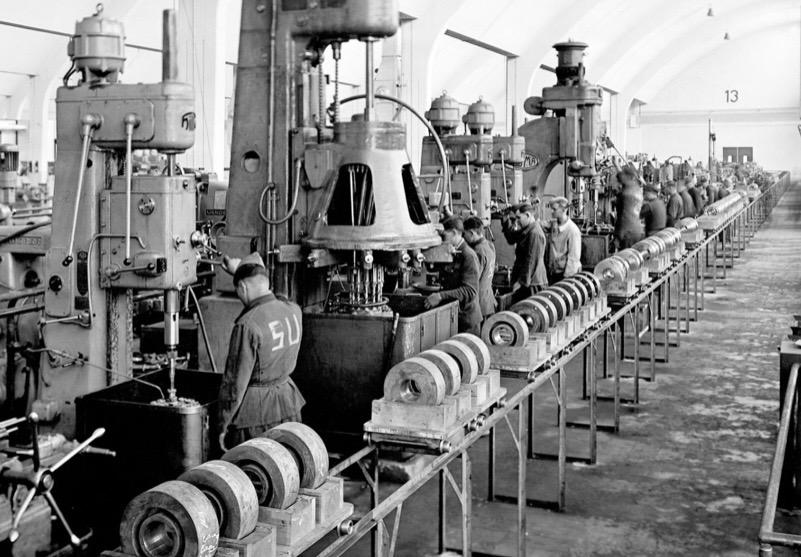
Factory Sabotage
Throughout the Second World War, prisoners of war and forced laborers found themselves trapped inside the industrial heart of the Axis war machine. Lacking weapons and operating under constant surveillance, many turned to a quieter form of resistance: sabotage carried out with files, gauges, lathes, and magnets. This kind of resistance rarely made headlines, but it slowly eroded the reliability of weapons, vehicles, and munitions, and it forced factories to waste time and resources chasing failures that seemed accidental.
In factories across Germany and occupied Europe, skilled workers from places such as Czechoslovakia were especially valuable to the occupiers, and therefore especially dangerous. Czech machinists were renowned for their prewar arms industry experience, and many were assigned to rifle and machine-gun production. One of the simplest and most effective acts of sabotage was the deliberate bending of rifle barrels or subtly warping receivers. These defects could be made small enough to evade visual inspection but large enough to ruin accuracy or cause jams after limited use. A rifle might pass factory tests, only to misfire or throw shots wildly once issued to a soldier at the front.
Equally damaging were alterations to tolerances. Prisoners working on precision components learned exactly how much metal could be removed before a part looked correct but behaved unpredictably. Removing a fraction of a millimeter too much from an engine bearing, piston ring, or crankshaft journal could guarantee premature wear, overheating, or seizure after a few hours of operation. Because engines failed under combat conditions rather than on the factory floor, blame often fell on drivers, pilots, or mechanics rather than the production line. This forced the enemy to waste time replacing parts and grounding vehicles that were desperately needed.
Sabotage also extended into the production of advanced weapons. In facilities linked to Germany’s long-range rocket program, including the V-weapons such as the V-2, forced laborers reportedly interfered with delicate electrical and guidance components. Some accounts describe magnetized parts being deliberately exposed to opposing magnetic fields or mechanical shock, degrading their calibration. Even slight disturbances could disrupt gyroscopes or guidance systems, causing rockets to veer off course or fail in flight. Given the complexity of these weapons, faults were difficult to trace and often attributed to design flaws rather than human interference.
Machine shops offered countless opportunities for quiet resistance. Cutting tools could be deliberately dulled, increasing the chance of chatter marks and micro-fractures in metal parts. Heat treatment processes could be subtly altered by adjusting temperatures or cooling times, producing steel that looked correct but was brittle or too soft. Welds might be contaminated so that they held under inspection but cracked under vibration. In ammunition factories, powder charges could be fractionally reduced or increased, leading to poor ballistic performance or dangerous pressure spikes.
Beyond physical sabotage, prisoners also targeted efficiency. They misread blueprints on purpose, swapped similar-looking components, or assembled parts in sequences that increased wear. Documentation might be filled out incorrectly, sending defective batches onward while sound ones were held back for reinspection. These acts slowed production lines already strained by bombing raids and material shortages.
What made this form of resistance remarkable was the discipline it required. Open defiance could mean execution, so sabotage had to look like incompetence, fatigue, or bad luck. Prisoners coordinated quietly, sharing knowledge about where defects would be hardest to detect and most costly in the field. In some factories, entire shifts participated, creating a steady stream of failures that no amount of supervision could fully eliminate.
After the war, Allied investigators uncovered evidence that these small acts had cumulative effects. Tanks breaking down short of the front, aircraft grounded by engine failures, and unreliable small arms all sapped combat effectiveness. While sabotage alone did not decide the war, it represented a powerful moral victory. Unarmed, imprisoned, and brutalized workers managed to strike back using skill, patience, and an intimate understanding of the machines they were forced to build.