Graff Spee
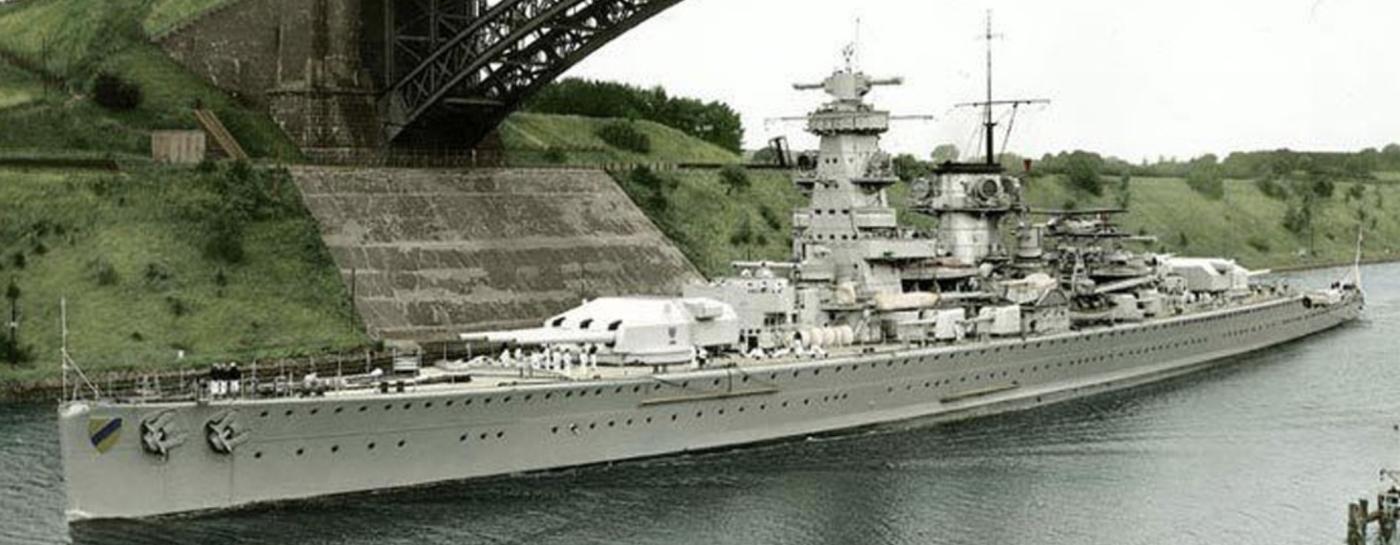
Admiral Graf Spee belonged to the Deutschland class of Panzerschiffe (armoured ships), a unique category created by German naval designers to comply—at least on paper—with the 10,000-ton limit imposed by the Treaty of Versailles. The design work was overseen by the Reichsmarine’s naval construction department, whose architects worked to produce a ship that could outrun stronger opponents while outgunning anything fast enough to catch her.
Ordered under the cover name “Ersatz Braunschweig,” she was constructed at the Reichsmarinewerft in Wilhelmshaven, the German Navy’s own shipyard on the North Sea. Her keel was laid on 1 October 1932, she was launched on 30 June 1934, and she entered service on 6 January 1936. The ship was named in honour of Admiral Maximilian von Spee, who had been killed during the First World War at the Battle of the Falkland Islands.
In size she fell between a heavy cruiser and a small battleship. Admiral Graf Spee measured about 186 metres in length with a beam of roughly 21.6 metres and a draft of around 7.3 metres. Although Germany claimed a treaty-compliant displacement of 10,000 tons, the ship in reality displaced between about 12,000 and nearly 16,000 tons depending on load. She was powered entirely by MAN diesel engines—eight of them driving two shafts—an unusual configuration for a major warship at the time. This gave her a top speed of around 28 to 29 knots and a remarkable cruising range in excess of 16,000 nautical miles, allowing her to operate far from home on extended raiding missions.
Her armament was formidable for a ship of her tonnage. She carried six 28 cm (11-inch) guns in two triple turrets, one forward and one aft, capable of outranging and outgunning any cruiser she might encounter. Her secondary armament included eight 15 cm (5.9-inch) guns mounted singly along the sides. For anti-aircraft protection she was equipped with a battery of 10.5 cm heavy AA guns supplemented by 3.7 cm and 2 cm light AA weapons. She also carried eight 533 mm (21-inch) torpedo tubes in two quadruple mounts at the stern. A catapult and a reconnaissance floatplane—initially a Heinkel He 60 and later an Arado Ar 196—extended her scouting capabilities across the open ocean.
The crew complement varied with time, but in wartime service she typically carried around 1,100 men, including officers, sailors, and aircrew for her floatplane.
Admiral Graf Spee achieved early success as a commerce raider during the first months of the war, sinking or capturing several Allied merchant ships in the South Atlantic and Indian Ocean. Her career came to an end after the Battle of the River Plate in December 1939, when she was damaged while fighting British cruisers. She retreated to Montevideo, Uruguay, where international regulations limited her stay. Believing that superior British forces were waiting outside the harbour, her captain, Hans Langsdorff, chose to scuttle the ship rather than sacrifice his crew.
Today the wreck of Admiral Graf Spee lies in relatively shallow waters off Montevideo, where parts of the ship—such as the rangefinder and large eagle crest—have been recovered over the years. Much of the hull remains on the seabed, gradually deteriorating but still an object of historical interest and ongoing debate regarding preservation.