
German Tank Destroyers, 1940-1945
Germany developed tank destroyers to give its anti-tank guns the mobility to keep pace with armoured warfare. Mounting a gun on tracks allowed its crew to fire and change position without waiting for a towing vehicle. Early designs used obsolete tanks and captured chassis; later vehicles combined heavier weapons with enclosed armoured bodies. Unlike conventional tanks, these vehicles had no rotating turret. Their guns moved only through a limited arc, so engaging targets farther to either side meant turning the whole vehicle.
The Panzerjäger I entered combat in France in May 1940. A Czech 47 mm PaK(t) gun replaced the turret of the small Panzer I Ausf. B, providing more firepower than Germany’s standard 37 mm anti-tank gun. About 200 were converted. At roughly 4.4 metres long, 2.1 wide and 2.2 high, it carried three men behind thin armour, with the fighting compartment open above and behind. Its mobility was useful, but the exposed crew remained vulnerable to shell fragments and infantry fire. Reports from the French campaign also recorded overheating and suspension trouble. Later service in North Africa and Russia stretched this small vehicle further.
The invasion of the Soviet Union in 1941 made heavier guns urgent. Soviet T-34 and KV tanks were difficult opponents for existing German anti-tank weapons. The Marder series answered this need quickly, although its numbering disguises the sequence: the Marder II and III preceded the Marder I.
Appearing in spring 1942, the Marder III used the Czech-designed Panzer 38(t) chassis. Its first version mounted a captured Soviet 76.2 mm gun, modified as the PaK 36(r). It measured approximately 5.9 metres long, 2.2 wide and 2.5 high, including its projecting gun. Later Ausf. H and M versions carried the German 75 mm PaK 40/3; the M placed the engine centrally and the fighting compartment at the rear. Around 1,700 were built or converted across the series. The reliable chassis gave useful mobility, but the gun crews remained exposed. Early examples reached North Africa in May 1942, while later versions served in Russia, Italy and Normandy.
The Marder II also appeared in spring 1942, initially combining Panzer II flamethrower-tank chassis with captured 76.2 mm PaK 36(r) guns. From summer, another version used conventional Panzer II chassis and the 75 mm PaK 40/2. This more numerous version was about 6.4 metres long over the gun, 2.3 wide and 2.2 high. Together, the two types numbered over 800. A report from the 4th Panzer Division’s anti-tank battalion described penetrating a T-34’s turret side at 1,200 metres, but also complained about ammunition supply. Thin armour and an open fighting compartment made exchanging fire hazardous: the gun could defeat tanks that could easily destroy its carrier.
From summer 1942, the Marder I put the 75 mm PaK 40/1 on captured French Lorraine tracked carriers. Around 170 conversions made economical use of vehicles already available. The Lorraine version measured about 5 metres long over the gun, 2.1 wide and 2.1 high. It provided substantial firepower on a small chassis, although its modest engine and thin, open-topped fighting compartment limited mobility and protection. Marder Is served on the Eastern Front and in France. The 709th and 716th Infantry Divisions still had them in Normandy in June 1944, showing how long provisional equipment remained necessary.
The Hornisse, renamed Nashorn in 1944, took this approach further. Entering service in 1943, it mounted the powerful 88 mm PaK 43/1 on a chassis combining Panzer III and IV components. Nearly 500 were built. About 8.4 metres long over the gun, 3 wide and nearly 3 high, it was difficult to conceal. Its gun could engage Soviet tanks at long range, and the type fought at Kursk that July. However, its fighting compartment had no roof and armour only about 10 mm thick.
Careful positioning was essential, since shell fragments could enter from above and infantry could attack the exposed crew.
Kursk also saw the Ferdinand’s debut. Around 90 were built using chassis from Porsche’s unsuccessful Tiger design. An 88 mm PaK 43/2 gun gave firepower comparable to the Nashorn’s, backed by frontal armour up to 200 mm thick. Approximately 8.1 metres long over the gun, 3.4 wide and 3 high, the Ferdinand weighed about 65 tonnes. Its petrol engines drove generators, which supplied electric motors turning the tracks.
At Kursk, its gun proved effective at long range, but mines and breakdowns immobilised vehicles that were difficult to recover. Poor visibility and the absence of a fitted machine gun complicated defence against nearby infantry. During rebuilding in early 1944, roughly 48 survivors received improvements including a bow machine gun and a commander’s cupola, a raised observation position. The design was renamed Elefant that year. These were rebuilt Ferdinands, not a new production series. Their deployment near Anzio again exposed the difficulties of moving and recovering such heavy vehicles.
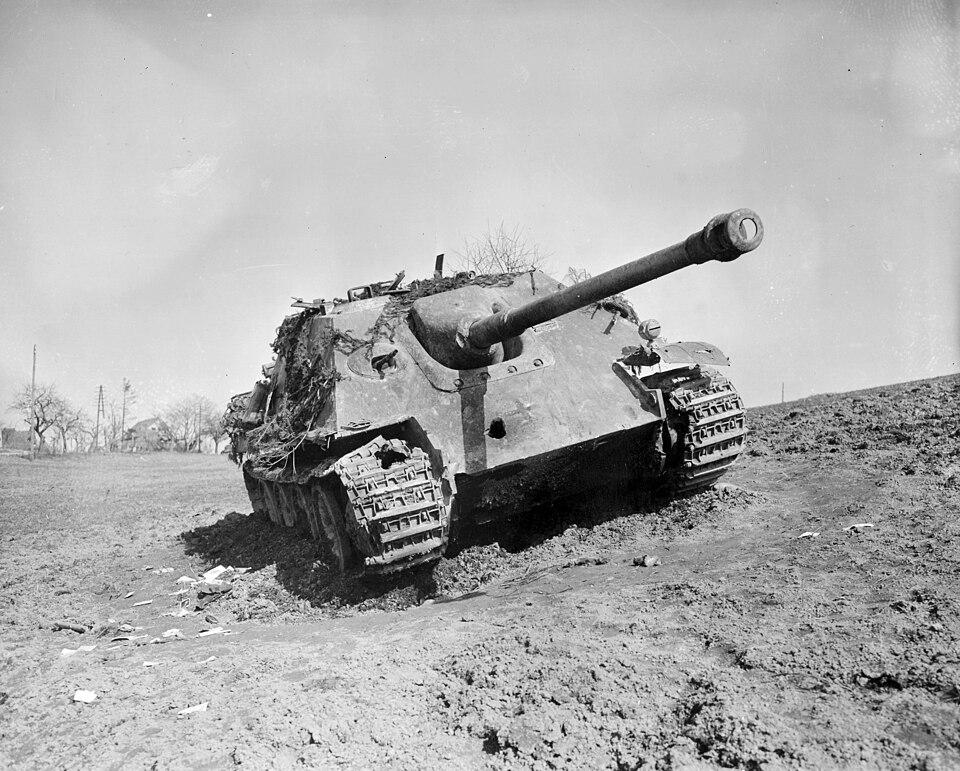
The Jagdpanzer IV reached units in early 1944. Based on the Panzer IV, it mounted a 75 mm PaK 39 L/48 inside a low, fully enclosed armoured body. Here the emerging Jagdpanzer approach offered better crew protection than the open Panzerjäger designs, although German terminology was not entirely consistent. Around 770 of the original version were built, measuring about 6.9 metres long over the gun, 3.2 wide and just 1.9 high. This low profile helped concealment. Panzer Lehr used the type against British armour around Tilly-sur-Seulles in June 1944.
From August, the related Panzer IV/70 carried the longer 75 mm L/70 gun, designated Panzerjägerkanone 42. The L-number indicates barrel length: L/70 means 70 times the gun’s calibre. Around 930 low-bodied Vomag vehicles and 280 taller Alkett versions followed. Greater armour penetration came with additional weight over the front suspension, reducing agility and increasing wear.
The Jagdpanther brought the long 88 mm PaK 43 L/71 to the Panther chassis. Production began in January 1944 and it fought in Normandy that summer. Around 410 were completed. Approximately 9.9 metres long over the gun, 3.3 wide and 2.7 high, it weighed about 46 tonnes. Its sloping frontal armour and powerful gun made it dangerous from a prepared position, but its mechanical demands were considerable. The 654th Heavy Tank Destroyer Battalion recorded repeated breakdowns on its march to Normandy: only eight of its 25 Jagdpanthers were operational on 17 July. Workshop repairs subsequently restored many to service. The distinction between vehicles built and vehicles available for battle mattered greatly.
A more economical answer reached frontline units in July 1944. The Jagdpanzer 38(t) used a redesigned chassis derived from the Panzer 38(t), with sloping armour and a 75 mm PaK 39 L/48. It is commonly called ‘Hetzer’ today, although that was not its standard official wartime name. About 2,600 gun-armed vehicles were produced, excluding recovery and other specialised versions. Roughly 6.3 metres long over the gun, 2.6 wide and 2.1 high, it could be hidden readily. Its 60 mm frontal armour was useful, but thin sides, restricted visibility and cramped accommodation hindered its four-man crew. Issued widely to infantry divisions, it provided mobile anti-tank support during the retreat, including fighting on the Eastern Front and in the Ardennes.
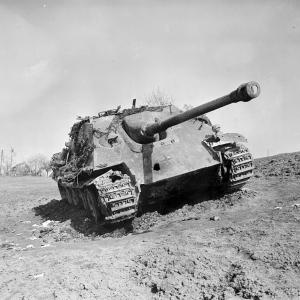
The Jagdtiger represented the opposite extreme, intended to engage tanks and fortifications at long range. Issued from autumn 1944, it mounted a 128 mm PaK 44 L/55 on an extended Tiger II
chassis. About 85 were built. At roughly 10.7 metres long over the gun, 3.6 wide and 3 high, it weighed over 70 tonnes. Its gun and frontal fighting-compartment armour, 250 mm thick, promised formidable performance. In practice, breakdowns, fuel demands and recovery problems restricted its use. During the January 1945 Nordwind offensive, only a few initially reached action. Their size and maintenance burden sharply limited where and how often they could fight.
Between 1940 and 1945, German tank destroyers gained firepower and protection, but battlefield usefulness never followed gun size alone. Older, lightly protected vehicles remained necessary alongside newer designs. Enclosed armour improved survival, while excessive weight could undermine mobility and reliability. Factories faced bombing and disrupted component supplies. As fuel, spare parts and transport became scarcer, Germany’s ability to manufacture weapons increasingly exceeded its ability to keep them supplied and operational.
Author: Tom Dankers, Historian - Arnhems Oorlogsmuseum 40-45