German Doppelfernernrohr periscope
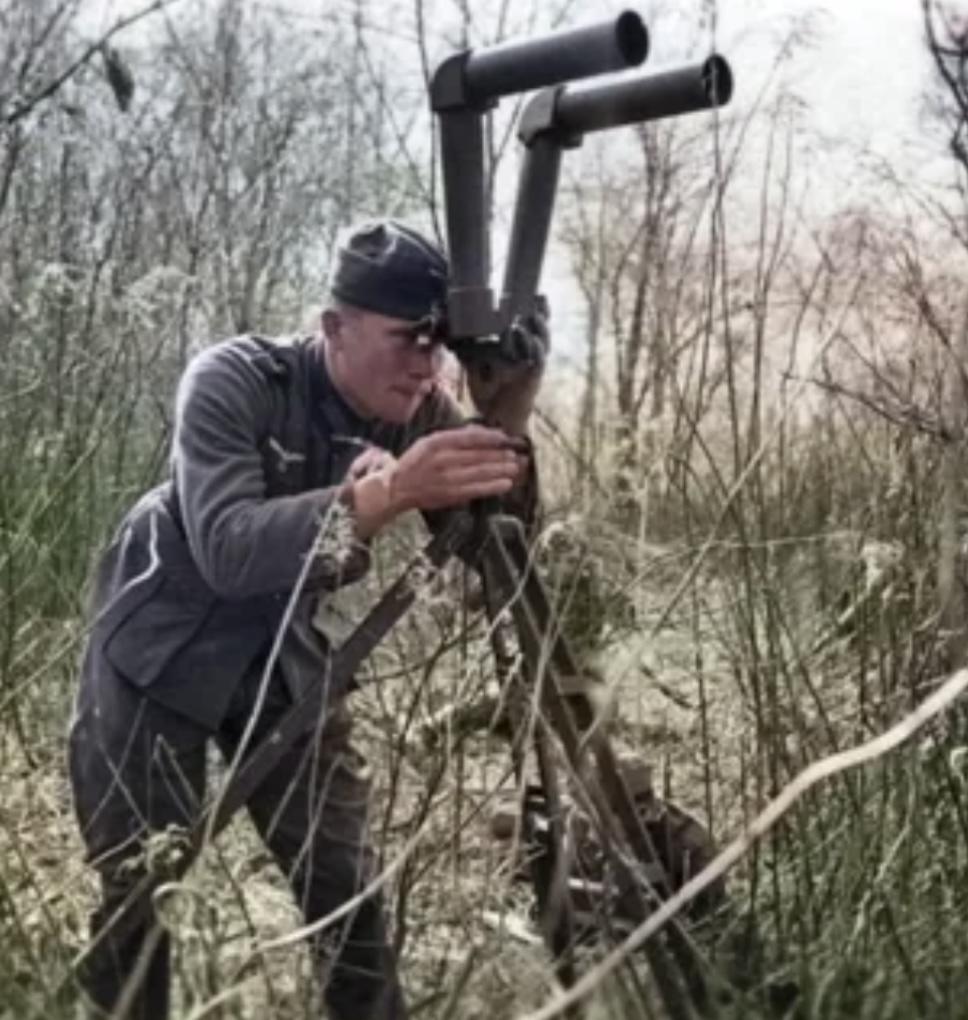
The German Second World War doppelfernrohr periscope trench binoculars formed a distinctive class of optical instruments designed to let an observer remain low in a trench or behind an armoured firing slit while still monitoring distant movement with precision. By redirecting the incoming view through tall prism assemblies and down into sheltered eyepieces, the user could track enemy positions, estimate range and direct fire without rising into the line of danger. German optics research had explored this idea long before 1939, but renewed emphasis on artillery coordination and fortification defence pushed the concept into mature wartime production.
The designs that emerged in the 1930s were shaped largely by engineers at Carl Zeiss Jena working under Heereswaffenamt directives. Emil Busch and Ernst Leitz Wetzlar contributed parallel development and manufacturing capacity, reflecting the German military’s reliance on multiple firms to meet stringent optical standards. These companies refined pre-war periscopic concepts into sturdier, brighter and more adaptable instruments that could endure frontline punishment. Tens of thousands of units across all models were produced between the mid-1930s and 1945, though exact totals remain elusive due to scattered archival records and the decentralised nature of wartime contracting.
Several models became fixtures in German fieldcraft. The Doppelfernrohr 14 was the principal early trench and bunker instrument, a compact periscopic binocular that allowed infantry and fortification crews to scan no-man’s-land or approach routes from comparative safety. Alongside it appeared medium-power periscopic binoculars such as the 10x50-type units, valued for a wide field of view in infantry reconnaissance and defensive observation. Higher-magnification instruments emerged as the war intensified: the 10x80 Flakglas, famous for its luminous optics, began life with anti-aircraft batteries but soon found a home wherever clear distant vision from cover was required. The 12x60 Beobachtungsfernrohr served artillery observers who needed to judge fall of shot at long ranges, often mounted in fixed positions where its weight mattered less than its acuity. Some of these higher-grade systems incorporated swing-out periscope heads, narrow embrasure hoods and selectable filters to accommodate everything from glare to twilight operations.
These instruments remained in service to the end of the war and persisted afterward in the hands of occupying forces and border units due to their optical excellence. Their robust housings, wide exit pupils and precisely aligned prism assemblies allowed German observers to work effectively in low light, near explosions and in cramped defensive works. The engineering lessons learned from them helped shape later Cold War bunker periscopes, proving that even equipment born of trench warfare could echo forward into the age of radar and satellites. The surviving examples, often still optically sharp after eight decades, tell a story of meticulous craftsmanship pressed into the mud and noise of a conflict that demanded clarity from behind cover.