General Omar Bradley
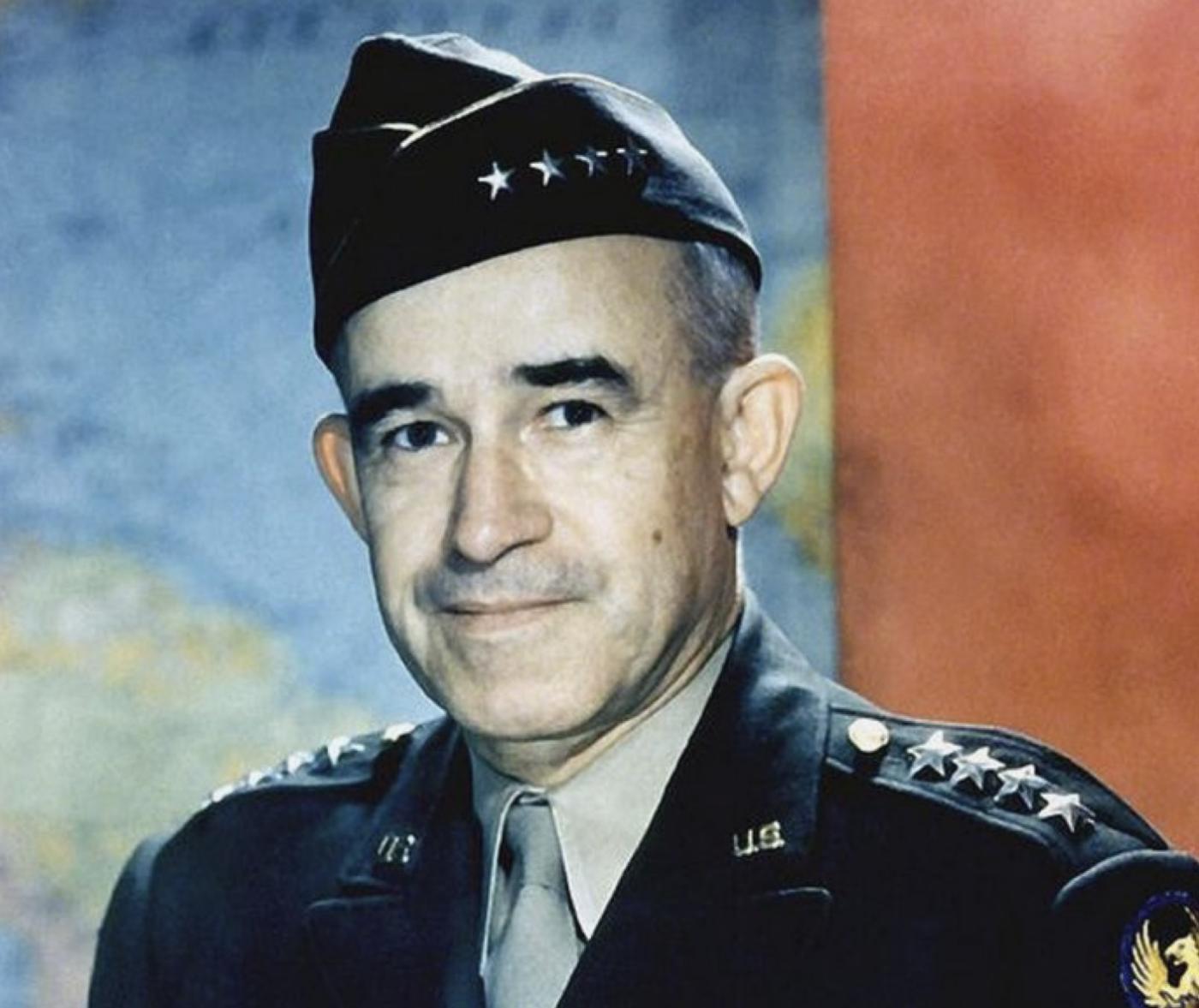
Omar Nelson Bradley was born on February 12, 1893, in the rural town of Clark, Missouri, the son of a schoolteacher who died when Omar was still young. His mother struggled to support the family, and Bradley grew up in modest circumstances, spending his childhood fishing, hunting, and attending the local one-room school. A chance suggestion from a Sunday school teacher encouraged him to apply to the United States Military Academy at West Point. He had little knowledge of military life, but he was accepted, entering the Academy in 1911. At West Point he earned a reputation not for flash or bravado but for reliability, steadiness, and a quiet competence that would become the hallmark of his military career. He graduated in 1915 as part of the famous “Class the Stars Fell On,” which produced an extraordinary number of future generals, including Dwight D. Eisenhower.
When the United States entered World War I, Bradley hoped for a combat role in Europe but instead spent the period as an instructor in Montana and later at West Point. Though he missed the opportunity for battlefield experience, he developed a deep understanding of infantry doctrine and training, skills that proved crucial in the next war. Between the wars he served in a variety of posts, from teaching mathematics at West Point to studying advanced military tactics at the Infantry School at Fort Benning. Promoted slowly during the interwar years, like most officers of his generation, Bradley remained a captain for more than a decade. Yet he was increasingly recognized as a thoughtful, meticulous planner and an exceptional trainer of soldiers.
Bradley’s rise accelerated rapidly after the U.S. entered World War II. In 1941 he became commandant of the Infantry School, where he oversaw major expansions and training reforms. By early 1943 he was promoted to major general and sent to North Africa, where he first served as Eisenhower’s adviser and then took command of II Corps after the disastrous Battle of Kasserine Pass. Bradley reorganized and retrained the battered formation, laying the groundwork for its later victories in Tunisia and Sicily. His calm leadership and respect for the wellbeing of enlisted men earned him the nickname “the G.I.’s General.”
In Sicily, Bradley served under General George S. Patton during the 1943 campaign. The two men were strikingly different in temperament, but Bradley’s steady approach balanced Patton’s aggressiveness, and their partnership helped secure Allied control of the island. After the success in Sicily, Bradley was selected to plan and command the U.S. First Army for the Normandy invasion. On D-Day, June 6, 1944, he directed American landings at Omaha and Utah beaches. The brutal fighting at Omaha nearly resulted in failure, but Bradley’s decision-making—reinforcing critical sectors and committing reserve units at decisive moments—was instrumental in turning the tide.
Following the breakout from Normandy, Bradley commanded the newly formed 12th Army Group, the largest body of American troops ever assembled under a single commander. At its peak it comprised more than 1.3 million soldiers. Under his leadership, American forces liberated Paris alongside the French, crossed the German border, and fought in the Hürtgen Forest and the Battle of the Bulge. During the Bulge, Bradley oversaw the defense and counterattack that ultimately sealed the fate of Germany’s last major offensive in the west. His methodical style, often overshadowed in popular imagination by Patton’s flamboyance, proved reliable and effective in large-scale operations that demanded coordination and logistics on an immense scale.
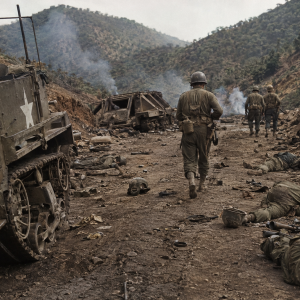
After the war Bradley became head of the Veterans Administration, where he worked to improve services for millions of returning servicemen. He later served as the first Chairman of the Joint Chiefs of Staff when the position was established under the National Security Act of 1947, shaping early Cold War strategy and helping manage the U.S. military’s transition into a nuclear age. In 1950 he was promoted to General of the Army, a five-star rank held by only a handful of officers. He remained an influential military figure during the Korean War, advocating for limited war aims and playing a key role in the decision to relieve General Douglas MacArthur.
Bradley retired from active service in 1953 but continued to write, consult, and speak on military affairs for decades. Known for his humility, he often resisted comparisons to more dramatic wartime figures and emphasized the contributions of ordinary soldiers. He published a well-regarded memoir, A Soldier’s Story, which remains a key primary account of the European theater. Even in his later years he stayed involved in military analysis and appeared frequently at historical commemorations. Omar Bradley died on April 8, 1981, as the last surviving five-star general of the United States.
Among the interesting details of his life is that Bradley enjoyed a surprisingly warm public image, one shaped not only by his leadership style but also by Hollywood. He served as a consultant for the film Patton (1970), in which his calm manner was contrasted with Patton’s fiery character. The movie further cemented Bradley in popular memory as the patient, measured general who cared deeply for the lives of his troops. His legacy remains that of a commander who achieved immense victories not through theatrics but through discipline, planning, and an unwavering commitment to the soldiers who served under him.