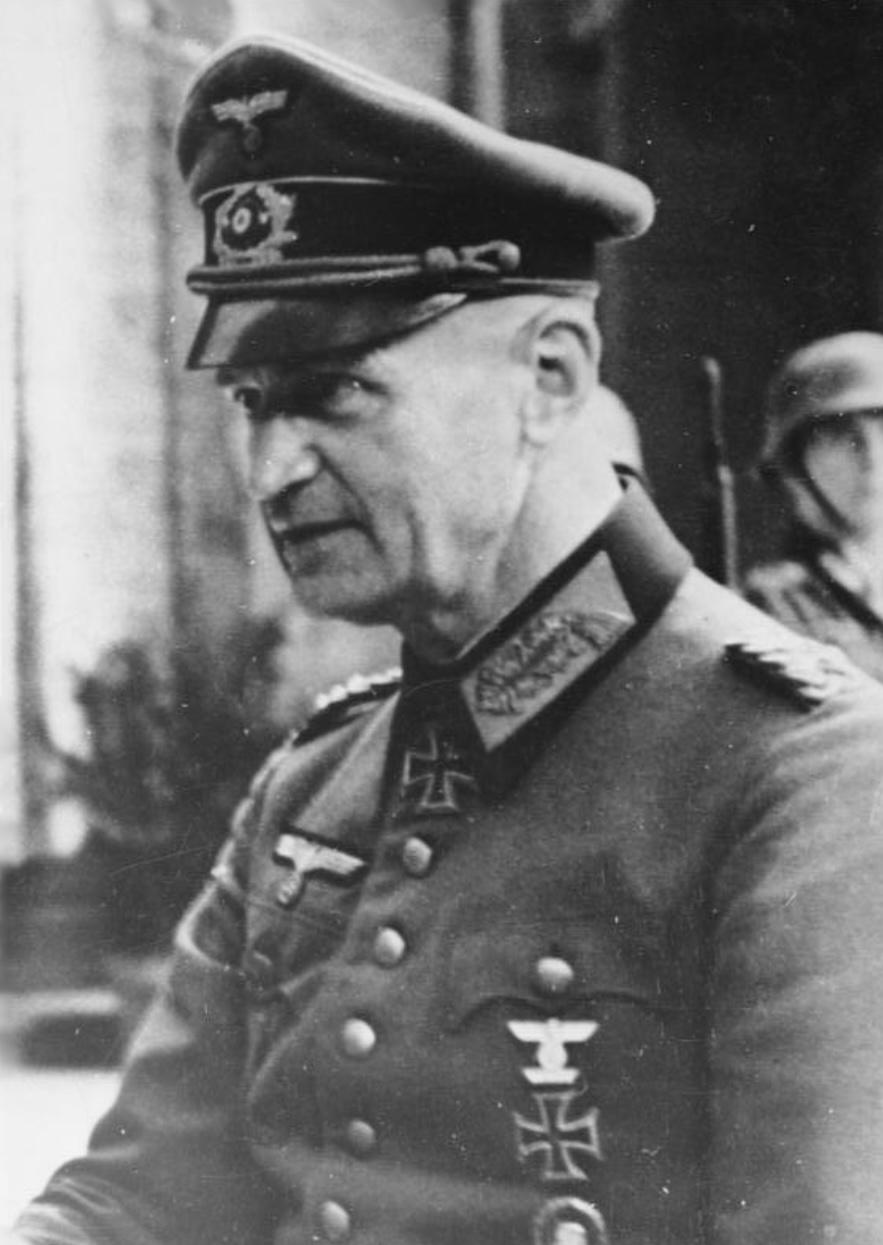
General Johannes Blaskowitz
Johannes Albrecht Blaskowitz was born on 10 July 1883 in Paterswalde, East Prussia, into a conservative Prussian family with a strong military tradition. Like many officers of his generation, he was shaped by the values of duty, discipline, and loyalty to the state rather than to any political ideology. He entered the German Army in 1901 as an officer cadet and was commissioned as a lieutenant in the infantry in 1902. Blaskowitz proved to be a capable and methodical officer, though not a flamboyant one, and his early career followed the steady, professional path typical of pre–First World War Prussian officers. He attended the Prussian War Academy, which marked him as an officer of above-average ability and prepared him for staff work.
During the First World War, Blaskowitz served primarily on the Western Front. He held various staff and command positions and gained a reputation for calm competence under pressure rather than personal daring. He was wounded during the war and decorated for his service, including receiving the Iron Cross. By the end of the conflict, he had risen to the rank of captain. Like many professional officers, he remained in the drastically reduced Reichswehr after Germany’s defeat, navigating the politically unstable Weimar years while focusing on rebuilding a professional, apolitical army within the strict limits imposed by the Treaty of Versailles.
Blaskowitz’s rise through the ranks during the interwar period was slow but consistent. He benefited from the Reichswehr’s emphasis on professionalism and merit, rather than political loyalty. By the early 1930s, he had reached senior field officer rank and was recognized as a solid planner and trainer of troops. When Adolf Hitler came to power in 1933 and began openly rearming Germany, Blaskowitz continued to advance, largely avoiding entanglement with Nazi ideology. He was promoted to lieutenant general in 1938 and given command of VIII Army Corps, positioning him for major responsibility when war broke out.
At the outbreak of the Second World War in September 1939, Blaskowitz commanded the German 8th Army during the invasion of Poland. Militarily, his performance was effective, and his forces played a key role in defeating Polish units in central and southern Poland. However, it was during this campaign that Blaskowitz distinguished himself in a way unusual among senior German commanders. He repeatedly protested, both orally and in written memoranda, against atrocities committed by SS units and Einsatzgruppen against Polish civilians and Jews. He argued that these actions were immoral, illegal under military law, and damaging to army discipline. His reports, which described mass shootings and brutality in unusually blunt language, reached the highest levels of the army command.
These protests brought Blaskowitz into conflict with Heinrich Himmler and Adolf Hitler. Hitler reportedly dismissed him as naïve and weak, and Blaskowitz’s career suffered as a result. Although he was promoted to colonel general in 1940 after the successful campaign in France, he was sidelined from the most prestigious commands. During the Battle of France, Blaskowitz commanded Army Group G in southern France and conducted operations efficiently, including managing the occupation of Vichy France’s unoccupied zone in 1942. Despite these achievements, he was never entrusted with the kind of decisive eastern-front command given to more politically reliable or aggressive generals.
Throughout the war, Blaskowitz remained primarily a defensive and administrative commander. In 1944, after the Allied landings in Normandy, he was appointed commander-in-chief in the Netherlands, a strategically important but increasingly hopeless posting. He was responsible for defending against Allied advances such as Operation Market Garden. While he carried out orders to resist Allied forces, he again showed a tendency toward pragmatism and concern for civilian suffering. He reportedly supported negotiations to limit destruction in Dutch cities late in the war, although his ability to act independently was limited.
After Germany’s surrender in May 1945, Blaskowitz was taken into Allied custody. Unlike many Nazi-era generals, he was not accused of direct involvement in war crimes, but he was nonetheless indicted by an Allied military tribunal on charges related to actions committed by troops under his command, including alleged responsibility for crimes in occupied territories. The charges weighed heavily on him, particularly given his earlier protests against SS brutality. On 5 February 1948, before his trial could conclude, Blaskowitz died after falling from a balcony at the prison in Nuremberg. His death was officially ruled a suicide, though it has occasionally been the subject of speculation.
Blaskowitz remains a complex and somewhat tragic figure in German military history. He was a traditional professional soldier who neither embraced Nazism nor effectively resisted it. His documented protests against atrocities make him stand out among Wehrmacht generals, yet they did not translate into open defiance or resignation. Militarily competent but politically marginalized, he represents the limits of professional ethics within a criminal regime. His life illustrates how traditional military values could coexist with, but not overcome, the moral collapse of the German state under Hitler.