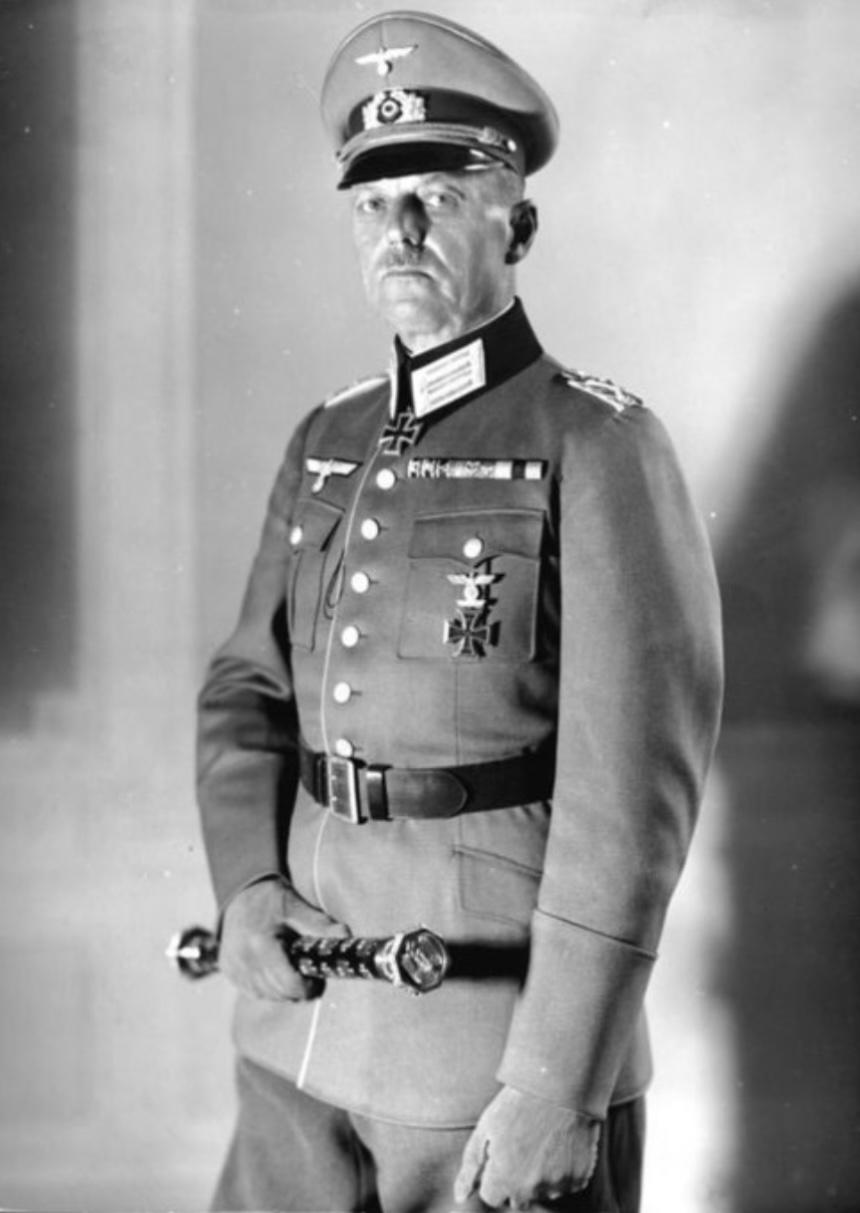
Field Marshal Karl Rundstedt
Karl Gerd von Rundstedt was born on 12 December 1875 in Aschersleben, then part of the Prussian Province of Saxony, into an old military family whose traditions stretched back generations. His upbringing followed the pattern expected of a Prussian officer’s son: discipline, duty, and a clear path into the army. He entered the cadet schools at an early age, where he showed steady competence rather than brilliance, but enough determination to secure a commission in 1893 with the prestigious 83rd Infantry Regiment.
Rundstedt’s early military years were marked by quiet professionalism. He built a reputation as a reliable and thoughtful officer, more reserved than flamboyant, but respected for his field sense and his ability to remain calm under pressure. The First World War accelerated his rise. Serving mostly on the Western Front, he earned several decorations and gained experience that shaped his later command style—cautious, methodical, and grounded in traditional Prussian principles. By 1918 he had advanced to the rank of lieutenant colonel, with staff positions that exposed him to the complexities of operational planning.
In the aftermath of Germany’s defeat, he remained in the drastically reduced Reichswehr, one of the fortunate few chosen to rebuild the officer corps under the strict limitations of the Treaty of Versailles. His steady temperament and loyalty to the army, rather than to politics, made him valuable during the turbulent Weimar years. He climbed the ranks slowly but surely, becoming one of the Reichswehr’s key senior officers by the early 1930s, when the Nazi regime began expanding Germany’s military power. Rundstedt was not a Nazi himself, nor was he especially sympathetic to National Socialism, but he believed in service to the state and continued to do his duty.
With the formation of the Wehrmacht and the rapid rearmament of Germany, he emerged as one of its leading army commanders. By 1938 he was a full general, and by the start of the Second World War he had command responsibilities that placed him among the highest-ranking officers. His role in the 1939 invasion of Poland demonstrated his ability to coordinate large, fast-moving formations. But it was during the 1940 Western Offensive that Rundstedt made his mark. As commander of Army Group A, he oversaw the breakthrough through the Ardennes—a daring plan that ultimately cut off the Allied armies in Belgium and northern France. Although the concept is often attributed to others, Rundstedt supported the operation and executed it decisively. His forces surrounded the British Expeditionary Force at Dunkirk, though he later agreed with Hitler’s controversial halt order that allowed the British to evacuate.
He later directed operations on the Eastern Front, commanding Army Group South during the initial invasion of the Soviet Union. Rundstedt’s methods were cautious compared to some of the more aggressive German commanders, but he achieved substantial early successes, including the encirclements that led to the fall of Kiev. As the war dragged on and the Eastern Front grew increasingly strained, he was dismissed and recalled multiple times as Hitler cycled through commanders in frustration. Rundstedt often voiced the view that the war should be ended before total collapse, something he could never say openly to Hitler but which he made known to other officers.
His final major command came in the West. As commander-in-chief of all German forces in France during 1944, he oversaw the defense against the Allied invasion. Rundstedt warned repeatedly that Germany could not throw the Allies back into the sea and that the best hope was to conserve forces for a prolonged defensive campaign. After the Normandy breakout shattered the German position, he presided—unhappily—over the retreat across France. Still, his experience remained valuable, and he was kept on as Hitler searched for senior commanders he still trusted. In late 1944 he was involved in the early planning stages of what became the Ardennes Offensive, though he believed the operation unrealistic. Once the offensive failed, Rundstedt again found himself in an impossible situation, trying to manage a collapsing front with diminishing resources until he was finally dismissed for the last time in March 1945.
After Germany’s surrender, Rundstedt was taken prisoner by Allied forces. He was held for several years but was never tried as a war criminal, largely because his health deteriorated and because there was no specific charge that singled him out in the way other commanders had been. He returned to Germany in 1949 and lived quietly in Hanover until his death on 24 February 1953 at the age of seventy-seven.
Among the interesting details of his life is that Rundstedt was one of the few senior officers to avoid becoming entangled in explicit political scheming, something that ironically both helped and hindered his career. He also narrowly escaped being arrested after the July 20 plot against Hitler, even though he was not involved, simply because he was tangentially connected to some of the officers who were. Known for his dry wit, he once remarked during the chaotic final months of the war, when Hitler demanded to know how the front could be stabilized, “Make peace, you fools,” a statement whispered privately rather than spoken aloud. Though a loyal soldier of the old Prussian tradition, he ultimately became the embodiment of a military leader caught between professional duty and an unwinnable political war.