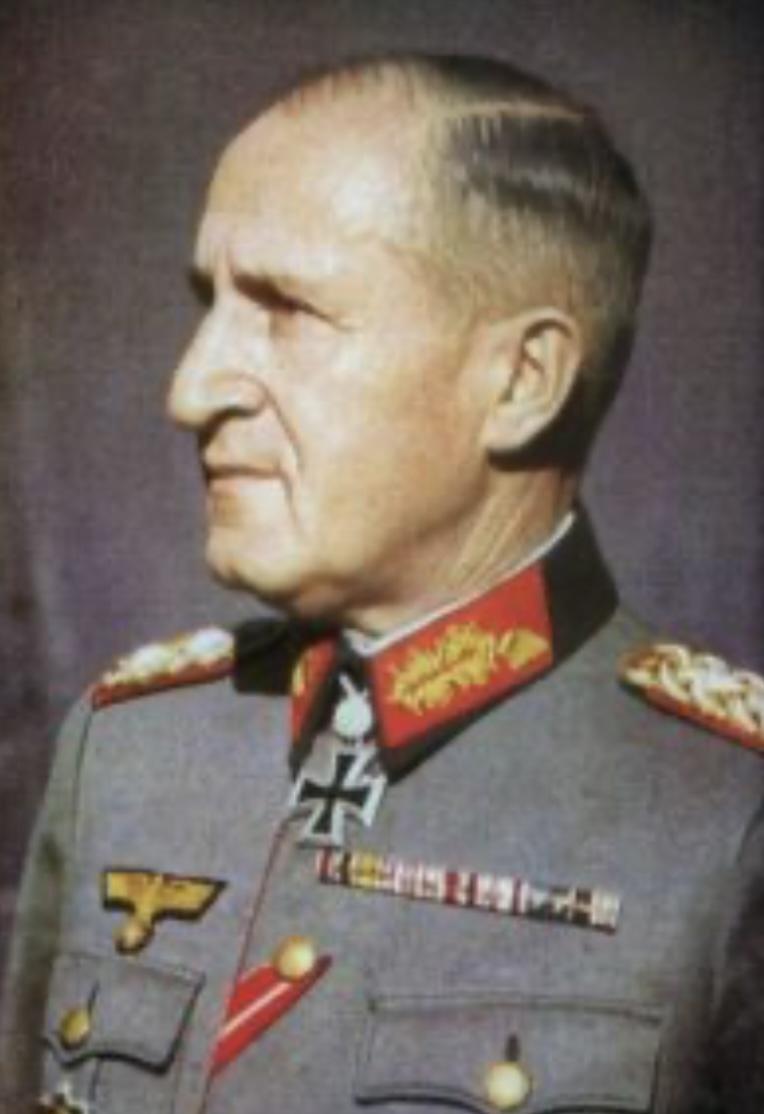
Erhard Raus
Erhard Raus was born on 8 January 1889 in the small village of Wolframitz, in what was then Moravia, part of the Austro-Hungarian Empire. His upbringing was rural and modest, shaped by the disciplined, conservative values of the empire’s border regions. From an early age he showed a keen interest in technical matters and military affairs, an inclination encouraged by life in a culturally mixed German-Czech frontier community where military figures were common. The army offered one of the few clear paths for advancement, and Raus applied himself at school with that goal in mind, eventually securing a place at a cadet academy that set the foundation for his long military career.
He entered the Austro-Hungarian Army as a young officer before the First World War and fought on both the Eastern and Italian fronts. During these campaigns he gained a reputation for calm leadership, sound judgment, and an ability to adapt to harsh and rapidly changing conditions. Decorations and steady promotion followed, and when the war ended with the collapse of the empire, he continued his profession in the smaller Austrian Army, remaining a dedicated career soldier in a turbulent political era.
After the Anschluss in 1938, Raus was absorbed into the German Wehrmacht along with other Austrian officers. Though he was not a member of the Nazi Party, his professionalism, staff experience, and strong grasp of both logistics and mobile warfare doctrine made him highly valued. He took on significant training and command duties, and by the outbreak of the Second World War had established himself as an expert in coordinating infantry and mechanized forces.
Raus came to prominence during Operation Barbarossa in 1941, when he commanded the 6th Rifle Brigade of the 6th Panzer Division. He excelled in fast-moving combined-arms operations, helping drive the German advance through Ukraine and across the Dnieper. His brigade’s actions during the battles around Kharkov and later near Stalingrad highlighted his talent for controlling difficult sectors and executing orderly withdrawals under immense pressure—qualities that earned him further promotion.
As Germany’s situation deteriorated, he became increasingly relied upon for defensive operations. He commanded the 6th Panzer Division and later the XI Army Corps, becoming known for flexible, mobile defensive tactics that sought to disrupt and delay much larger Soviet forces. By late 1944 he was appointed commander of the 3rd Panzer Army, where he attempted to stabilize collapsing fronts in East Prussia and along the Vistula. Although the overall situation was hopeless, his formations repeatedly managed to slip out of encirclement and reestablish defensive lines, achievements respected even by his adversaries.
When the war ended, Raus surrendered to American forces. He was held for a period but was not implicated in war crimes, and after his release he turned to writing. His analytical works for the U.S. Army Historical Division, including the widely read “Panzer Operations,” contributed significantly to postwar understanding of Eastern Front tactics and remain valuable references for military historians and professionals.
Erhard Raus died on 3 April 1956 at the age of sixty-seven. His postwar years were spent quietly in Vienna, where he focused on writing and reflecting on a lifetime of military experience. Among the more interesting aspects of his life were his Austrian origins—unusual among senior German commanders—and his emphasis on the psychological and technical dimensions of warfare. Fluent in several languages and shaped by service in multi-ethnic regions, he remained throughout his life a professional soldier first and foremost, leaving behind a legacy defined by tactical skill rather than ideology.