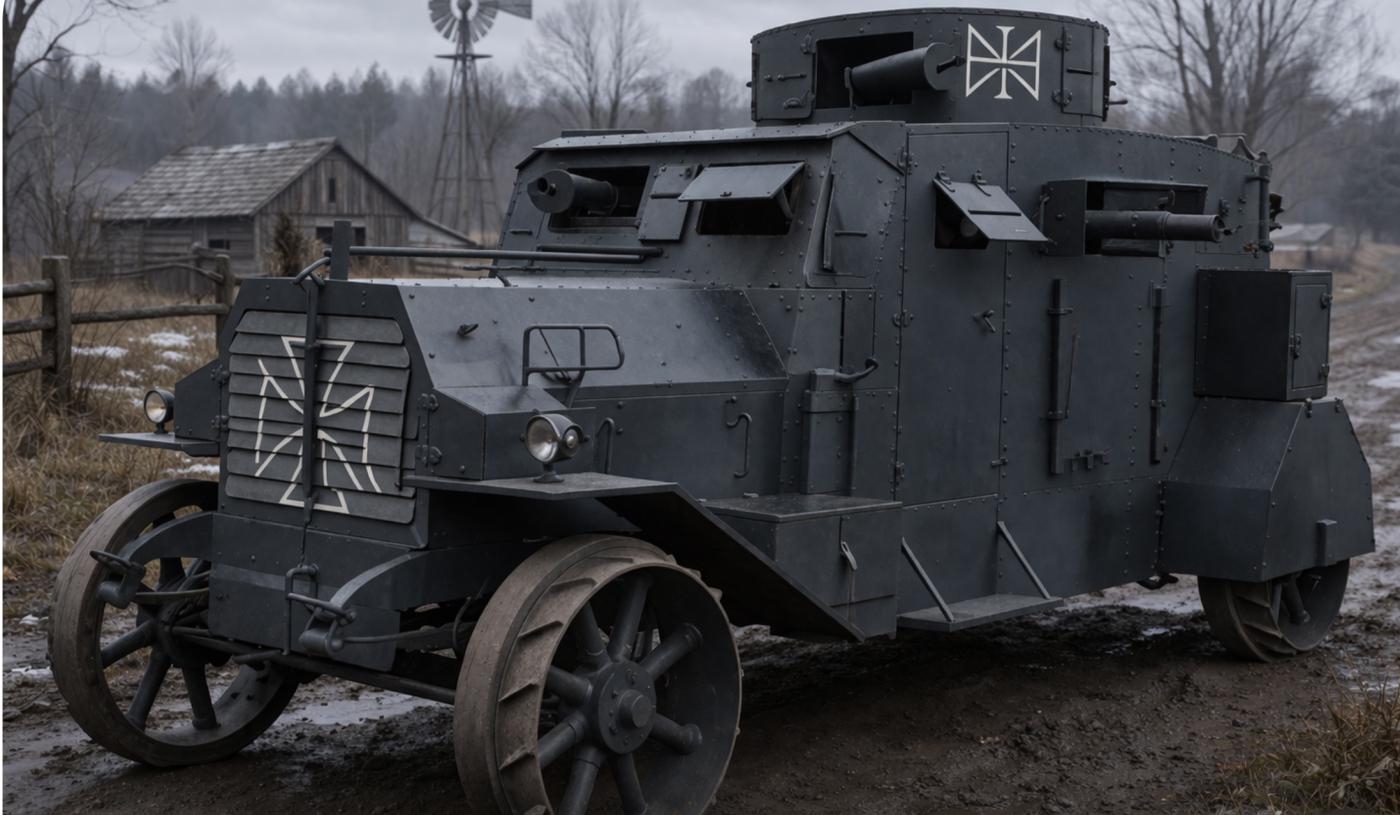
Ehrhardt Armoured Car
The Ehrhardt M1917 armoured car, properly known as the Ehrhardt E-V/4 Panzerkraftwagen 1917, was one of Germany’s early purpose-built armoured vehicles developed during the First World War. It was designed in response to the increasing use of armoured cars by Allied forces, particularly in the early years of the war when mobility and machine-gun firepower proved highly effective.
The vehicle was designed and manufactured by the German company Heinrich Ehrhardt Automobilwerke AG, which had experience in producing military equipment such as artillery. In 1915, the German Army requested designs for armoured cars from several firms, including Daimler-Motoren-Gesellschaft and Büssing. Ehrhardt’s design stood out because it was based on a robust truck chassis and incorporated features intended for combat use rather than simply modifying civilian vehicles.
The first prototype appeared in 1915, but the improved and more refined production version, known as the M1917, entered service in 1917. This version included design improvements such as better armour shaping, a fully rotating turret, and in some cases early radio equipment, which was quite advanced for the time.
The vehicle had a large, boxy structure made from riveted steel plates. Its armour thickness reached up to about 9 millimetres, providing protection against rifle fire and shell fragments but not against heavier weapons. The tall shape of the vehicle made it highly visible but also gave the crew good visibility, especially useful in urban operations later on.
The main armament consisted of three machine guns, typically mounted in the turret and along the sides of the hull. Additional firing ports allowed the crew to reposition weapons to cover different angles, giving the vehicle strong all-around defensive capability.
The crew size was relatively large, usually between eight and nine men. This included a commander, driver, and multiple gunners to operate the machine guns, as well as crew responsible for observation and communication duties.
Power came from an approximately 80 horsepower petrol engine, and the vehicle used a four-wheel-drive system, which was advanced for the period. Despite weighing around 7 to 9 tons, it could reach a top speed of roughly 60 kilometres per hour on roads. However, its off-road performance was limited due to its weight, solid wheels, and basic suspension system.
The Ehrhardt M1917 was mainly used on the Eastern Front during the First World War, where terrain conditions were more suitable for wheeled vehicles. It saw limited combat use overall, as armoured cars were still being developed and their role was not yet fully understood.
After the war, the vehicle became more useful in internal security roles. It was widely used by paramilitary groups such as the Freikorps and by police forces during periods of unrest in Germany. Its height, firepower, and intimidation factor made it effective in controlling crowds and urban disturbances.
Production numbers were relatively low, with just over 50 vehicles built in total. Despite this, the Ehrhardt M1917 is an important early example of an armoured car designed specifically for military use. It demonstrated both the possibilities and limitations of early armoured warfare and influenced later German vehicle development.