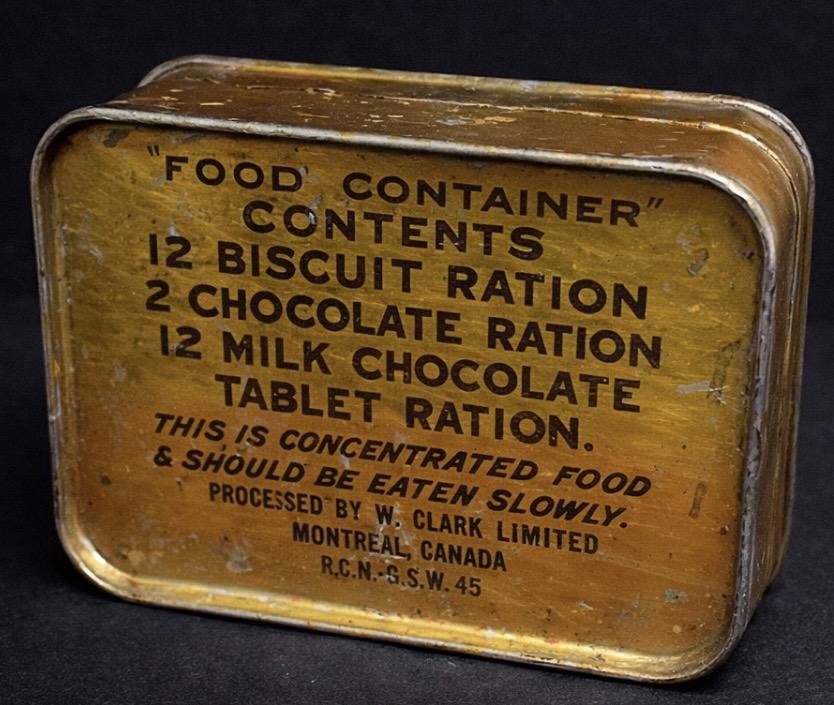
Canadian biscuit rations
The Canadian ration biscuit tin issued to troops during the Second World War represents a continuation of a very long military tradition of supplying durable, non-perishable food in compact, sealed containers. These tins, often referred to as emergency ration tins or naval ration tins, were designed primarily as a last-resort food source, especially for situations such as lifeboats, isolated operations, or when normal supply chains had broken down. Canadian versions were initially developed for naval use but were eventually distributed across all branches of the armed forces as the war progressed.
The tins themselves were typically small, robust containers made from tinplate steel, a material chosen for its resistance to corrosion and its ability to be sealed airtight. Their construction was deliberately simple and strong, usually rectangular in form with a tightly fitted lid that was either soldered or firmly crimped into place. Unlike modern tins with ring-pulls, these containers were not designed for convenience. They were built to remain sealed for long periods under harsh conditions, and ease of opening was very much a secondary concern.
To open one of these tins required a degree of improvisation. In the absence of a dedicated opener, soldiers would typically use whatever tools were available to them. A bayonet was commonly employed, worked carefully into the seam of the lid and levered upwards bit by bit. Some would use the edge of a clasp knife or a standard issue tin opener if one was available, although the thickness of the metal could make this slow work. In many cases the lid had to be punctured first, then gradually prised back, often bending and distorting the metal in the process. It was not unusual for the process to take several minutes, and care had to be taken to avoid cutting fingers on the sharp edges once the seal was broken. The difficulty of opening was in itself intentional, as the tins were meant to discourage casual consumption and preserve the contents until absolutely necessary.
Inside, the contents were deliberately simple but nutritionally concentrated. The central component was a tightly packed block or stack of hard biscuits, sometimes formed into a single slab to maximise space. These biscuits were essentially an advanced form of hardtack, made from basic ingredients such as flour and water, and baked to remove almost all moisture. This gave them an exceptionally long shelf life, allowing them to remain edible for years if kept dry and sealed.
The biscuits were designed to provide energy rather than enjoyment. Dense and extremely hard, they required effort to eat and were often softened before consumption. Soldiers commonly soaked them in tea or water, crumbled them into stews, or fried them with other ration items when possible. Despite their unappealing texture and bland taste, they were highly effective as a survival food, capable of sustaining a man when no other rations were available.
The company Clarke, associated with the production of some of these biscuit tins and their contents, was part of a broader network of North American food manufacturers that adapted to wartime needs. Firms like Clarke were typically based in established industrial centres with access to flour mills, transport links, and a skilled workforce. During the war, their facilities were redirected toward the mass production of durable ration foods, operating under strict specifications to ensure consistency and reliability across millions of units.