On this day in military history…
Operation Anger was the Allied military operation that led to the liberation of Arnhem in April 1945, during the closing weeks of World War II. The city had already become famous the previous year as the focal point of Operation Market Garden, a failed attempt to seize bridges across the Rhine. After that battle, Arnhem remained under German control through a harsh winter, its population largely evacuated and its infrastructure heavily damaged.
By early April 1945, Allied forces were advancing rapidly through the eastern Netherlands as part of a broader push into northern Germany. The responsibility for retaking Arnhem fell to the British Second Army, commanded by Miles Dempsey. Within this formation, the immediate task of capturing the city was assigned to the British I Corps under John Crocker. The principal assault force for Operation Anger was the 49th (West Riding) Infantry Division, commanded by Evelyn Barker.
The 49th Division, known for its polar bear insignia, consisted of several experienced infantry brigades, including the 146th, 147th, and 70th Infantry Brigades. These units had seen extensive combat in northwest Europe following the Normandy landings in 1944. Supporting them were artillery regiments, engineers, and elements of the Royal Engineers, who played a crucial role in river crossings and clearing obstacles. Armoured support was provided by units equipped with tanks and specialized vehicles, including those designed for amphibious operations and bridging.
Opposing the British were German forces that were by this stage of the war weakened, fragmented, and short of supplies. The defenders included elements of the German 346th Infantry Division and various ad hoc units composed of trainees, older soldiers, and remnants of previously defeated formations. Although still capable of resistance, these troops lacked the cohesion and strength that had characterized German defenses earlier in the war.
Operation Anger began on 12 April 1945 with preparatory artillery bombardments and coordinated assaults across water obstacles east of Arnhem, particularly the River IJssel. British forces executed carefully planned crossings using assault boats and amphibious vehicles, supported by suppressive fire from artillery and machine guns. Engineers worked under fire to establish ferry points and bridges, enabling the steady flow of troops and equipment.
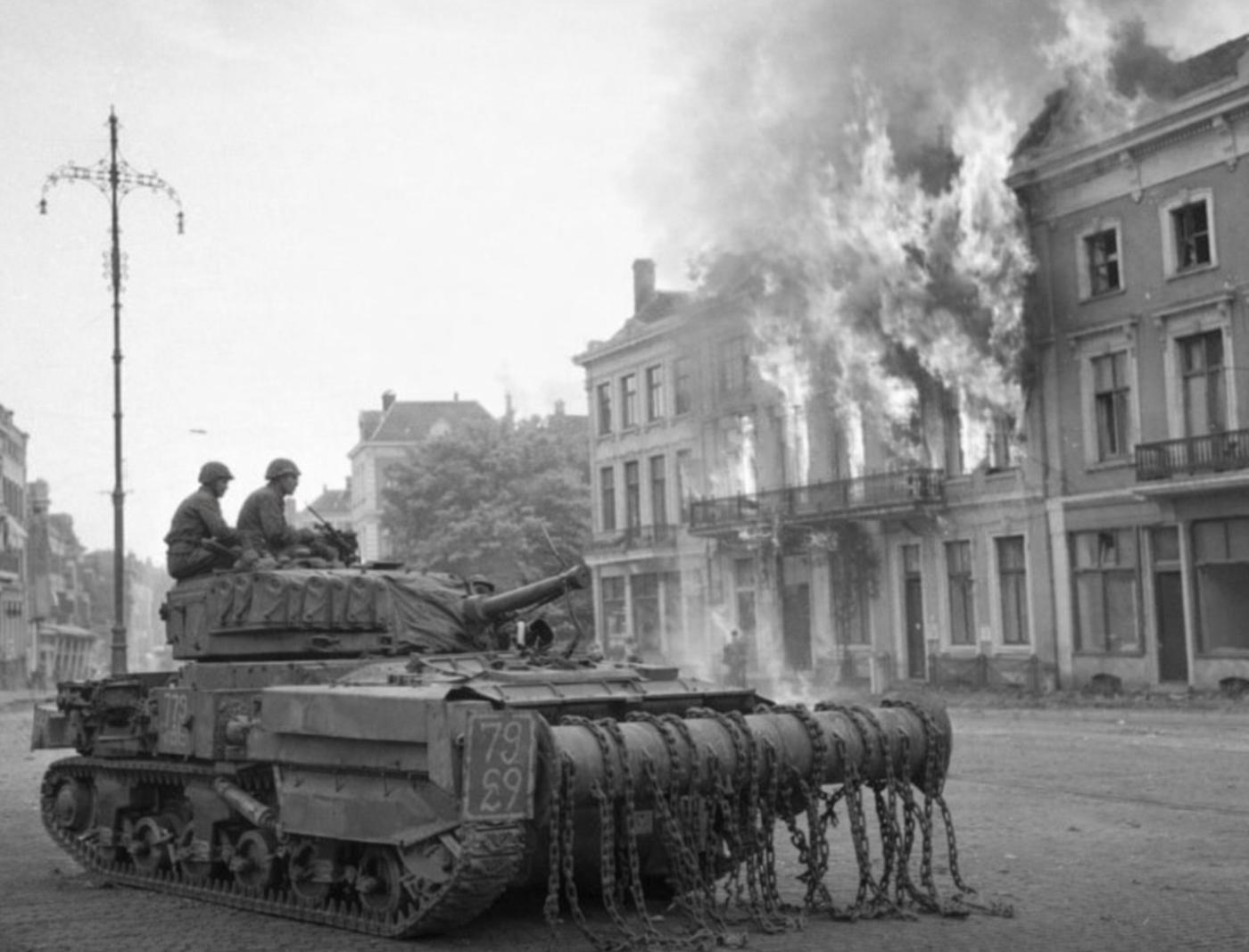
Once across the river, British infantry advanced toward Arnhem from the east and southeast. The fighting, while sharp in places, was not on the same scale as the desperate संघर्ष seen during the 1944 battle. German resistance was uneven, with some units withdrawing quickly while others attempted local counterattacks. Urban combat took place as British troops moved through ruined streets and cleared buildings, but the overall tempo of the operation reflected the deteriorating condition of German forces in the region.
Over the course of 13 and 14 April, the 49th Division consolidated its gains and pushed deeper into the city. Coordination between infantry, armour, and artillery allowed the British to maintain momentum. By 14 April, organized German resistance in Arnhem had effectively collapsed, and the city was declared liberated. The operation had achieved its objectives in a relatively short period, especially when compared to the earlier failed attempt to seize Arnhem’s bridges.
The capture of Arnhem was strategically significant because it secured a key crossing point over the Rhine and removed a remaining German stronghold in the Netherlands. It also contributed to the final Allied advance into northern Germany, hastening the end of the war in Europe. For the Dutch population, the liberation marked the end of a long and difficult occupation, although the city itself lay in ruins and would require extensive rebuilding in the postwar years.
Operation Anger stands in contrast to Operation Market Garden, illustrating how the strategic situation had shifted dramatically in just seven months. In September 1944, Arnhem had been the site of a costly Allied failure against strong German resistance. By April 1945, with German forces in retreat across all fronts, the same city could be taken through a well-coordinated but comparatively swift assault.