Dutch Resistance Medal
The Verzetskruis 1940–1945, commonly known in English as the Dutch Cross of Resistance, is one of the most exclusive and symbolically charged decorations ever instituted by the Netherlands. It was created to recognise exceptional courage and leadership shown in resistance against the occupying enemy during the German occupation of the Netherlands in the Second World War. The award was instituted by Royal Decree on 3 May 1946, almost exactly one year after liberation, reflecting the desire of the Dutch state and royal family to give formal recognition to resistance actions that went far beyond what could be acknowledged by existing military or civil honours.
The decoration was deliberately conceived as extremely rare. The Netherlands had witnessed resistance on a massive scale between 1940 and 1945, ranging from illegal press work and sheltering Jews to armed sabotage, intelligence gathering, escape lines for Allied airmen, and direct armed attacks on German forces and collaborators. Because of this, the government made a conscious decision that the Verzetskruis should not become a general resistance medal. Instead, it was reserved for individuals who had shown extraordinary courage, initiative, and leadership under the most dangerous circumstances, often over a sustained period and almost always at the cost of their lives.
In total, the Verzetskruis was awarded only 95 times. Of these, 93 awards were posthumous. This statistic alone illustrates the severity of the criteria. In practice, the decoration became almost synonymous with ultimate sacrifice. Although the regulations allowed it to be awarded to living persons, there was strong resistance sentiment in the immediate post-war years against honouring survivors while so many comrades had been executed, tortured, or killed in camps. As a result, the decoration was, with extremely rare exception, conferred only after death. Only one recipient is generally recognised as having received the Verzetskruis while still alive, making it unique among Dutch wartime decorations.
The actions for which the Verzetskruis was awarded were diverse but consistently extreme. Recipients included leaders of armed resistance groups, organisers of major intelligence networks, couriers who maintained critical communication lines under constant threat, and individuals who continued resistance activities despite arrest, torture, or certain knowledge that capture would lead to execution. Many recipients were betrayed, executed by firing squad, died under interrogation, or were killed in concentration camps. In several cases, the award citation explicitly refers to calm, defiant behaviour during imprisonment and refusal to betray comrades, underscoring that moral courage was considered as important as physical bravery.
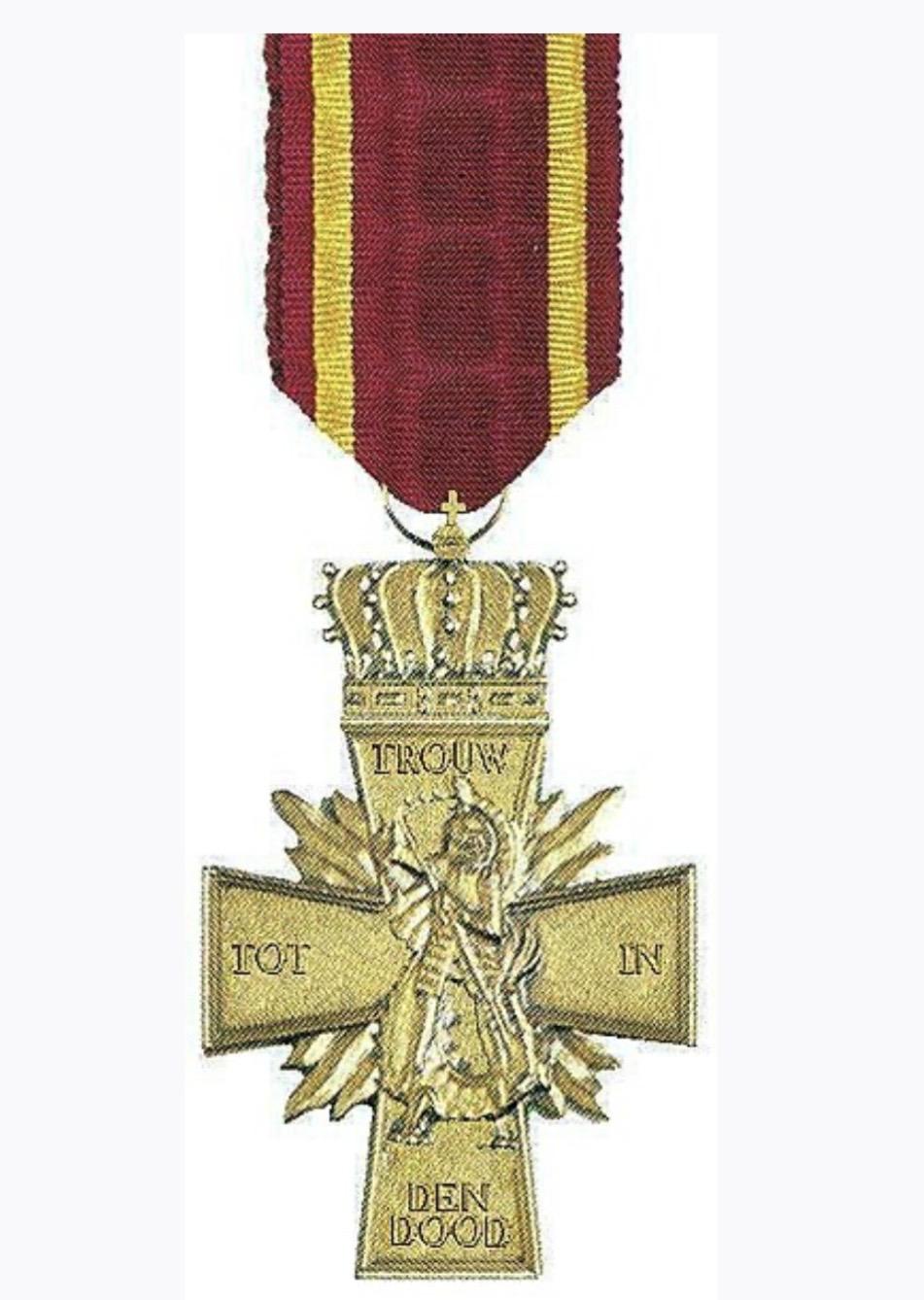
The design of the Verzetskruis was intended to convey this moral dimension. The cross is made of bronze and consists of four arms set against a background of flames, symbolising struggle, suffering, and purification through sacrifice. Above the cross is a royal crown, marking it as a decoration granted directly by the Dutch sovereign. On the obverse, Saint George is depicted slaying the dragon, a powerful and instantly recognisable allegory of good triumphing over evil. Along the arms of the cross is the inscription “Trouw tot in den dood,” meaning “Loyal unto death,” a phrase that encapsulates the spirit of the resistance and the fate of most recipients. The reverse shows a flaming sword breaking chains, representing liberation from tyranny and the destruction of oppression.
The ribbon is crimson, a colour traditionally associated with sacrifice and bloodshed, with narrow orange-gold stripes that refer to the House of Orange and national loyalty. Together, the cross and ribbon form one of the most visually and symbolically intense Dutch decorations, deliberately distinct from conventional military medals.
The design was created by L.O. Wenckebach, a respected Dutch artist and professor associated with Delft. His design was selected after the Dutch government tasked the state mint service, the Rijksmunt, with developing proposals for a new resistance decoration. Production was carried out under official state supervision, ensuring consistent quality and reinforcing the idea that this was not a veterans’ badge or commemorative token, but a formal national honour of the highest order.
When the recipient had been killed, the presentation of the Verzetskruis followed a solemn and highly ceremonial pattern. The decoration was usually presented to the next of kin, often parents, a widow, or children, sometimes years after the death had occurred. Presentations were typically conducted by a high-ranking government official or a member of the royal household, and in some cases personally by Queen Wilhelmina herself. The ceremony emphasised dignity and remembrance rather than celebration, and families were often given the full citation detailing the actions for which their relative had been honoured. For many families, the award served as one of the few official acknowledgements of secret resistance activities that could not be discussed during the occupation and were sometimes still only partially known even after the war.
An interesting and sometimes overlooked aspect of the Verzetskruis is its position in the Dutch order of precedence. It ranks immediately below the Military Order of William, the Netherlands’ highest military decoration for bravery. This placement underlines that the Dutch state regarded the resistance struggle as morally equivalent to frontline combat, even though it was fought clandestinely and often without uniforms or formal command structures.
Another striking detail is that no awards were made after the early post-war years. The list of recipients was effectively closed, reinforcing the idea that the Verzetskruis was tied specifically and exclusively to the resistance struggle of 1940–1945. It was not intended to evolve into a general award for later conflicts or political resistance movements, which has helped preserve its historical clarity and moral weight.