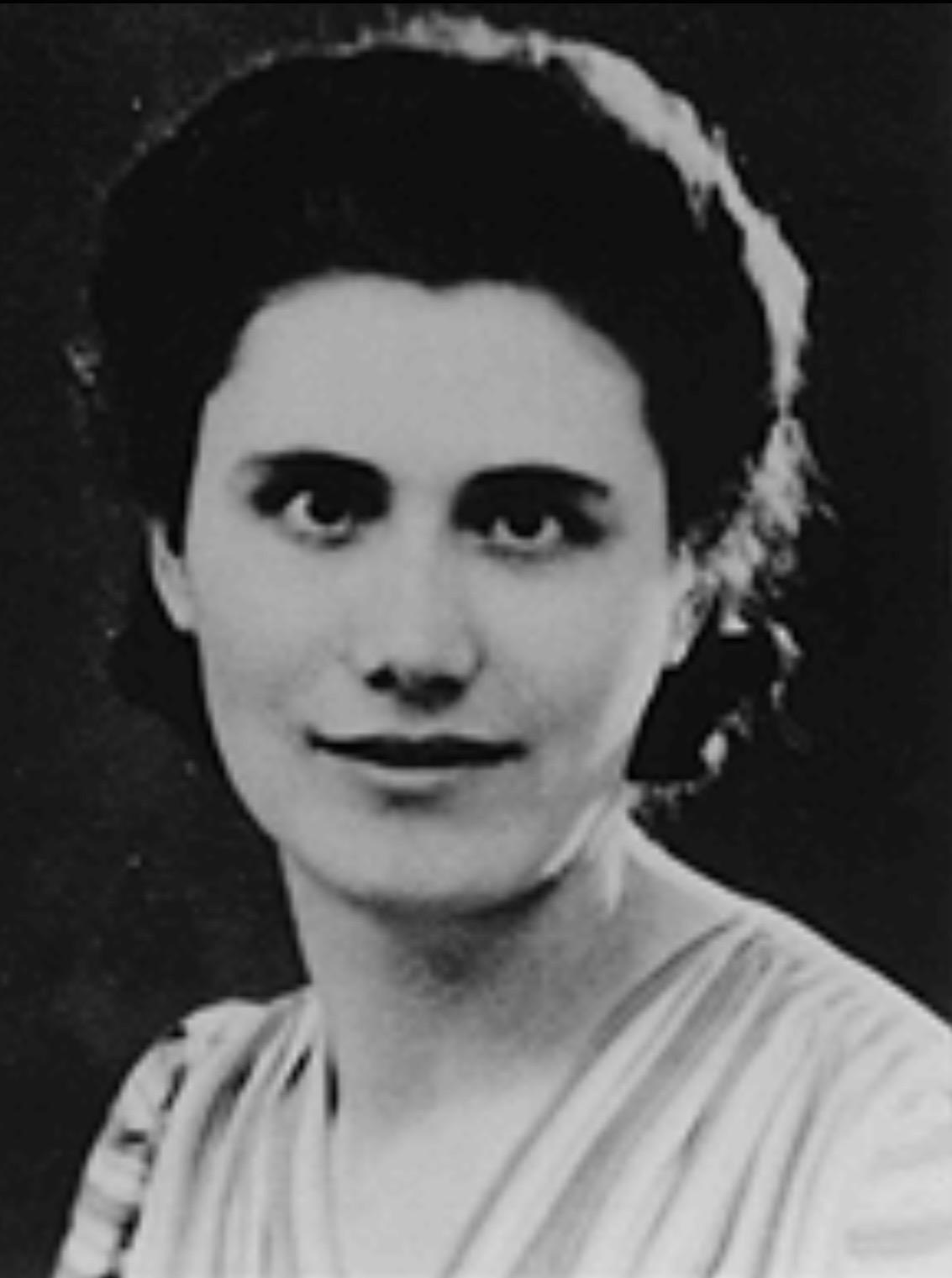
Gabrielle Weidner
Gabrielle Hermine Weidner was born on 17 August 1914 in Brussels to Dutch parents who were devoted members of the Seventh-day Adventist Church. She was the second of four children in a family where education, faith and a strong sense of moral duty played a central role. Her father was a classical languages teacher, and Gabrielle grew up in an intellectually stimulating environment, spending much of her childhood in Collonges-sous-Salève near the French–Swiss border. She was educated in several countries, including time at secondary school in London, and became fluent in multiple languages. From an early age she showed a quiet determination, discipline and compassion for others, traits that would later define her wartime actions.
In the 1930s Gabrielle settled in Paris, where she worked as a secretary at the headquarters of the French-Belgian Union of Seventh-day Adventists. The position involved extensive correspondence, organisation and travel, and gave her experience that would later prove invaluable. She lived a modest life shaped by religious conviction and service, and she maintained close ties with her siblings, particularly her brother Johan Hendrik Weidner, who shared her deep opposition to injustice and authoritarianism.
The German invasion of France in 1940 marked a decisive turning point in her life. Like many others, Gabrielle initially fled south during the collapse of France, but she soon returned to Paris under the occupation. There, as anti-Jewish laws, arrests and deportations intensified, she became involved in clandestine resistance activities. Through her brother she was drawn into what became known as the Dutch-Paris resistance network, an underground organisation dedicated to helping people escape Nazi persecution. The network assisted Jews, Allied airmen shot down over occupied Europe, resistance fighters, and young men attempting to evade forced labour in Germany.
Gabrielle’s role within the resistance was not one of armed combat but of coordination, communication and support, functions that were no less dangerous. She worked primarily as a courier and organiser, carrying messages between resistance members, maintaining contact points in Paris, preparing documentation and distributing supplies. Her language skills, reliability and calm demeanour allowed her to operate in an environment where a single mistake could be fatal. She was fully aware that arrest would likely mean torture and deportation, yet she continued her work with quiet resolve. Through these efforts, she contributed to the saving of hundreds of lives.
In early 1944 the Dutch-Paris network suffered a devastating blow when a courier was arrested and, under brutal interrogation, revealed names and addresses of resistance members. A wave of arrests followed across France. On 26 February 1944, Gabrielle was arrested by the Gestapo in Paris during a church service. She was taken to Fresnes prison, where she was held for months under harsh conditions. The authorities hoped her imprisonment might lure other resistance leaders into revealing themselves, but no rescue attempt came.
Later in 1944 she was deported to Germany in one of the last prisoner transports from Paris before liberation. She was first sent to Ravensbrück concentration camp, the main camp for women, where she endured forced labour, hunger, disease and constant brutality. Her health, never robust, declined rapidly. She was subsequently transferred to a subcamp near Königsberg in der Neumark, where prisoners were exploited for exhausting labour under appalling conditions. Food was scarce, clothing inadequate, and medical care almost nonexistent.
As Soviet forces advanced in early 1945, chaos spread through the camp system. Many prisoners were forced onto death marches, while others, too weak to move, were left behind. The Königsberg camp was liberated in early February 1945, but for many prisoners freedom came too late. Gabrielle was severely weakened by prolonged starvation and illness. In the final days, fires and violence accompanied the SS retreat, and she suffered further trauma. On 17 February 1945, just days after liberation, Gabrielle Weidner died from the effects of extreme malnutrition and exhaustion.
After the war, her courage and sacrifice were formally recognised. She was posthumously awarded the Dutch Cross of Resistance, and her name was inscribed among those who gave their lives opposing Nazi persecution. Though less widely known than some resistance figures, Gabrielle Weidner’s story stands as a powerful example of moral courage, quiet heroism and selfless commitment. She did not survive to see the freedom she helped secure for others, but her actions saved lives and remain a lasting testament to the role of ordinary individuals who chose to resist in extraordinary times.