DSO Medal
The Distinguished Service Order, usually known by its initials, is one of Britain’s most respected military decorations. It was created to recognise distinguished leadership and service in war, particularly by officers who showed exceptional ability, courage, judgement, and devotion to duty while commanding others in active operations. Although it is sometimes casually called a “medal,” it is technically an order of chivalry, and its decoration is a cross rather than a round medal.
The award was instituted by Queen Victoria on 6 September 1886. Its creation came during a period when the British Empire was involved in frequent military campaigns across the world, and there was a need for a formal honour that sat below the Victoria Cross but still recognised outstanding service in battle. The Victoria Cross was, and remains, the highest British award for gallantry in the face of the enemy, but it was reserved for acts of the most conspicuous bravery. The Distinguished Service Order filled a different role. It honoured officers whose actions were distinguished and important, especially in command, even when they did not meet the very narrow standard required for the Victoria Cross.
For much of its history, the decoration was primarily awarded to commissioned officers of the armed forces. It became closely associated with leadership under fire. Recipients were often battalion commanders, naval officers, squadron leaders, staff officers, or others whose decisions and conduct had a direct effect on military operations. In practice, many awards were made for personal gallantry as well as leadership, particularly during the First and Second World Wars. A soldier, sailor, or airman who led an attack, held a difficult position, commanded a successful raid, or continued to direct operations under heavy fire might be considered for it.
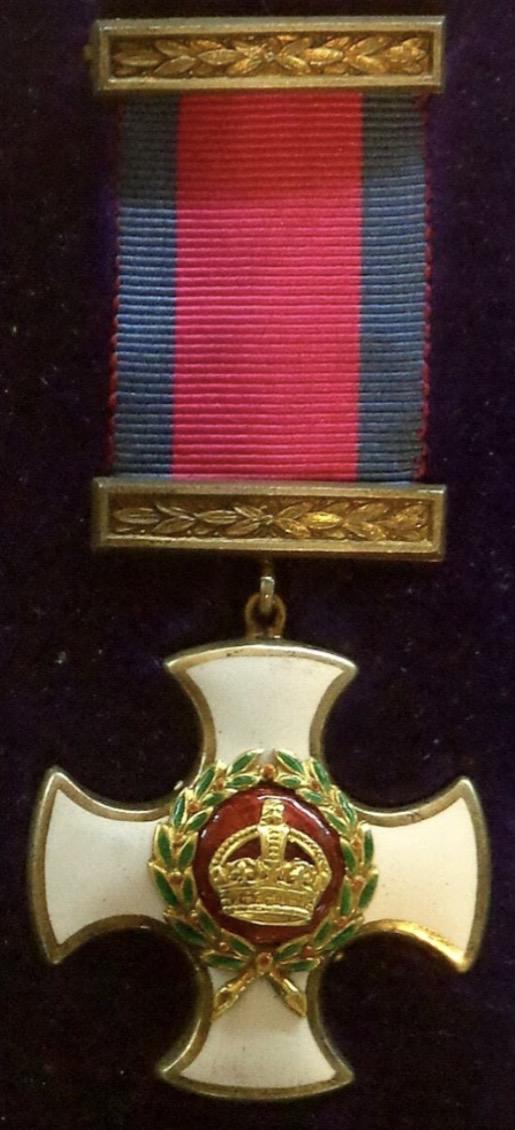
The decoration itself is a white-enamelled gold cross with curved ends, edged in gold. At the centre is a wreath of laurel surrounding the royal cypher. The reverse bears the royal cypher and crown. The ribbon has traditionally been red with blue edges. Because it is an order, recipients are appointed as Companions of the Distinguished Service Order and may use the post-nominal letters after their name.
The honour became especially prominent during the First World War. The scale of the conflict meant that thousands of officers were placed in situations of extreme danger and responsibility. Commanding troops in trench warfare required not only courage but also discipline, endurance, and the ability to make rapid decisions in chaotic circumstances. Many awards were made for actions on the Western Front, but the decoration was also given for service in other theatres, including Gallipoli, Mesopotamia, East Africa, and operations at sea and in the air. During this period, it was sometimes awarded to relatively junior officers if their conduct was exceptional, though it remained chiefly an officers’ award.
The award could also be granted more than once. A recipient who earned it again did not usually receive a second full decoration but instead received a bar to the original award. These bars were worn on the ribbon. A man with the decoration and one bar had been awarded the distinction twice; with two bars, three times; and so on. Multiple awards were rare and marked a very high level of repeated distinction in active service.
During the Second World War, the order again played a major role in recognising command and gallantry. It was awarded across the Army, Royal Navy, Royal Air Force, and associated forces of the British Empire and Commonwealth. Army officers might receive it for leading successful attacks, maintaining defensive positions against overwhelming opposition, or handling difficult operations with exceptional skill. Naval officers might receive it for successful actions against enemy ships, submarines, or aircraft, or for leadership during convoy operations. RAF officers could receive it for leadership in air operations, including bomber, fighter, reconnaissance, and special missions.
The decoration was not limited only to British-born servicemen. It was awarded throughout the British Empire and later the Commonwealth, and it could also be awarded to allied foreign officers. Many Australians, Canadians, New Zealanders, Indians, South Africans, and others received the honour while serving in imperial or Commonwealth formations. This gives it a wide historical reach, linking it not only to British military history but also to the shared military history of many countries.
Its meaning changed somewhat over time. Originally, it was tied very strongly to distinguished service in war and was usually associated with officers. In the modern British honours system, reforms have clarified the purpose of gallantry awards. Since the 1990s, it has been used specifically to recognise highly successful command and leadership during active operations. It is no longer simply an officers-only decoration in the older social sense, although its nature means that it is still most often associated with command appointments. Other modern awards, such as the Conspicuous Gallantry Cross and the Military Cross, recognise different forms of gallantry.
One important point is that it should not be confused with campaign medals. A campaign medal is normally awarded to personnel who served in a particular campaign or theatre of war, provided they met the qualifying conditions. This decoration, by contrast, is an individual honour for distinguished conduct, leadership, or service. It was not automatically given for serving in a war. A recipient had to be recommended, and the award was normally announced officially in the London Gazette or equivalent official records.
The honour also carried considerable prestige in civilian life. After the world wars, many former officers used the post-nominal letters in books, public records, military histories, and memorials. Seeing those letters after a name indicated that the person had been recognised for notable wartime service. In biographies and family histories, the award often points to a significant military episode worth researching further. Citations, where available, can reveal the circumstances of the award, though not all early awards were accompanied by detailed public citations.
Collectors and historians value these decorations because of their strong connection to named individuals and specific acts of service. Unlike anonymous campaign medals, gallantry and distinguished service awards are often researchable. The recipient’s service record, unit war diary, London Gazette entry, and local newspaper reports may help explain why the award was granted. In many cases, the story behind the decoration is more important than the object itself. It can open a window onto a battle, a regiment, a ship, an air squadron, or a particular moment of command under pressure.
The decoration is also part of Britain’s wider system of military honours. Above it stands the Victoria Cross for supreme gallantry. Around it are other awards such as the Distinguished Service Cross, Military Cross, Distinguished Flying Cross, and, in later reforms, the Conspicuous Gallantry Cross. Its special place lies in its emphasis on command. It does not merely say that someone was brave, though many recipients certainly were. It says that the person served with distinction in a position of responsibility during active operations.
The award has appeared in conflicts from the late Victorian imperial campaigns through the Boer War, the First World War, the Second World War, Korea, the Falklands, the Gulf War, Iraq, Afghanistan, and other operations. Its long history makes it one of the most recognisable British military distinctions. While the character of warfare has changed greatly since 1886, the qualities associated with the award have remained broadly consistent: leadership, steadiness, courage, judgement, and distinguished service in dangerous circumstances.
In historical writing, it should be treated carefully. It is accurate to call it a decoration or an order, but less precise to call it simply a medal. It is also important not to assume that every award was given for the same type of action. Some were granted for conspicuous personal bravery, especially in earlier wars, while others recognised operational command, planning, or sustained distinguished service in battle. The best way to understand any particular case is to trace the official announcement and, where possible, the citation.