On this day in military history…
The ambush of 22 May 1968 near Con Thien was one of the sharp, brutal small-unit actions that defined the war along the Vietnamese Demilitarized Zone. It did not have the scale or public fame of Khe Sanh, Hue, or the Tet Offensive, but for the Marines of 1st Battalion, 4th Marines, it became a day of sudden violence, leadership under fire, heavy casualties, and painful memory. The action took place in Quang Tri Province, close to the DMZ, in the northernmost part of South Vietnam, where U.S. Marines faced regular North Vietnamese Army formations rather than the lighter guerrilla forces more often associated with the war farther south.
Con Thien, meaning “Hill of Angels,” was a Marine combat base positioned only a few kilometers south of the DMZ. Its location made it strategically valuable and tactically dangerous. From the hill, Marines could observe movement across part of the border region, but the position was also exposed to North Vietnamese artillery, mortars, rockets, and ground probes. The wider area included the cleared obstacle belt known to Marines as “The Trace,” part of the anti-infiltration barrier system associated with the McNamara Line or Dye Marker project. By 1968, this system of strongpoints, roads, wire, minefields, and cleared lanes had drawn Marine units into a defensive struggle in which patrols and sweeps were required constantly to keep North Vietnamese units from occupying ground close to the bases.
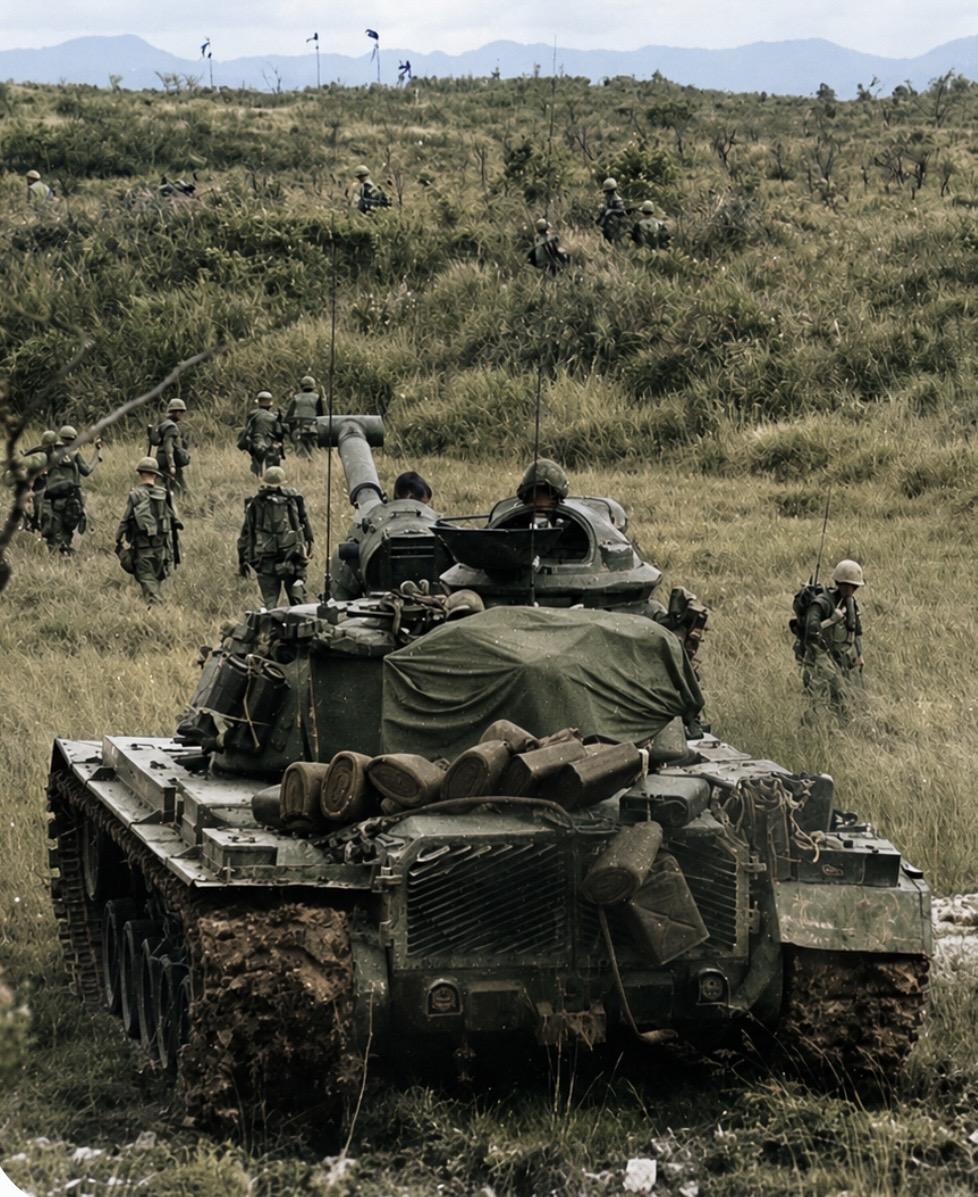
The setting of the 22 May ambush was the country east of Route 561, about 2,000 meters east of Con Thien. Route 561 ran through the Con Thien area and intersected with the cleared Trace. The terrain was ideal for a concealed ambush. It was not open, flat ground where Marines could easily see and maneuver. Instead, it consisted of rolling swales and ridges, waist-high Kunai grass, patches of heavy brush, and hedgerows that broke up visibility and divided the countryside into compartments. These features allowed North Vietnamese troops to hide, channel movement, and deliver close-range fire before the Marines could fully identify the enemy positions.
Bravo Company, 1st Battalion, 4th Marines, moved out from Yankee Station around noon on 22 May. The company was under Captain Robert E. Harris and was accompanied by eight Marine tanks. The unit moved east along the southern edge of the Trace and continued toward Route 561. The apparent mission was to flush out North Vietnamese Army troops operating east of the road. The plan called for Bravo Company to align itself south from the Trace along Route 561 and then move east toward Phu Oc. This was the kind of aggressive patrolling and sweeping operation that Marine units had to conduct repeatedly in the DMZ sector, where remaining inside fortified positions allowed the enemy too much freedom to prepare attacks, lay mines, establish firing positions, and move supplies.
At about 1720 hours, after advancing roughly 400 meters eastward, Bravo Company entered an L-shaped ambush. This was a classic and deadly arrangement. In an L-shaped ambush, one enemy element fires along the long axis of the target’s movement while another fires from the short leg, often creating crossing fields of fire. In this case, the short leg of the ambush lay along the Trace to the north. Once the Marines were inside the kill zone, the North Vietnamese opened fire with machine guns, mortars, and grenades. The first moments were devastating. Many Marines instinctively dropped to the ground, but the vegetation and terrain that had hidden the enemy also complicated the Marines’ response.
Captain Harris tried to restore initiative immediately. He ordered part of the company to advance against the northern side of the ambush, an attempt to break the enemy’s grip and prevent Bravo Company from being pinned in place. The Marines pushed forward but could not break that side of the trap. Heavy fire continued to sweep across their positions. Most of the casualties occurred in the first 20 minutes, which suggests the North Vietnamese had achieved the essential purpose of a well-laid ambush: to deliver maximum damage before the victim could organize a full counterattack or call in decisive supporting arms.
Captain Harris was killed early in the battle. His death was a severe blow, but accounts from surviving Marines later credited him with helping preserve order and discipline during the first chaotic minutes. That mattered greatly. In an ambush, especially one delivered at close range with automatic weapons and explosives, panic could multiply casualties. Harris’s immediate orders and example appear to have helped prevent the company from disintegrating under the shock of the first fire. First Lieutenant David Westphall, platoon leader of 1st Platoon, was also killed, along with his radio operator, Lance Corporal Charles Kirkland. The loss of leaders and radio personnel was especially damaging because command and communications were essential for coordinating movement, evacuation, artillery, tanks, and reinforcements.
Alpha Company was positioned several hundred meters north of Bravo Company and moved quickly toward the fight when it became clear that Bravo was in serious trouble. Meanwhile, much of Bravo’s 2nd Platoon, commanded by First Lieutenant Joe Johnston, remained pinned down until nearly dusk. Johnston was badly wounded in the jaw, but he continued to direct his men. Near dusk he ordered surviving members of his platoon to pull back about 300 yards west to a defensive position where the company command-post staff and other survivors had gathered. This withdrawal was not a rout but a necessary consolidation under pressure. The wounded were brought into a tight perimeter and treated. The dead who had been recovered were laid together at the company aid station.
The cost was heavy. Elements of 1st Battalion, 4th Marines suffered 17 killed in action and at least 36 Marines or Navy corpsmen wounded on 22 May. Two more Marines later died of wounds suffered in the ambush, one on 23 May and another on 25 May. Several of the dead could not be recovered before nightfall. Eight bodies, including those of Lieutenant Westphall and Lance Corporal Kirkland, had to be left on the battlefield overnight, a painful but sometimes unavoidable reality in close combat when enemy fire, darkness, and the risk of further casualties made recovery impossible.
The battle did not end emotionally or tactically on 22 May. The next morning, the battalion commander ordered the recovery of the Marines left on the field. Second Lieutenant David Hauntz, who had led the forward observer team during the fight, was given responsibility for the recovery operation. All of the dead were accounted for and brought back. The recovery operation also placed Marine units in positions that trapped many of the North Vietnamese troops who had sprung the ambush. With Marines positioned around the area, the enemy had to stand and fight or attempt to escape across about 600 meters of open ground in the Trace. They chose to cross the Trace and were hit heavily by Marine tanks and artillery. North Vietnamese losses were reported as heavy, with at least 150 dead and some accounts placing the total higher.
The ambush shows the character of the war along the DMZ in 1968. This was not simply a war of isolated patrols stumbling into random firefights. The North Vietnamese Army operated in organized units, studied Marine patterns, used terrain skillfully, and prepared positions that could punish American movement. At the same time, Marine units relied on aggressive patrolling, tanks, artillery, mortars, air support, and rapid reinforcement. The 22 May action demonstrated both sides of that equation. The North Vietnamese achieved surprise and inflicted severe casualties in the opening phase. The Marines, despite losing leaders and taking heavy fire, maintained enough discipline to form a defensive position, evacuate wounded, recover their dead the next day, and bring supporting arms to bear.
The wider Con Thien fight had already become infamous before May 1968. In 1967, the base had been under repeated bombardment, sometimes so intense that Marines nicknamed the place “the meat grinder” or spoke of being “in the barrel.” By early 1968 the tempo was not always as intense as the worst months of 1967, but the danger remained constant. The exposed base depended on mines, wire, bunkers, artillery, tanks, and air support for survival.
The human legacy of the 22 May ambush is especially strong because one of those killed, First Lieutenant David Westphall, became central to the story of the Vietnam Veterans Memorial at Angel Fire, New Mexico. His father, Dr. Victor Westphall, later helped establish a memorial in his son’s memory and in memory of others who died in Vietnam. The ambush therefore occupies two places in history: first as a hard tactical fight in the DMZ war, and second as part of the grief and remembrance that followed the conflict home.
In military terms, the ambush was a costly but localized engagement. It did not change the course of the Vietnam War, and it did not decide control of the DMZ. Yet its importance lies in what it reveals. It shows how dangerous even a routine sweep could become within seconds. It shows how prepared North Vietnamese troops could exploit grass, hedgerows, ridges, and roads to create a killing zone. It shows how Marine leadership at the platoon and company level could determine whether a battered unit survived the first minutes of shock. And it shows the grim rhythm of combat near Con Thien: patrol, contact, casualties, recovery, retaliation, and renewed vigilance.