Battle of Boulongne
The German capture of Boulogne in May 1940 was one of the sharp, violent episodes that helped turn the British Expeditionary Force’s campaign in France from an attempted defence of Western Europe into a desperate retreat to Dunkirk. Boulogne-sur-Mer, on the Channel coast, was not simply a port town. In the crisis of May 1940 it became part of a chain of ports whose control could decide whether the British Army escaped from France or was destroyed there. Boulogne, Calais and Dunkirk all lay within reach of the German armoured spearheads that had broken through the French front and driven to the sea. Once those spearheads turned north, the BEF and its French and Belgian allies were in grave danger of being trapped with their backs to the Channel.
The crisis began with the German offensive launched on 10 May 1940. The Allies had expected the main German blow to come through Belgium and the Netherlands, and so British and French forces moved north-east to meet it. This was exactly what the German plan encouraged them to do. The decisive thrust came farther south, through the Ardennes, where German panzer divisions crossed the Meuse and broke open the French line. The speed of the German advance shocked Allied commanders. Within days, German armour had poured through the gap and raced westward. By 20 May, German forces had reached the Channel coast, cutting the Allied armies in Belgium and northern France off from the main body of the French Army to the south.
For the BEF, commanded by Lord Gort, the campaign had changed almost overnight. The British Army had gone to France expecting to fight alongside the French in a broad Allied front. Instead, it found itself part of a northern pocket, with German forces behind it, German pressure in front of it, and the Channel as its only remaining line of escape. The Allied situation was confused, fast-moving and increasingly desperate. Communications between British and French commands were strained, orders changed quickly, and the map altered from hour to hour as German armoured columns cut roads, seized crossings and pushed toward the ports.
Boulogne’s position made it strategically important. It lay south-west of Calais and Dunkirk and offered both a possible supply route and an escape point. If the port could be held, it might help the British withdraw men or receive supplies. If it fell, the Germans would tighten their grip on the Channel coast and bring Dunkirk under greater threat. The same was true of Calais. These ports became buffers, obstacles and potential exits all at once. They were never likely to stop the German offensive completely, but if defended strongly enough they could slow it down and buy precious time.
The main German formation moving against Boulogne was the 2nd Panzer Division, part of the fast-moving armoured force that had reached the coast. The German panzer divisions had advanced with extraordinary speed, but they were not invincible. Their supply lines were stretched, their men and machines were tired, and the roads behind them were crowded with traffic, prisoners and refugees. Even so, their momentum was formidable. They had already achieved the great operational success of the campaign: they had split the Allied armies and reached the sea. Now they were turning against the Channel ports.
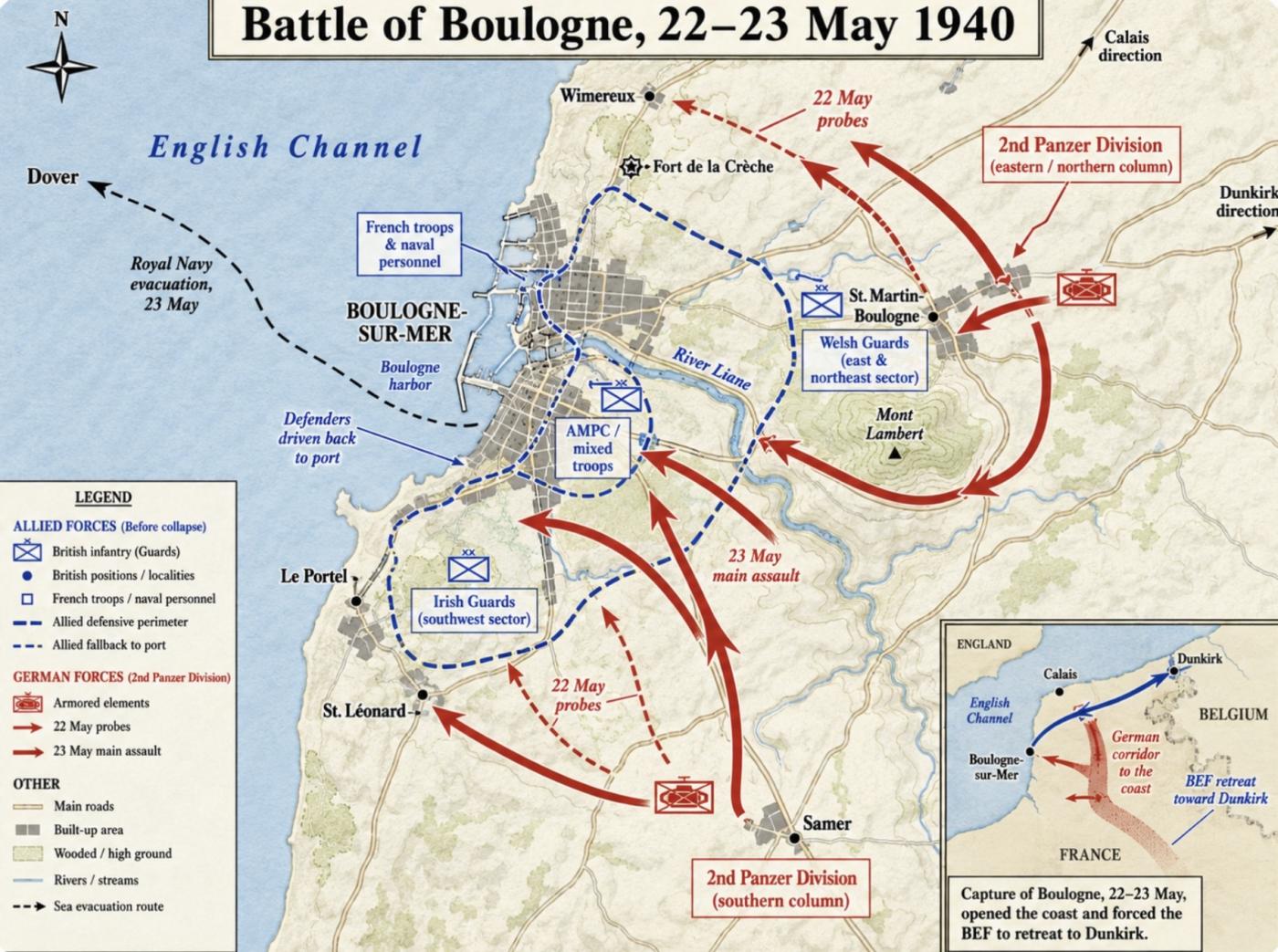
To strengthen Boulogne, the British sent elements of the 20th Guards Brigade, including the 2nd Battalion Welsh Guards and the 2nd Battalion Irish Guards. These troops arrived in a town already under pressure. Boulogne was crowded with soldiers, rear-area personnel, refugees, dock workers and local civilians. French troops and naval personnel were also involved in the defence. There was little time to prepare. The defenders had to improvise positions around the town, the harbour, the high ground and the approaches from which German armour was expected to come.
The battle began in earnest on 22 May. Boulogne was a difficult place to defend and an equally difficult place to attack. It was not an open battlefield but a port town of streets, docks, railway lines, hills, bridges and built-up areas. The River Liane ran through it, dividing parts of the town and complicating movement. German tanks and infantry pushed toward the perimeter while British and French defenders tried to hold roadblocks, strongpoints and approaches to the harbour. The Germans had armour, artillery and air support, but the defenders had cover, determination and the advantage of forcing the enemy to fight through confined ground.
The Irish Guards and Welsh Guards fought under intense pressure. German attacks struck their positions repeatedly as the panzer division tried to force its way into the town and toward the port. The defenders were too few to hold a wide perimeter for long, and they lacked the heavy weapons needed to resist a full armoured attack indefinitely. Yet they fought with stubbornness and discipline. In street fighting, tanks could be slowed by barricades, narrow roads and defenders firing from cover. The Germans could not simply drive through Boulogne without paying a price. Every delay mattered.
As the German pressure increased, the British and French defenders were gradually pushed back toward the harbour area. The situation became confused and dangerous. Units were separated, communications were difficult, and German fire was reaching deeper into the town. Boulogne’s harbour, which had been valuable as a possible escape route, became the centre of the struggle. If ships could still enter, troops might be evacuated. If the Germans reached the quays in strength, the defenders would be trapped.
The Royal Navy’s role became crucial. Destroyers were sent into Boulogne to take off British troops under fire. This was not an orderly withdrawal from a secure port. It was an emergency evacuation from a town under attack. German artillery and aircraft threatened the ships, and the waterfront was increasingly dangerous. Troops had to be gathered, embarked and taken away while fighting continued nearby. The evacuation from Boulogne was smaller than the later evacuation from Dunkirk, but it had many of the same features: naval courage, confusion, air attack, hurried embarkation and the constant fear that the enemy would close the exit before the soldiers could be rescued.
Many British troops were successfully taken off, including much of the Guards force, but the evacuation did not remove everyone at once. Some defenders remained behind, including British and French troops holding out around the port and railway areas. These rearguards continued to resist even after the main withdrawal had begun. Their stand was important because it forced the Germans to keep fighting for the town rather than immediately turning all their strength toward the next objective. Boulogne was falling, but it was not given up without cost.
The town eventually fell to the Germans after fierce fighting. Its capture removed one possible Channel port from Allied use and showed how quickly the German advance was swallowing the exits from France. Calais would soon become another desperate battlefield, and Dunkirk increasingly became the last major escape route for the BEF. The fall of Boulogne therefore cannot be understood as an isolated local defeat. It was part of the wider collapse of the Allied position in northern France, where the British, French and Belgian armies were being squeezed into a narrowing pocket.
For Lord Gort and the BEF, the loss of Boulogne sharpened an already grim reality. There had been attempts to strike back, most notably the counterattack at Arras on 21 May, but these efforts were not enough to cut the German corridor to the sea. The French command still hoped at times for a coordinated counteroffensive from north and south, but the speed of events made such plans increasingly unrealistic. Gort had to think first of preserving the BEF. If the British Army remained too long in forward positions, it risked encirclement and destruction. The retreat toward Dunkirk became not merely advisable but essential.
The withdrawal to Dunkirk was not a simple march to safety. Roads were blocked with military traffic, abandoned vehicles, refugees and units moving under changing orders. German aircraft attacked columns, bridges, ports and road junctions. Soldiers were tired, hungry and often unsure of the wider situation. Some units conducted disciplined withdrawals; others had to fight their way out of danger. Equipment was abandoned or destroyed. Guns, lorries, stores and supplies that could not be moved were left behind. The BEF was retreating as an army still capable of fighting, but it was shedding the material strength it had brought to France.
Boulogne’s fall also had a powerful psychological effect. The Channel ports represented contact with Britain. To see them threatened or captured was to understand how close the BEF had come to disaster. British troops who had expected a long campaign on the Continent now found themselves driven back toward the sea after only a few weeks. The German advance seemed almost unstoppable. The collapse of the Allied front, the speed of the panzer divisions and the pressure on the ports created a sense of crisis unlike anything Britain had faced in the war so far.
Yet the defence of Boulogne was not meaningless simply because the town was lost. In late May 1940, time was one of the most valuable things the Allies possessed. The defenders of Boulogne could not reverse the German breakthrough, but they could delay the enemy. They could force German commanders to commit troops, tanks and artillery to reducing the port. They could cover evacuation and complicate the German timetable. Along with the defence of Calais, the fighting at Boulogne helped slow the German pressure on the Channel coast during the critical days before the evacuation from Dunkirk reached full scale.
At the same time, the Germans themselves were not without problems. Their armoured spearheads had advanced so quickly that they were exposed and stretched. Commanders worried about counterattacks against their flanks, the condition of their tanks and the need to bring up infantry support. The famous halt order, which paused the panzer advance near Dunkirk, remains one of the most debated decisions of the campaign. Whatever its motives, the pause gave the Allies time to strengthen the Dunkirk perimeter and begin the evacuation. The resistance at Boulogne and Calais formed part of this wider struggle for time.
By 26 May, the British had begun Operation Dynamo, the evacuation from Dunkirk. Dunkirk became the last great exit from the trap. The BEF and French forces had to hold a defensive perimeter while ships crossed the Channel to take men off. The harbour was bombed and damaged, so troops were evacuated both from the port and from the beaches. Large naval vessels, merchant ships, ferries and smaller civilian craft all played their part. The evacuation became one of the most dramatic episodes in British military history, but it was born from defeat, not victory.
The men who reached Dunkirk had often fought hard retreats across northern France and Belgium. Many arrived exhausted, dirty and hungry, carrying only what they could keep with them. They waited under air attack, sometimes standing in long lines on open beaches while smoke rose from the town and harbour. The Royal Navy and civilian crews crossed again and again to bring them home. By the end of the operation, hundreds of thousands of British and French troops had been evacuated. The BEF had lost most of its heavy equipment, but its trained manpower survived. That survival mattered enormously, because it meant Britain could continue the war.
The capture of Boulogne stands behind the better-known story of Dunkirk as one of the hard, costly episodes that shaped the retreat. It was a defeat, but also a delaying action. The defenders did not save the port, but they helped buy time. In May 1940, time meant ships could be organised, beaches could be prepared, defensive lines could be formed and thousands more men could reach the coast. Boulogne was one of the places where small Allied forces resisted the German advance long enough to affect events beyond their own battlefield.
The German seizure of Boulogne also revealed the nature of modern war in 1940. Speed, armour, air power and surprise had shattered older assumptions about steady fronts and orderly withdrawals. The BEF’s retreat to Dunkirk was not the result of one failure or one decision. It came from a chain of shocks: the breakthrough at Sedan, the dash to the Channel, the isolation of the northern Allied armies, the pressure on the Channel ports, the fall of Boulogne, the battle for Calais, and the final concentration on Dunkirk. Each event narrowed the British options until evacuation became the only realistic way to save the army.
When Boulogne fell, the road to Dunkirk became more urgent and more dangerous. The BEF was being driven into a shrinking coastal pocket, and every lost port reduced the margin for escape. Yet the resistance at Boulogne showed that even in retreat, disciplined troops could still influence the course of events. The battle did not stop the Germans, but it slowed them. It did not prevent defeat in France, but it helped make possible survival at Dunkirk. In that sense, Boulogne was both a symbol of the Allied collapse and a small but important part of the effort that saved the British Army from destruction.