B5 British Boot
The British First World War B5 army boot was a plain, tough and practical piece of military equipment. It was not designed by one famous man, nor made by one single factory. It was an official British Army pattern, created through War Office requirements and then produced by private bootmaking firms under government contract. Like much army equipment, it came from need. The Army knew what its soldiers had to face, set the standard, and ordered boots in huge numbers.
It was made for the ordinary soldier. Officers could often buy their own footwear, but the men in the ranks wore what they were issued. For them, a boot was not about style. It was about marching, standing, digging, working and surviving. A soldier might wear the same pair through mud, rain, frost, broken roads, trench boards, shell holes and long route marches. If the boots failed, the man suffered.
The Western Front quickly proved how important good footwear was. Soldiers lived in trenches that filled with water and mud. They crossed shell-torn fields, walked over slippery duckboards, and marched for miles on hard roads while carrying heavy equipment. Poor boots could cripple a man. Blisters, cracked leather, wet socks and trench foot could put him out of action without a shot being fired.
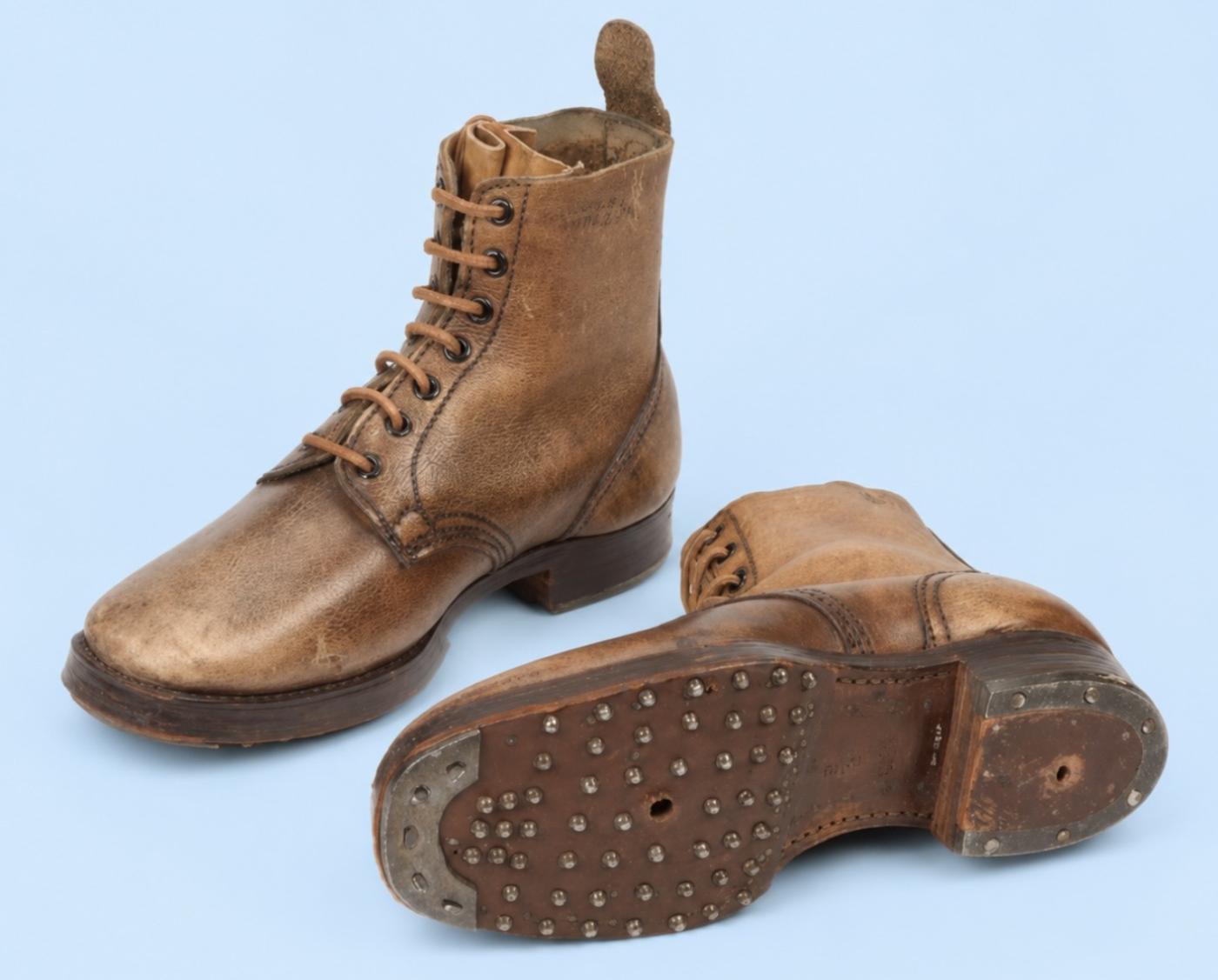
The B5 pattern was part of the Army’s answer to these conditions. It was a strong ankle boot with a broad, practical shape. It was usually made from brown leather, often with the rough side facing outwards. This rough-out finish may look unfinished today, but it made sense. It took grease and dubbin well, resisted scuffs, and did not need to be polished like a parade boot. A soldier could work dressing into the leather to help protect it from water and mud.
The toe was broad and blunt, giving the foot room. That mattered on long marches, when feet swelled and socks bunched. A tight boot could become torture. The boot came only to the ankle, so it used less leather than a high boot and could be made more quickly. It was worn with puttees wrapped around the lower leg, giving the British soldier one of the most recognisable looks of the Great War.
The front was laced, and the tongue was partly enclosed to help keep out grit, dirt and water. No boot could keep a man completely dry in the worst trench conditions, but every small protection helped. Once mud got inside, it could rub the foot raw.
The sole was one of the most important parts. It was made from thick leather and fitted with metal studs or hobnails. These gave grip and helped the sole last longer. On stone or cobbles they made a hard clattering sound, and on smooth surfaces they could be slippery, but on rough ground, muddy tracks and broken roads they were very useful. The heel was also strongly built, often with metal fittings and nails.
A pair would feel stiff, heavy and solid compared with modern footwear. Comfort, as we understand it now, was not the main idea. The Army wanted boots that could be mass-produced, repaired and used hard. Soldiers already carried rifles, ammunition, packs, water bottles, gas masks, entrenching tools and greatcoats. Heavy boots were another burden, but also part of their protection.
The name B5 belonged to a pattern, not a single maker. Many British bootmakers were involved because the Army needed millions of pairs. Northamptonshire was especially important, as it was one of Britain’s great centres of boot and shoe manufacture. Other firms across the country also took part. They had to follow official standards and pass inspection, though small differences in leather shade, eyelets, soles and markings could still appear.
Known names connected with surviving examples include John Blunston & Sons and William Lennon & Co of Stoney Middleton in Derbyshire. William Lennon is especially interesting because the firm has preserved old bootmaking methods and is still associated with this pattern today. Its modern reproduction is based on an original pair and uses the old square-toe last shape. A last is the foot-shaped form around which a boot is made, and it controls the final shape.
The making of each pair involved many skilled hands. Leather was selected and cut, the upper pieces were stitched together, eyelets were fitted, and the boot was shaped over the last. The thick leather sole was attached, the heel built up, and the hobnails driven in. The finished boots were inspected, paired, packed and sent into the military supply system. Women played a major part in this factory work as more men joined the forces.
Once issued, the soldier had to look after them. Leather needed grease, dubbin or oil to stay supple and resist water. If soaked boots were dried too quickly near heat, they could harden and crack. Foot inspections were common because officers and NCOs knew that bad feet could weaken a unit quickly. A man who could not march became a problem for everyone.
Trench foot was one of the great dangers. It came from long exposure to cold, wet and filthy conditions. Strong boots helped, but they were not enough on their own. Men needed dry socks, foot care and rest, which were not always possible. Even the best footwear could not completely defeat the mud of Flanders.
These boots were often called ammunition boots, or ammo boots, a term used for British military service boots. The name came from the army supply system, not because the boots carried ammunition. Their hobnails gave them a distinctive sound, the hard metallic clatter of marching men on roads, yards and cobbles.
Original examples are now rare because they were working objects. They were worn out, repaired, reissued, thrown away or used long after the war. Unlike medals or photographs, old boots were not often kept as family treasures. Surviving pairs are valuable because they show the real shape, materials and workmanship of the footwear soldiers actually used.
There is sometimes confusion between this pattern and earlier British Army boots such as the B2. That is understandable because they belonged to the same family of wartime service footwear. The differences can be small and technical, involving toe shape, sole detail, leather finish and construction. What matters most is that the B5 represents a later, practical wartime pattern for other ranks.
The boot’s importance lies in its plainness. It was not glamorous, famous or decorative. It was brown leather, stitching, nails, studs and hard wear. Yet without boots like this, soldiers could not move, fight or endure the conditions they faced. Armies depend on ordinary things as much as famous ones, and footwear was one of the most ordinary and most essential of all.
The clearest answer is that the B5 army boot was designed by requirement rather than by a named designer. The British Army, through War Office standards, created the specification, and British bootmaking firms produced it under contract. Its story belongs to the leather workers, cutters, stitchers, finishers, inspectors, depot staff and quartermasters who helped keep the Army supplied.