
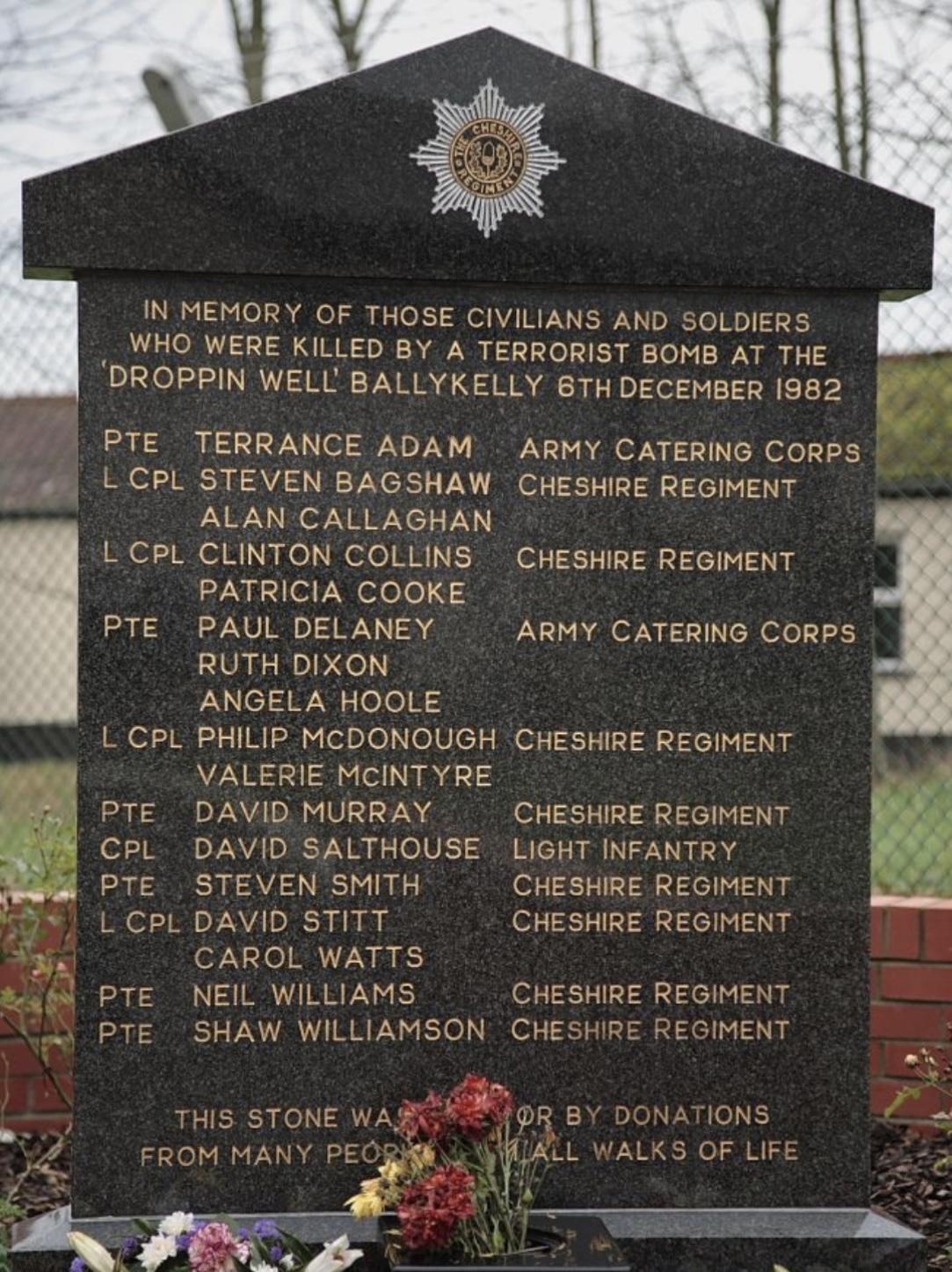
Droppinwell Bombing
The Ballykelly bombing, more commonly known as the Droppin Well bombing, was one of the most lethal attacks of the Troubles in County Londonderry, Northern Ireland. It took place late on the night of 6 December 1982, when a time bomb exploded inside the Droppin Well bar and disco in the small garrison village of Ballykelly. The attack was carried out not by the Provisional IRA, but by the Irish National Liberation Army (INLA), a smaller republican paramilitary group that had split from the Official IRA in the 1970s.
Ballykelly lay close to Shackleton Barracks, a major British Army base. The Droppin Well was a popular social venue where local civilians and off-duty soldiers mixed, especially on pay nights. On the evening of the bombing there were around 120–150 people in the bar and disco area, many of them soldiers from the Cheshire Regiment, Army Catering Corps and the Light Infantry, alongside local young men and women from the surrounding towns.
The bomb itself was assembled by an INLA unit based in nearby Derry. Later accounts said that INLA members had carried out several reconnaissance visits to the pub to check how many soldiers tended to be present and to decide whether, in their view, the presence of soldiers justified the risk of heavy civilian casualties. Royal Ulster Constabulary investigators later concluded that the device contained around 5 lb of commercial Frangex explosives, small enough to be carried into the building in a handbag or small box. It was placed close to a load-bearing pillar in the function room, an evidently deliberate choice intended to maximise structural damage.
At about 11.15 p.m. the bomb detonated without warning. The blast and the collapse of the roof and heavy masonry did most of the killing. The front of the building was torn open and the disco area collapsed on top of those inside. Survivors described sudden darkness, choking dust, screams and chaos as people lay buried in rubble or trapped under beams. Rescue efforts involving local residents, soldiers from Shackleton Barracks, fire crews and ambulance teams continued through the night.
Seventeen people were killed: eleven off-duty British soldiers and six civilians. Dozens more were injured, many seriously, including patrons who suffered burns, fractures, crush injuries and trauma from falling debris. The soldiers who died were from units stationed at Shackleton Barracks, and many were in their teens or early twenties.
Responsibility for the attack was claimed by the INLA’s political wing, the Irish Republican Socialist Party, soon after the explosion. The organisation later claimed the target had been off-duty soldiers they considered “legitimate targets,” though the high civilian toll drew widespread condemnation. Among those believed to have been involved in planning or authorising the attack were senior INLA members based in Derry at the time, including Dominic McGlinchey, who had risen to prominence within the organisation. McGlinchey was later arrested and questioned about the bombing, though he was not convicted for it. Several other INLA operatives were suspected of involvement, but securing prosecutions proved difficult due to lack of direct evidence and the reluctance of witnesses to come forward.
The British government and security forces described the attack as an atrocity deliberately designed to cause mass casualties among young soldiers and civilians. It intensified security operations in the northwest and reinforced public pressure on paramilitary groups. For the local community, the bombing left a deep and lasting trauma. Memorials and annual acts of remembrance continue to honour the victims, while the ruins of the Droppin Well were eventually rebuilt as part of efforts to restore the life of the village after one of the darkest nights of the Troubles.