Dog Fight
By January 1973 the air war over Vietnam was drawing to a close. After years of intense jet combat between American fighters and North Vietnamese MiGs, U.S. involvement was ending and a ceasefire was close at hand. Even so, the skies were not completely quiet. On 12 January 1973, a brief but historic encounter took place that would become the final air-to-air victory of the Vietnam War.
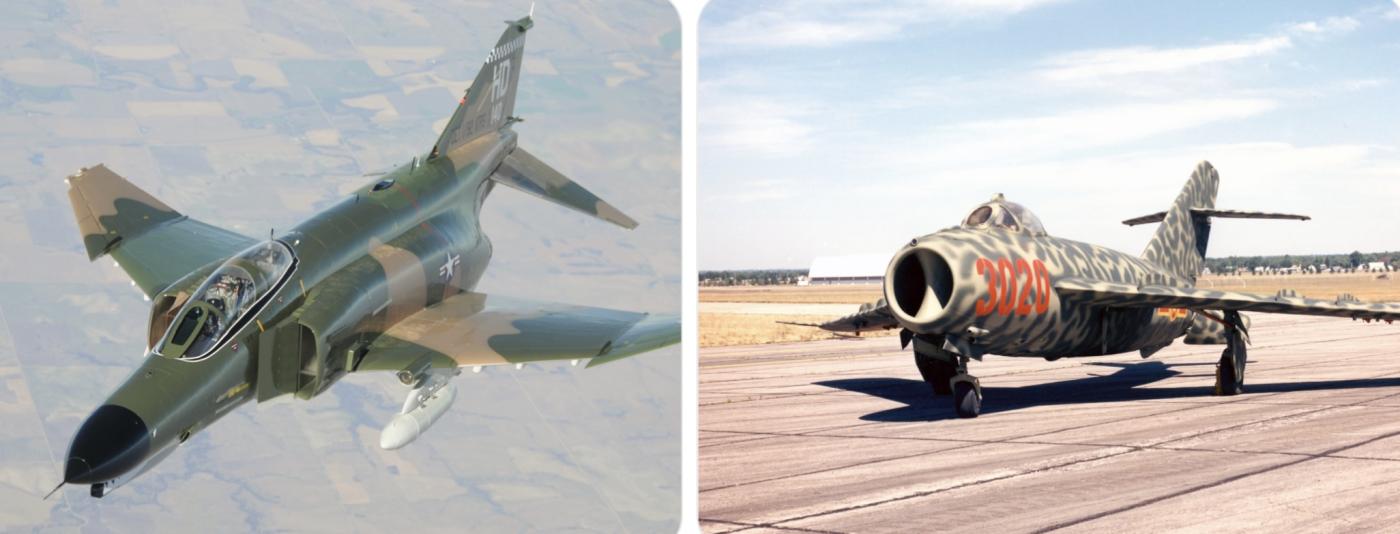
The aircraft involved was the F-4 Phantom II, the main American fighter of the conflict. Since the mid-1960s, the Phantom had flown thousands of missions over Southeast Asia and had faced every type of North Vietnamese fighter. It was fast, heavily armed, and flown by a two-man crew, and it accounted for most American air-to-air victories during the war.
On that day, two U.S. Navy Phantoms from Fighter Squadron VF-161, known as the Chargers, were flying a combat air patrol mission from the aircraft carrier USS Midway in the Gulf of Tonkin. Their task was to protect other aircraft and guard against any enemy fighters that might appear.
During the patrol, the Phantom crew detected a North Vietnamese MiG-17. Although the MiG-17 was an older design and slower than the Phantom, it was highly maneuverable and had proved dangerous earlier in the war, particularly in close-range dogfights. Many American pilots regarded it as a capable and resilient opponent.
The Navy Phantom closed in and engaged the MiG. After a short aerial fight, the Phantom successfully shot it down. The American crew were Lieutenant V. T. Kovaleski, the pilot, and Lieutenant J. A. Wise, the radar intercept officer. The MiG-17 was flown by a pilot of the North Vietnamese air force, though his name was never publicly confirmed.
This shootdown became the last confirmed air-to-air kill of the Vietnam War. It was also the final time an American aircraft destroyed an enemy fighter in aerial combat during the conflict. Over the course of the war, U.S. Navy and Air Force pilots achieved nearly two hundred air-to-air victories against North Vietnamese aircraft, with the F-4 Phantom responsible for the majority of them. These victories came against MiG-17s, MiG-19s, and MiG-21s in engagements that stretched from 1965 to 1973.
What makes this final kill especially notable is how late it occurred. Only days later, the Paris Peace Accords came into effect, ending direct U.S. combat operations over North Vietnam. After years of dogfights, missile launches, and close-in aerial battles, this brief encounter quietly closed the chapter on American air combat in the war.
The event also marked the end of an important era in military aviation. The Vietnam War revealed major flaws in early jet combat doctrine and led to lasting changes in training, tactics, and aircraft design. Lessons learned from Phantom versus MiG combat influenced future fighter development and reshaped how air forces prepared pilots for aerial warfare.
On a winter day in January 1973, high above Vietnam, one last clash between a Phantom and a MiG brought the long air war to its conclusion. After that moment, the fighting in the skies ended, and one of the most intense periods of jet-to-jet combat in history passed into memory.