On this day in military history…
Operation Mercury was one of the most extraordinary and dangerous operations of the Second World War. In May 1941 Germany launched the first full-scale invasion in history carried out mainly by airborne troops. Never before had an entire army been dropped from the sky to capture an island defended by tens of thousands of Allied soldiers. The invasion of Crete shocked the world and changed military warfare forever.
The German codename was Unternehmen Merkur, or Operation Mercury, named after the Roman messenger god Mercury. The operation began on 20 May 1941 and lasted until 1 June. Although Germany eventually captured Crete, the cost was so horrific that Adolf Hitler never again approved another massive airborne invasion.
The man behind the operation was General Kurt Student, commander of Germany’s elite Fallschirmjäger paratroopers. Student believed airborne troops could strike deep behind enemy lines, seize vital objectives and cause total confusion before defenders could react. German paratroopers had already achieved impressive successes earlier in the war in Norway, Holland and Belgium, especially during the capture of the Belgian fortress of Eben-Emael. But Crete was on an entirely different scale.
After Germany conquered mainland Greece in April 1941 the island of Crete remained in Allied hands. The island sat in a vital position in the eastern Mediterranean. From Crete the British could threaten German and Italian shipping and potentially attack the Romanian oil fields that supplied much of Germany’s fuel. Hitler wanted the island neutralised before launching Operation Barbarossa, the invasion of the Soviet Union.
The German invasion force was huge for an airborne assault. Around 22,000 German troops took part. The core of the invasion was made up of about 10,000 Fallschirmjäger paratroopers from the elite 7th Air Division. Around 750 glider troops would land in assault groups while another 5,000 mountain troops from the 5th Mountain Division were ready to be flown in once airfields were secured. Thousands more troops were intended to arrive by sea.
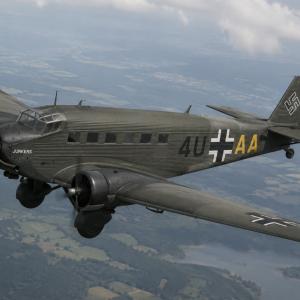
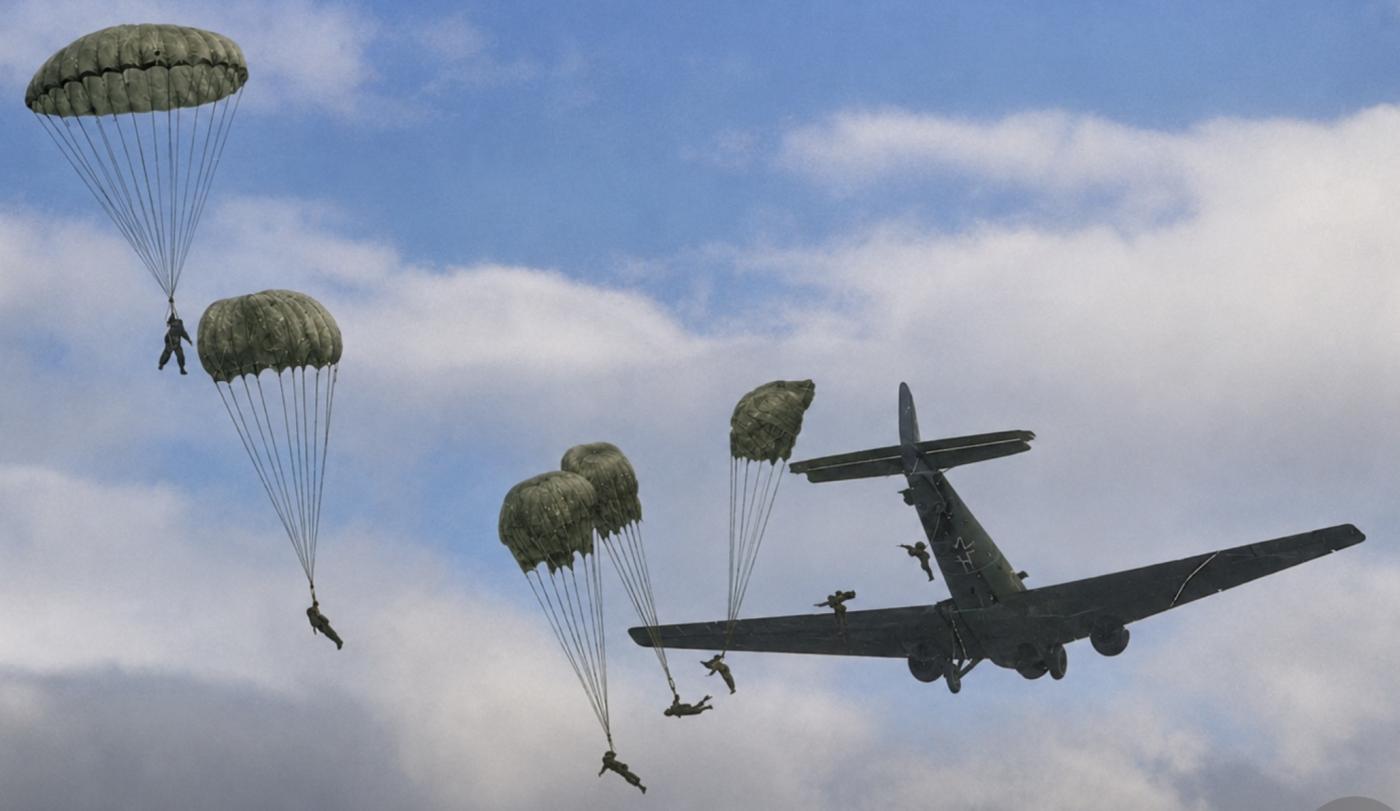
The Germans used over 500 Junkers Ju 52 transport aircraft, the famous three-engined planes that became one of the symbols of the war. Slow and vulnerable but reliable, the Ju 52 carried paratroopers, weapons and supplies. The Germans also used DFS 230 assault gliders which silently landed troops directly onto objectives. These gliders carried heavily armed assault teams who could attack before defenders fully realised what was happening.
Supporting the invasion was the full power of the Luftwaffe. German Messerschmitt Bf 109 fighters controlled the skies while Junkers Ju 87 Stuka dive bombers pounded Allied positions day and night. The Germans knew complete air superiority was essential because the invasion depended entirely on reinforcing troops quickly once they landed.
The invasion force was divided into several groups. One force targeted Maleme airfield in western Crete, the single most important objective on the island. Others attacked Chania and Souda Bay while eastern forces assaulted Heraklion and Rethymno. Everything depended on capturing an airfield quickly enough for reinforcements to land.
The Allied defence of Crete was commanded by General Bernard Freyberg, a New Zealander famous for his bravery during the First World War where he had won the Victoria Cross. Freyberg commanded around 40,000 Allied troops known collectively as Creforce. These included British, Australian and New Zealand soldiers together with Greek troops.
Many Allied soldiers had only recently escaped from mainland Greece after the German invasion there. They had lost much of their heavy equipment during evacuation. There were very few tanks, shortages of ammunition and almost no modern aircraft left to defend the island. Greek troops were often armed with old rifles dating back to the First World War.
Despite these weaknesses the Allies possessed one enormous advantage. British intelligence had broken German Enigma codes and knew an airborne invasion was coming. Freyberg knew the Germans would target the airfields, especially Maleme. However one of the great controversies of the battle was how the defence was organised. While strong forces defended the airfields themselves, the high ground overlooking Maleme airfield, especially Hill 107, was not fully secured.
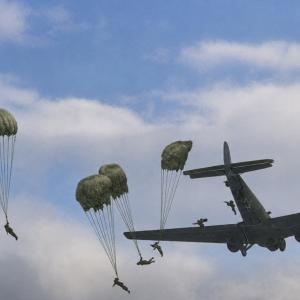
At dawn on 20 May 1941 the invasion began with a massive German bombing campaign. Stuka dive bombers screamed down onto Allied positions while transport aircraft appeared in enormous formations overhead. Witnesses described the sky turning black with aircraft. Then the parachutes began opening.
Thousands of German paratroopers dropped onto Crete under intense fire. Many were armed only with pistols and grenades because heavier weapons were dropped separately in containers. This proved disastrous. Paratroopers landed scattered across olive groves, vineyards and rocky hillsides while Allied troops shot at them from prepared positions. Many Germans were killed before even reaching the ground.
The first day was close to catastrophe for Germany. Entire groups of Fallschirmjäger were wiped out almost immediately. Some landed directly into enemy strongpoints. Others drowned in reservoirs or became tangled in trees. Gliders crashed under fire. German casualties mounted at a terrifying rate.
At Heraklion and Rethymno the Allied defenders fought brilliantly and contained the airborne assault. In many places isolated German units clung desperately to defensive positions waiting for reinforcements that never came.
One of the most remarkable features of the battle was the fierce resistance from ordinary Cretan civilians. Men, women and even children attacked German paratroopers using hunting rifles, kitchen knives, axes, farming tools and stones. Villagers joined the fighting wherever Germans landed. The Germans had not expected civilians to resist so violently and were deeply shocked by it.
The turning point came at Maleme airfield. Fighting around Hill 107 was savage and confused. Due to poor communication and uncertainty about the situation, New Zealand defenders withdrew from the hill during the night. This decision proved fatal. Once the Germans occupied the heights overlooking Maleme they gained control of the airfield.
Although Allied artillery still fired on the runway, German Ju 52 transports began landing reinforcements under extremely dangerous conditions. Some aircraft crashed or were destroyed while unloading troops, but enough survived to bring in the battle-hardened mountain troops of the 5th Mountain Division. Once these reinforcements arrived the balance of the battle shifted dramatically.
German air superiority now became overwhelming. Allied troops could barely move during daylight without being attacked by fighters and dive bombers. The Luftwaffe dominated the skies completely. German reinforcements steadily built up while Allied strength slowly weakened.
The Royal Navy fought desperately to protect Crete and stop German reinforcements arriving by sea. British cruisers and destroyers intercepted German convoys and destroyed many invasion boats. But the navy suffered terribly from constant Luftwaffe attacks. Several warships were sunk while others were heavily damaged. The Mediterranean Fleet endured one of the worst periods in its history during the battle.
As German troops pushed eastward across Crete the Allied defence gradually collapsed. Chania fell and the remaining Allied forces retreated south towards the evacuation beaches. Freyberg eventually ordered evacuation and Royal Navy ships rescued around 16,000 troops under constant air attack. Thousands more Allied soldiers were left behind and became prisoners of war.
German losses were appalling despite victory. Several thousand German troops were killed, wounded or missing. Entire Fallschirmjäger units were shattered and hundreds of transport aircraft were damaged or destroyed. Hitler was horrified by the scale of the casualties. He concluded that mass airborne invasions were simply too costly. After Crete Germany never again attempted another operation on this scale using paratroopers.
Yet despite the losses Operation Mercury changed warfare forever. Military planners across the world studied the battle closely. Britain and the United States rapidly expanded their own airborne forces after seeing what airborne troops could achieve. Later operations such as the Normandy landings and Arnhem all drew lessons from Crete.
The battle proved both the incredible potential and terrifying danger of airborne warfare. Paratroopers could strike suddenly and seize key objectives but they were terribly vulnerable during the first hours after landing. Success depended on speed, surprise and air superiority.
Even today the invasion of Crete remains one of the most dramatic operations of the Second World War. For the first time in history an army fell from the sky to conquer an island, and for those who witnessed thousands of parachutes descending over Crete in May 1941 it must have seemed like the future of warfare had arrived in a single terrifying morning.