Cease resistance
During the Second World War the United States and its Allies fought not only with bombs, ships, and rifles, but also with words. One of the most fascinating examples of psychological warfare in the Pacific was the famous “I Cease Resistance” leaflet distributed to Japanese troops during the final years of the war. These leaflets were carefully designed to persuade Japanese soldiers to stop fighting without directly demanding that they “surrender.” The wording, appearance, and method of distribution reflected a deep understanding of Japanese military culture and the psychology of soldiers who had been taught that surrender was dishonorable.
The “I Cease Resistance” leaflet was produced by the Allied Psychological Warfare Branch operating under General Douglas MacArthur’s South West Pacific command. The branch was formally organised in 1944 and included military intelligence officers, translators, artists, printers, and Japanese language specialists. One of the key figures behind the programme was Brigadier General Bonner F. Fellers, who had spent years studying Japanese military culture and believed propaganda aimed at Japanese troops had to be truthful and respectful if it was going to work.
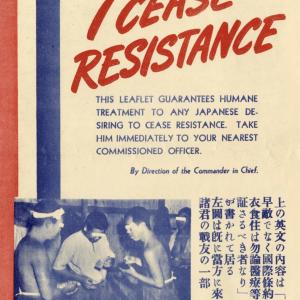
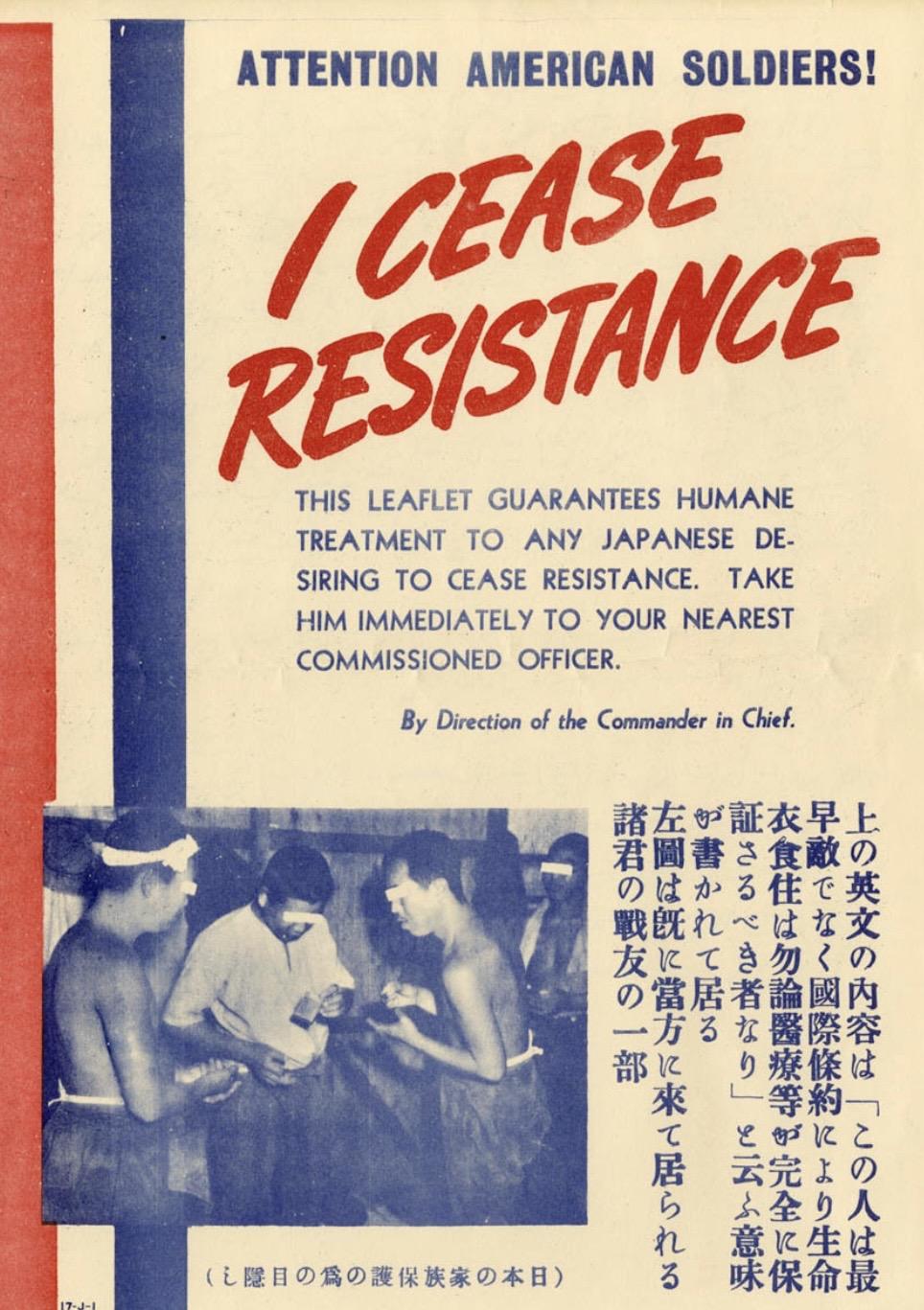
The leaflet itself usually looked like an official military document. Printed in Japanese, it often included instructions to Allied troops stating that the bearer should be treated properly under international law. Some versions acted almost like a safe conduct pass, giving Japanese soldiers proof that they wished to stop fighting. The wording reassured them they would not automatically be tortured or killed if they gave themselves up.
The reason the leaflet never used the word “surrender” was extremely important. Japanese soldiers had been indoctrinated from the beginning of their military training that surrender was shameful. Under the Imperial Japanese military code soldiers were expected to fight to the death rather than be captured. Many were taught that becoming a prisoner would disgrace not only themselves but also their families. American psychological warfare experts quickly realised that directly ordering Japanese soldiers to “surrender” would simply make many refuse automatically.
Instead they carefully chose softer phrases such as “cease resistance,” “stop fighting,” or “lay down your arms.” These words gave Japanese troops a way to save face psychologically. Rather than admitting dishonourable surrender, a soldier could think of himself as merely ending resistance because the situation had become hopeless. It was a subtle but brilliant understanding of Japanese military thinking.
The Americans also discovered that exaggeration and lies were usually ineffective against Japanese troops. If soldiers found out even one leaflet contained false information they would ignore future ones completely. Because of this many Allied leaflets were surprisingly factual. They often described genuine military defeats, shortages of food and ammunition, or the hopeless isolation of Japanese island garrisons. The aim was to slowly break morale by convincing troops the war could no longer be won.
The design of the leaflets was carefully planned as well. Many used formal Japanese writing styles and official-looking layouts to make them appear trustworthy. Some showed photographs of healthy Japanese prisoners receiving medical treatment, food, or cigarettes from Allied troops. Others included statements from captured Japanese soldiers encouraging their comrades to stop fighting while they still had the chance. This directly challenged Japanese propaganda which claimed Allied forces tortured or murdered prisoners.
Printing the leaflets became a massive operation. Millions were produced in Australia, the Philippines, and other Allied bases across the Pacific. Mobile printing presses travelled with advancing forces so new leaflets could be produced quickly as battles changed. The paper had to be light enough for aircraft drops but durable enough to survive tropical humidity and rough handling.
Distribution methods were varied and often ingenious. Aircraft were the most common delivery system. Bombers and transport planes dropped huge bundles over Japanese positions, jungle strongholds, caves, airfields, and occupied towns. Special artillery shells were even designed to burst in the air and scatter propaganda leaflets over enemy lines. Allied patrols sometimes left leaflets near tunnels, supply trails, or water sources where isolated Japanese troops were likely to find them.
Loudspeaker teams were also used during some battles. These units broadcast messages in Japanese while leaflets drifted down from aircraft overhead. In places like Okinawa, New Guinea, and the Philippines the propaganda campaigns often began before major attacks, with the intention of weakening enemy morale before the fighting even started.
The leaflets became increasingly effective as the war turned against Japan. Early in the conflict many Allied soldiers believed Japanese troops would never surrender under any circumstances. However, intelligence reports gradually showed that large numbers were willing to stop fighting if they believed they would survive captivity. As Japanese supply lines collapsed and isolated garrisons faced starvation, disease, and constant bombardment, the promises made in the leaflets became harder to ignore.
The Pacific War was exceptionally brutal and this made psychological warfare even more important. Japanese troops frequently fought to the death, launched suicidal banzai charges, or killed themselves rather than be captured. Allied soldiers meanwhile were often suspicious because Japanese forces sometimes pretended to surrender only to launch surprise attacks. The “I Cease Resistance” leaflet was partly designed to reduce this confusion by providing a recognised document that signalled genuine intentions.
By the final year of the war the leaflet campaigns focused heavily on the hopelessness of Japan’s military situation. They described destroyed Japanese fleets, overwhelming American industrial power, and the complete isolation of many island garrisons. Some informed troops that they had already been abandoned by their commanders. Others stressed that continuing resistance would only lead to pointless death.
Even after Japan formally surrendered in August 1945 leaflet operations continued. Allied aircraft dropped millions more papers across Asia and the Pacific informing both civilians and isolated Japanese troops that the war was truly over. This was necessary because some soldiers refused to believe Japan had surrendered and continued hiding in jungles or remote islands for years afterwards.
Today the “I Cease Resistance” leaflet is regarded as one of the most sophisticated examples of wartime psychological warfare ever produced. It showed that words and cultural understanding could sometimes achieve what bullets could not. Rather than simply demanding surrender, Allied planners created a message that worked within the mindset of Japanese soldiers themselves. By avoiding humiliating language and offering a path to survival without openly admitting disgrace, the leaflet gave thousands of men a way out of a hopeless war.