On this day in military history…
The First Arab–Israeli War, known in Israel as the War of Independence and to Palestinians as the Nakba, meaning “catastrophe,” was one of the most consequential conflicts of the twentieth century. It began in late 1947 and expanded into a full regional war on 15 May 1948, immediately after the declaration of the State of Israel. The conflict reshaped the Middle East, created the Palestinian refugee crisis, redrew borders, and established patterns of warfare and political hostility that still influence the region today.
The roots of the war stretched back decades before the first shots were fired. During the late nineteenth and early twentieth centuries, Zionist immigration to Ottoman and later British-controlled Palestine increased steadily. Jewish immigrants, many fleeing persecution in Europe, established agricultural settlements and urban communities. At the same time, the Arab population of Palestine increasingly feared displacement and political domination. Tensions rose sharply during the British Mandate period after the First World War.
Britain had promised support to both Arabs and Jews in contradictory wartime agreements. The 1917 Balfour Declaration endorsed the establishment of a “national home for the Jewish people” in Palestine, while Britain had also encouraged Arab independence movements against the Ottoman Empire. These conflicting promises created deep mistrust and periodic violence throughout the interwar years.
By the end of the Second World War, the situation became explosive. The Holocaust had murdered six million Jews in Europe and intensified international support for a Jewish homeland. Jewish underground militias such as the Haganah, Irgun, and Lehi fought both Arab forces and British authorities. Britain, exhausted and unable to control the violence, referred the Palestine issue to the United Nations.
On 29 November 1947, the United Nations approved Resolution 181, the Partition Plan for Palestine. The proposal divided the territory into separate Jewish and Arab states while placing Jerusalem under international administration. Jewish leaders accepted the plan despite dissatisfaction with some borders. Arab leaders rejected it entirely, arguing that it unfairly allocated more land to the Jewish minority population.
Civil war erupted almost immediately between Jewish and Arab communities inside Palestine. From December 1947 to May 1948, the conflict was primarily an internal struggle. Arab irregular forces, local militias, and volunteers from neighboring countries attacked Jewish convoys, settlements, and urban districts. Jewish forces responded with increasingly organized military operations.
One of the earliest and most important struggles centered on the roads leading to Jerusalem. Jewish neighborhoods in the city were vulnerable because Arab forces controlled the surrounding hills and ambushed supply convoys. Food, medicine, and ammunition became desperately scarce. The battle for Jerusalem became symbolic as well as strategic, with both sides viewing the city as essential.
The Haganah gradually transformed itself from a defensive militia into an organized army. Jewish forces launched Operation Nachshon in April 1948 to break the siege of Jerusalem. This marked a major turning point because it demonstrated growing Jewish military coordination and offensive capability.
During this period, one of the most controversial events of the war occurred at the Arab village of Deir Yassin on 9 April 1948. Fighters from Irgun and Lehi attacked the village near Jerusalem, killing over one hundred villagers according to most estimates. News of the massacre spread rapidly throughout Palestine, creating fear and panic among Arab civilians. Many historians believe the psychological impact of Deir Yassin accelerated the flight of Palestinian Arabs from contested areas.
At the same time, Jewish communities also suffered severe attacks. One particularly notorious incident was the Hadassah medical convoy massacre on 13 April 1948, in which Arab fighters ambushed a convoy traveling to a hospital on Mount Scopus in Jerusalem, killing doctors, nurses, patients, and guards.
As British forces prepared to withdraw, both sides rushed to seize territory. The final weeks before Israeli independence saw intense fighting in cities such as Haifa, Jaffa, Safed, and Tiberias. Many Arab residents fled these urban areas due to fear, direct expulsions, combat conditions, or expectations of returning after Arab victory.
On 14 May 1948, David Ben-Gurion proclaimed the establishment of the State of Israel in Tel Aviv. The declaration came just hours before the British Mandate officially ended. The United States recognized Israel within minutes, while the Soviet Union recognized it shortly afterward.
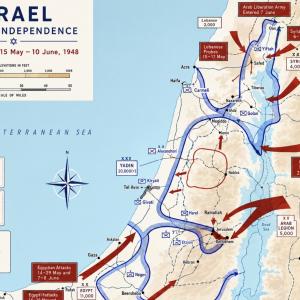
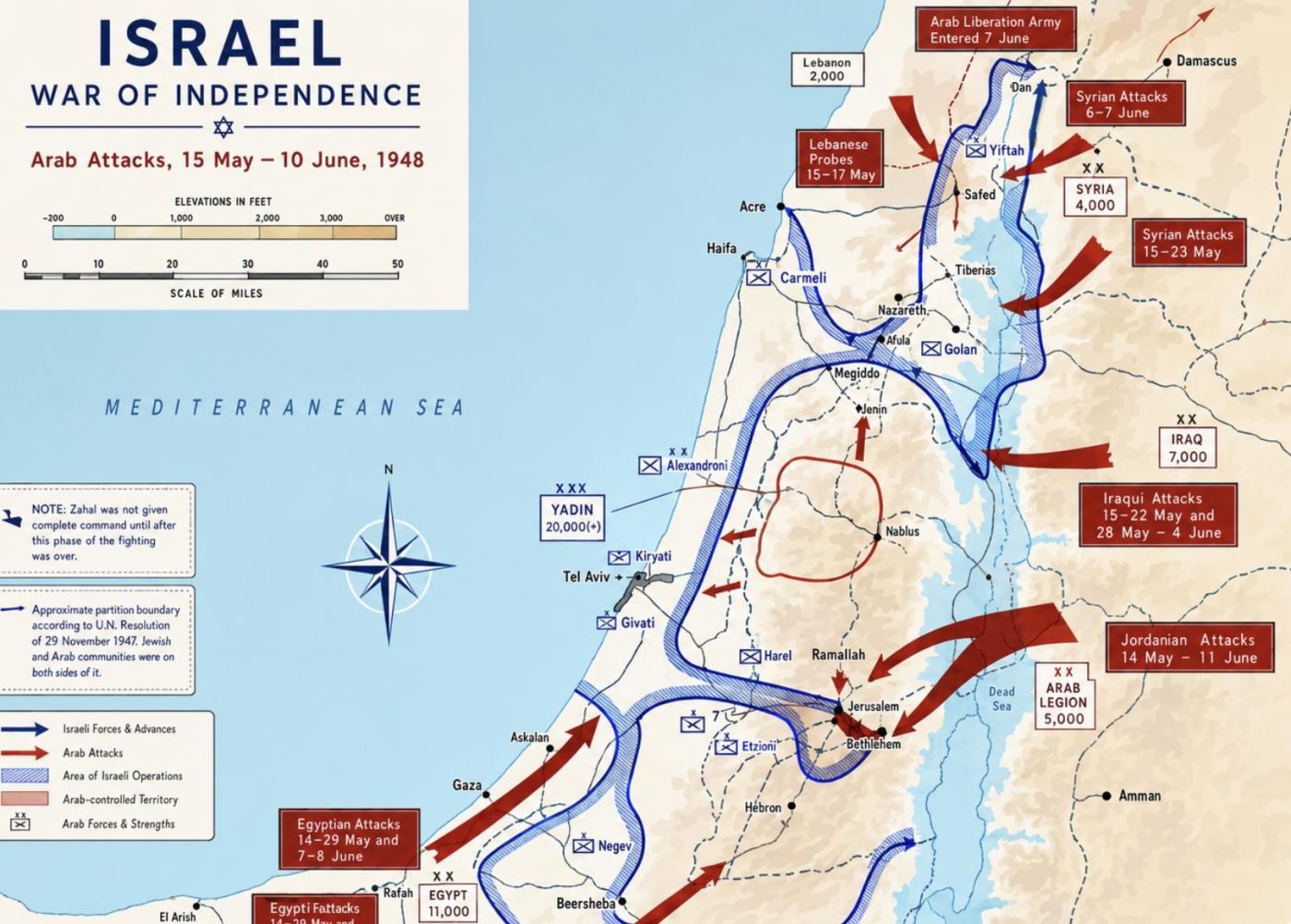
The next day, 15 May 1948, armies from Egypt, Transjordan, Syria, Lebanon, and Iraq invaded the former Mandate territory. Saudi Arabian and Yemeni forces also contributed smaller contingents. The Arab states declared that they were intervening to restore order and support Palestinian Arabs.
The invasion marked the transition from civil war to international war.
Despite widespread assumptions that the Arab armies would quickly destroy the new Israeli state, the situation was more complicated. The Arab coalition lacked unified command, strategic coordination, and shared political objectives. Each Arab state pursued its own interests. King Abdullah of Transjordan, for example, was more interested in annexing the Arab parts of Palestine than destroying Israel outright.
Transjordan’s Arab Legion, commanded by British officer Sir John Glubb, known as Glubb Pasha, was considered the most professional Arab force. It captured the Jewish Quarter of Jerusalem’s Old City after fierce fighting. Jewish defenders eventually surrendered, and many ancient synagogues were destroyed or damaged.
Egyptian forces advanced northward along the Mediterranean coast and through the Negev desert. Syrian troops attacked from the northeast near the Sea of Galilee, while Iraqi forces entered through the Jordan Valley.
Israel faced enormous disadvantages initially. The new state had limited heavy weapons, few aircraft, and shortages of trained soldiers. Many fighters were recent Holocaust survivors who had arrived only months earlier. Yet Israeli forces possessed advantages in organization, motivation, and interior supply lines.
A crucial factor in Israel’s survival was clandestine arms procurement. Czechoslovakia, acting with Soviet approval, supplied rifles, machine guns, ammunition, and aircraft to Israel. These shipments significantly strengthened Israeli military capacity at a critical moment.
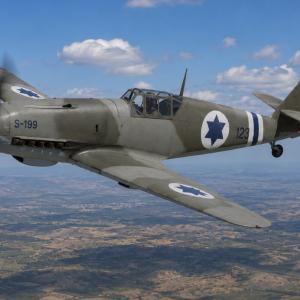
One fascinating episode involved improvised Israeli air power. Israel’s first combat aircraft included Avia S-199 fighters, Czech-built versions of the German Messerschmitt Bf 109. Pilots often hated them because they were difficult to control and mechanically unreliable. Nevertheless, these aircraft helped halt the Egyptian advance toward Tel Aviv during the war’s opening days.
The war also witnessed the birth of the Israeli Air Force under extraordinary conditions. Some volunteer pilots were foreign veterans from the United States, Britain, South Africa, and Canada. Many had fought during the Second World War. These volunteers became known as Machal, short for “volunteers from abroad.”
Several truces interrupted the fighting during 1948. The first UN-mediated ceasefire began on 11 June. During these pauses, both sides rearmed and reorganized. Israel used the ceasefires particularly effectively to train troops, import weapons, and consolidate command structures into the Israel Defense Forces, officially established on 26 May 1948.
One dramatic internal crisis during the war involved the Altalena Affair in June 1948. The Irgun militia attempted to bring a ship loaded with weapons into Israel independently of the new government. Ben-Gurion ordered the army to seize the ship to enforce state authority over all armed groups. Fighting broke out between Jewish factions, and the Altalena was shelled off the coast of Tel Aviv. The incident nearly sparked civil war within Israel but ultimately strengthened centralized military control.
As the war progressed, Israeli forces increasingly gained the initiative. Operations such as Dani, Yoav, Hiram, and Horev expanded Israeli-held territory beyond the original UN partition borders.
Operation Dani in July 1948 captured the towns of Lydda and Ramle. Large numbers of Palestinian Arabs fled or were expelled during the operation. The broader refugee crisis became one of the defining outcomes of the war. By the conflict’s end, around 700,000 Palestinian Arabs had become refugees. Some fled combat zones voluntarily, others were expelled, and many left due to fear of massacres or collapse of local leadership. Their descendants today number in the millions across the Middle East.
Meanwhile, Jewish communities in Arab-controlled areas were also displaced. Jews living in East Jerusalem, the West Bank, Gaza, and some Arab countries faced expulsions, violence, or pressure to emigrate in the following years.
The fighting in the Negev desert was especially harsh. Israeli forces conducted daring long-range operations against Egyptian positions. One famous engagement occurred at Kibbutz Yad Mordechai, where vastly outnumbered defenders delayed the Egyptian army for several days, buying critical time for Israeli mobilization.
In the north, Operation Hiram in October 1948 drove Arab Liberation Army forces out of Galilee. Israeli troops reached the Lebanese border and secured the entire region.
The war formally ended through a series of armistice agreements signed in 1949 between Israel and Egypt, Lebanon, Jordan, and Syria. No permanent peace treaties were signed. The resulting ceasefire lines became known as the Green Line.
Israel emerged from the war controlling approximately 78 percent of former Mandatory Palestine, substantially more territory than allocated under the UN Partition Plan. Jordan annexed the West Bank and East Jerusalem, while Egypt controlled the Gaza Strip.
Jerusalem remained divided for nearly two decades. West Jerusalem was controlled by Israel, while East Jerusalem, including the Old City, remained under Jordanian rule.
The casualty figures remain debated, but approximately 6,000 Israelis died, nearly one percent of the Jewish population at the time. Arab military and civilian losses were significantly higher.
The war produced enduring legends and myths on all sides. Israelis viewed it as a miraculous struggle for survival against overwhelming odds. Palestinians remembered it as a national disaster marked by dispossession and exile. Arab governments often blamed each other for defeat, leading to political instability across the region.
The conflict also transformed military doctrine in the Middle East. Israel concluded that rapid mobilization, offensive initiative, intelligence superiority, and preemptive action were essential for survival. These lessons shaped Israeli strategy in later wars.
One lesser-known fact is that several future world leaders participated directly in the war. Yitzhak Rabin served as a young commander during the fighting and later became Israeli prime minister. Ariel Sharon also fought as a junior officer. On the Arab side, young officers observing the defeat included future Egyptian president Gamal Abdel Nasser, whose experiences deeply influenced the rise of Arab nationalism.
Another intriguing aspect was the international dimension. Both the United States and the Soviet Union briefly supported Israel’s creation, an unusual moment of agreement during the early Cold War. Yet this alignment soon changed as regional politics evolved.
The First Arab–Israeli War did not truly resolve the conflict over Palestine. Instead, it created the foundation for future wars in 1956, 1967, 1973, and beyond. The refugee issue, status of Jerusalem, border disputes, and mutual distrust remained unresolved. More than seventy-five years later, the legacy of the war continues to shape politics, identity, and conflict throughout the Middle East.