
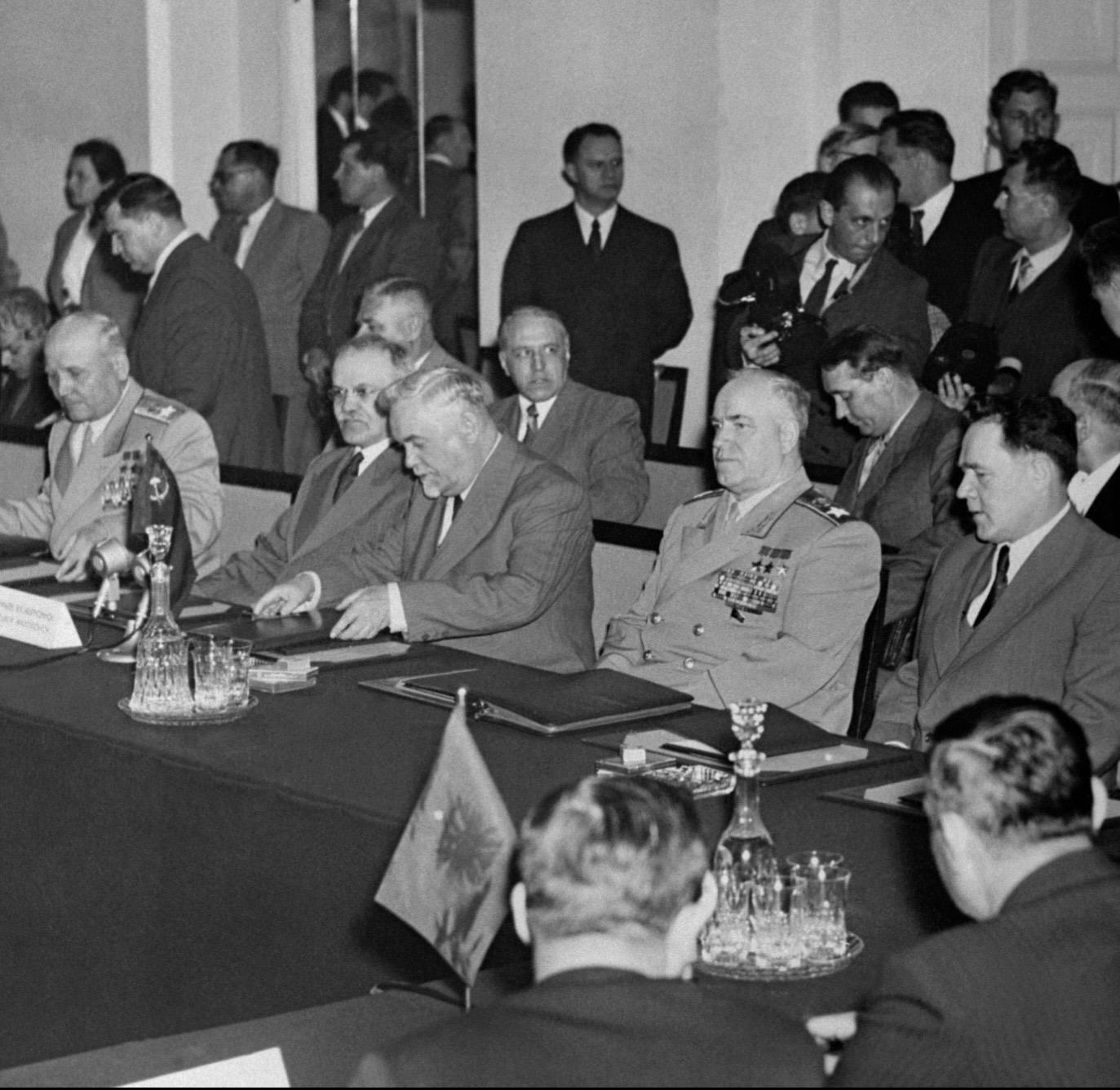
Warsaw Pact Formed
The Warsaw Pact was one of the most powerful military alliances of the Cold War, created at a time when the world was divided between communist East and capitalist West. Officially called the Treaty of Friendship, Cooperation and Mutual Assistance, it was established on 14 May 1955 in Warsaw, the capital of Poland. Leaders from the Soviet Union and several Eastern European communist nations gathered there to sign the agreement, creating a united military alliance under Soviet leadership.
The countries that joined included the Soviet Union, Poland, East Germany, Czechoslovakia, Hungary, Romania, Bulgaria and Albania. Together they became known as the Eastern Bloc. Although Albania later withdrew, the alliance remained a major force in world politics for many years.
The alliance was mainly formed in response to the growing strength of NATO, which had been created in 1949 by Western nations such as the United States, Britain and France. Tension between East and West had increased sharply after the Second World War, and both sides feared attack from the other. The Soviet Union became especially alarmed when West Germany was allowed to rearm and join NATO in 1955. Soviet leaders still remembered the destruction caused by Germany during the war and saw this as a serious threat.
To communist governments, the alliance was presented as a defensive shield that would protect socialist countries and maintain peace in Eastern Europe. In Western nations, however, many viewed it as a sign that the Soviet Union wanted tighter control over its neighbouring states. The agreement allowed Soviet troops to remain across Eastern Europe and placed member armies under Soviet influence, giving Moscow enormous power in the region.
As Cold War tensions grew, both sides built massive armies and stockpiled nuclear weapons. Europe became divided into two armed camps facing each other with suspicion and fear. Although a direct war between the superpowers never happened, the world lived under the constant threat of conflict.
The alliance also became a tool for keeping communist governments in power. In 1956, Soviet-led troops entered Hungary after an uprising against communist rule. Thousands were killed as the rebellion was crushed. A similar event happened in 1968 during the Prague Spring in Czechoslovakia, when troops invaded to stop political reforms and restore strict communist control. These actions damaged the alliance’s image internationally and showed that the Soviet Union would use force to maintain its influence.
By the 1980s, communist governments across Eastern Europe were struggling with economic problems and growing public anger. Calls for democracy spread quickly, and Soviet control weakened. The fall of the Fall of the Berlin Wall in 1989 became a powerful symbol that the Cold War division of Europe was ending.
The alliance officially dissolved on 1 July 1991 in Prague, only months before the collapse of the Soviet Union itself. Its disappearance marked the end of a long period of political tension that had shaped global affairs for decades.
Today, it is remembered as one of the clearest symbols of the Cold War. To some, it represented protection and unity among communist nations. To others, it stood for Soviet domination and the division of Europe. Its history remains an important reminder of how fear, ideology and military power influenced the modern world.