On this day in military history…
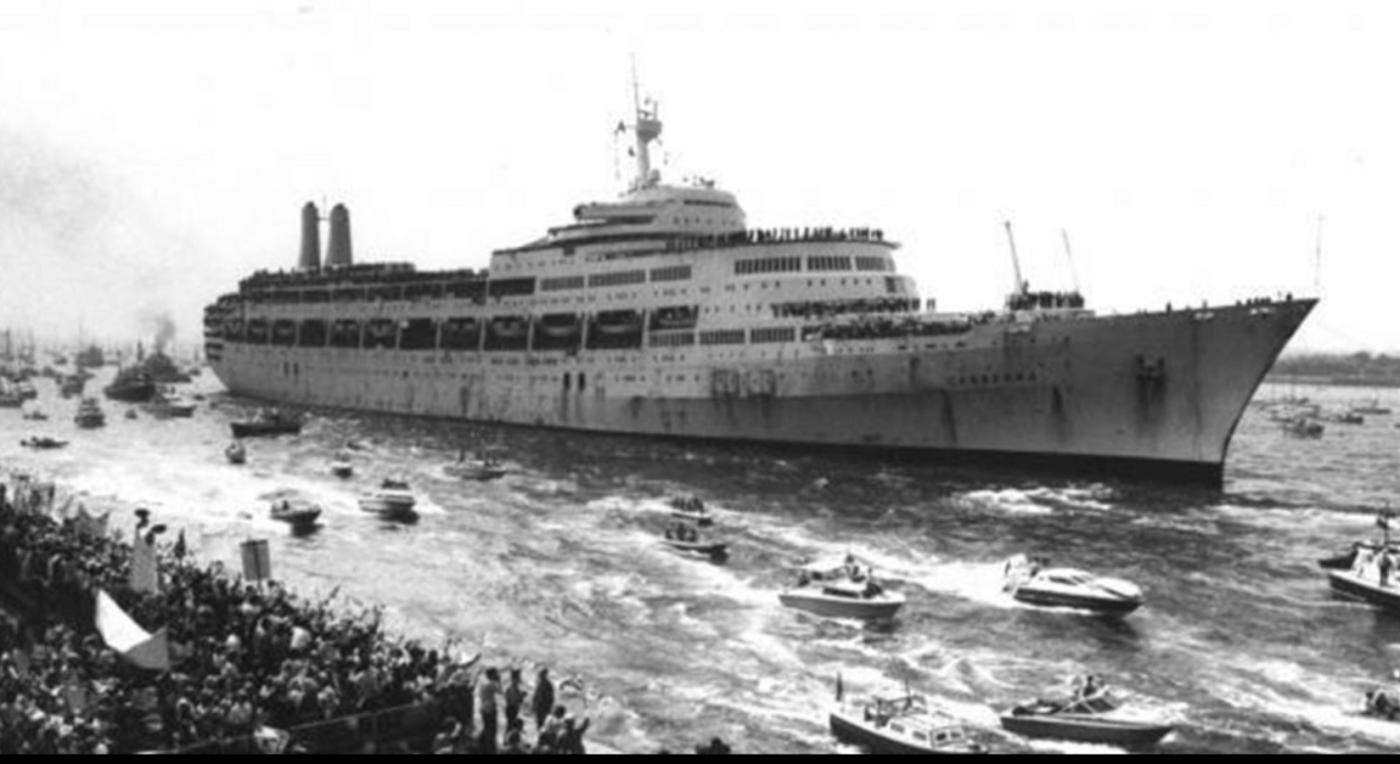
The departure of the P&O liner SS Canberra on 9 April 1982 marked one of the most important early movements of the Falklands campaign, when Britain’s front-line ground forces—Royal Marines commandos and Parachute Regiment troops—began their long journey south. Although often associated with the wider naval mobilisation centred on Portsmouth, Canberra herself sailed from Southampton after being rapidly converted from a cruise liner into a troopship, while Portsmouth continued to dispatch warships and supporting vessels assembling the task force.
In the days following the Argentine invasion on 2 April, Canberra was requisitioned and brought into Southampton, where shipyard workers and naval personnel worked around the clock to prepare her for war. Luxury fittings were removed or adapted, additional communications equipment installed, and her vast passenger spaces reorganised to accommodate troops, equipment, and supplies. Helicopter operations were improvised, allowing her to function in a limited amphibious role despite being a civilian vessel.
On 9 April she sailed carrying a major portion of 3 Commando Brigade. Embarked aboard were 40 Commando Royal Marines, 42 Commando Royal Marines, and the 3rd Battalion, Parachute Regiment. These units formed the core of Britain’s amphibious assault force. In addition to the fighting troops, Canberra also carried brigade headquarters staff, signallers, logistics personnel, and naval detachments.
In total, approximately 3,000 to 3,200 personnel were aboard. Each of the main combat units contributed around 600 to 700 men, with the remainder made up of supporting elements essential for command, communications, and sustainment. Vehicles, ammunition, and stores were packed into every available space, though Canberra could not carry everything required for a sustained campaign.
Sailing alongside Canberra was the merchant vessel MV Elk, heavily loaded with around 2,000 tons of ammunition and military supplies. This pairing of troopship and supply vessel reflected the improvised yet highly coordinated nature of the early task force deployments, where civilian ships were pressed into service to augment naval capability.
The departure came at a time of intense activity across southern England’s naval ports. Just days earlier, on 5 April, the main naval task force had sailed from Portsmouth, including the aircraft carriers HMS Hermes and HMS Invincible, escorted by destroyers, frigates, and Royal Fleet Auxiliary vessels. Amphibious ships such as HMS Fearless were already en route, forming the backbone of the landing force that Canberra’s troops would later join. Additional escorts and support ships continued to sail in the same period, gradually building the full strength of the task force as it headed south.
For the troops aboard Canberra, the voyage began with a mixture of urgency and uncertainty. Many had been given only days’ notice. Equipment was incomplete, cold-weather gear was hastily issued, and there was limited clarity about what they would face on arrival. Conditions on board were crowded, with men sleeping in makeshift arrangements throughout the ship. Training continued where possible on deck, while briefings and preparation intensified as the scale of the operation became clearer.
The initial destination was Ascension Island, which served as the critical staging post in the mid-Atlantic. There the task force would regroup, redistribute supplies, and prepare for the final approach to the South Atlantic war zone. During this phase, Canberra became part of a growing fleet, as ships from different ports converged into a single, coordinated force.
Canberra’s role did not end with transport. In May, she played a direct part in the landings at San Carlos, where elements of 40 Commando and 3 PARA were among the first troops ashore, securing the beachhead that allowed further forces to land. The ship later operated in Falkland Sound under threat of Argentine air attack, demonstrating both the risks taken by these converted civilian vessels and their importance to the success of the campaign.
The sailing of Canberra on 9 April symbolised the moment when Britain’s response shifted fully into military action. It was the departure of the men who would fight on the ground—commandos and paratroopers embarking on a long and uncertain journey that would ultimately lead to the recapture of the Falkland Islands.