On this day in military history…
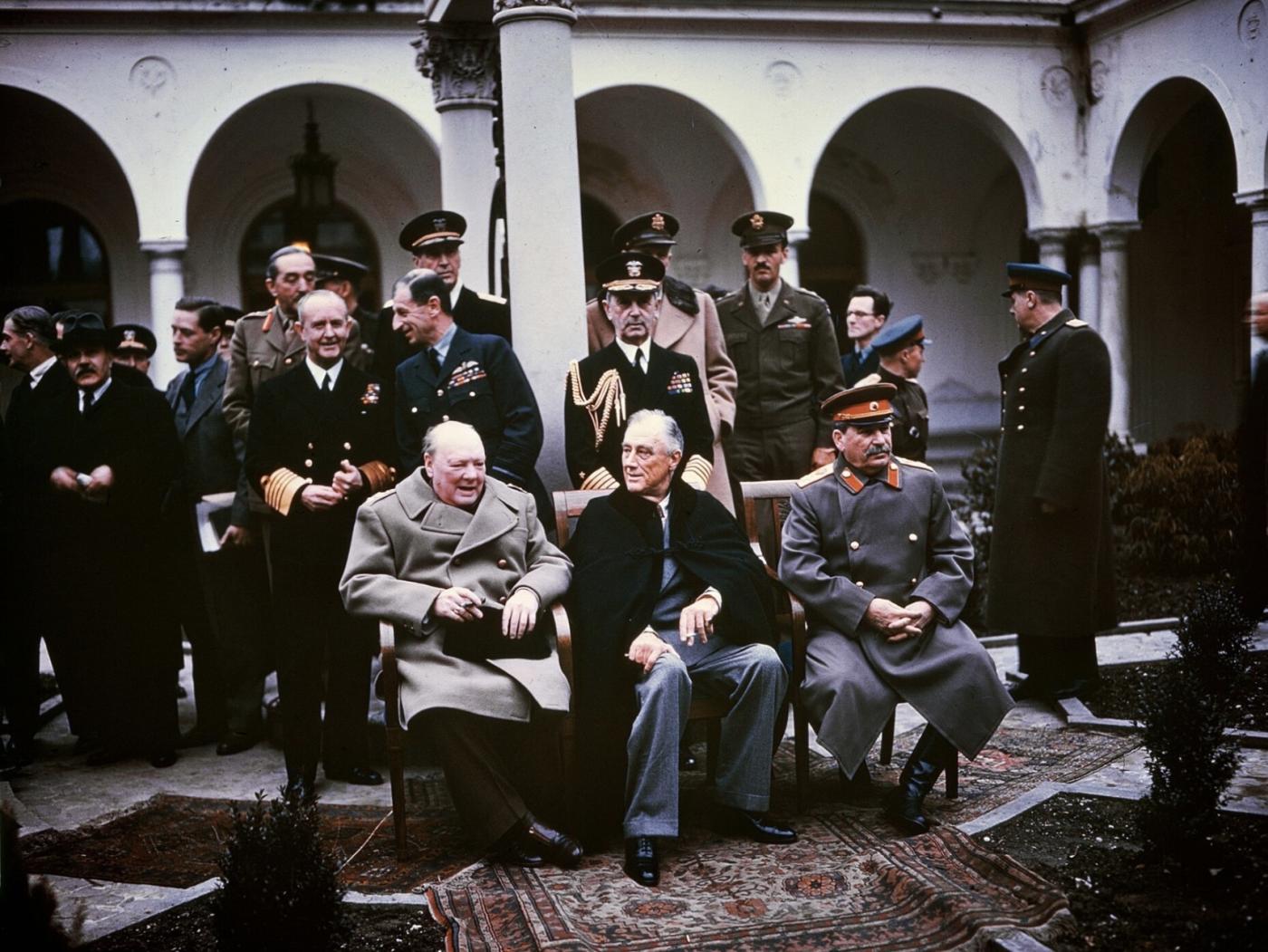
The meeting that became known as the Yalta Conference began on 4 February 1945 at a moment when the Second World War in Europe was clearly approaching its end, but the shape of the peace that would follow was deeply uncertain. The leaders who gathered there were Winston Churchill, Joseph Stalin, and Franklin D. Roosevelt, each arriving with distinct priorities shaped by their nations’ wartime sacrifices, military positions, and political systems.
The conference took place in the Crimean resort town of Yalta, on the Black Sea, chosen largely at Stalin’s insistence. The Soviet leader argued that his health and the demands of command made long-distance travel difficult, but the choice also reflected the Red Army’s dominance in Eastern Europe by early 1945. The main sessions were held at the Livadia Palace, a former imperial summer residence that had once belonged to the Russian tsars. Other delegations were housed in nearby palaces, and the surrounding area was heavily secured by Soviet forces, with checkpoints, guards, and controlled access that underscored who held power on the ground.
The conference lasted eight days, from 4 to 11 February 1945. By this point, Allied victory over Nazi Germany was no longer in doubt. Soviet armies were less than 50 miles from Berlin, while British and American forces were pushing steadily eastward from the west. This military reality shaped the atmosphere from the very start. Stalin arrived as the leader whose troops occupied much of Eastern Europe, giving him considerable leverage. Roosevelt, weakened by serious illness, nevertheless saw the meeting as crucial for securing Soviet cooperation in the final defeat of Germany and in the planned war against Japan. Churchill, wary of both Soviet expansion and the decline of British global power, aimed to protect Europe’s balance and Britain’s influence.
The opening day set the tone for what followed. The leaders reaffirmed their commitment to unconditional surrender by Germany, a principle agreed upon earlier in the war, but quickly moved beyond military matters to political questions about the postwar world. Central to these discussions was the future of Germany itself. There was agreement that Germany would be divided into occupation zones controlled by the United States, Britain, and the Soviet Union, with France also receiving a zone carved out of the western areas. Reparations, demilitarization, and the dismantling of Nazi institutions were debated in detail, reflecting both a desire to prevent another German war and differing views on how harsh the peace should be.
Equally significant, and more controversial, were discussions about Eastern Europe. Poland became a focal point almost immediately. Its borders, government, and political future symbolized the wider question of whether Eastern European countries liberated by the Red Army would be genuinely independent or effectively controlled by Moscow. Stalin argued that friendly governments on the Soviet Union’s western borders were essential for security after the immense losses the USSR had suffered. Churchill and Roosevelt pressed for free elections and representative governments, leading to carefully worded compromises that promised democratic processes but left much open to interpretation.
Another major outcome of the early sessions was agreement on the creation of a new international organization to replace the failed League of Nations. Plans for what would become the United Nations were advanced, including the structure of the Security Council and the controversial veto power for its permanent members. Roosevelt, in particular, saw this as a cornerstone of lasting peace and was willing to make concessions elsewhere to ensure Soviet participation.
The atmosphere at Yalta was a mix of cooperation and underlying tension. The leaders dined together, posed for photographs, and spoke publicly of unity, yet behind closed doors there was constant bargaining and mistrust. Language barriers, exhaustion, and the harsh winter conditions added to the strain. Roosevelt’s declining health was evident, while Churchill often worked late into the night, writing memoranda and trying to rally support for his views.
By the time the conference ended on 11 February 1945, a series of agreements had been announced that seemed, on the surface, to offer a clear blueprint for the postwar world. In reality, many of the key decisions were compromises shaped by wartime necessity and unequal power. The way the conference began on 4 February 1945, with optimism tempered by suspicion and cooperation shadowed by rivalry, foreshadowed the tensions that would soon harden into the Cold War.