Buchenwald
Buchenwald concentration camp was one of the largest and most infamous camps established by Nazi Germany, and it became a central symbol of systematic terror, exploitation, and mass murder carried out by the SS. The camp was located on the Ettersberg hill, approximately eight kilometers north of the city of Weimar in central Germany. Its proximity to a city closely associated with German culture and enlightenment was not accidental; the camp was intended to demonstrate Nazi power and serve as a permanent instrument of repression within the German heartland.
The camp was established in July 1937, initially to imprison so-called “dangerous” political opponents of the Nazi regime, including communists, social democrats, and other critics. Over time, its function expanded dramatically. Jews, Roma and Sinti, Jehovah’s Witnesses, homosexual men, so-called “asocials,” prisoners of war, resistance fighters from across occupied Europe, and ordinary civilians caught in the machinery of Nazi rule were all sent to Buchenwald. It was not designed primarily as an extermination camp like Auschwitz-Birkenau, but death was an integral and constant outcome of its operation.
Command of the camp rested with the SS, and several camp commandants presided over its evolution into a site of extreme brutality. The first and most notorious commandant was Karl Otto Koch, who ruled the camp with corruption, sadism, and arbitrary violence. He was later arrested by the SS itself for embezzlement and murder, though this did not lessen the suffering inflicted under his authority. Other commandants followed, including Hermann Pister, who oversaw the camp during the later years of the war as prisoner numbers and mortality rose sharply.
One of the most chilling and emblematic crimes committed at Buchenwald involved a specially designed execution facility disguised as a medical measuring station. Prisoners, particularly Soviet prisoners of war, were told they were to be measured for height as part of routine processing. They were instructed to stand against a measuring device fixed to a wall. Unbeknownst to them, the apparatus was aligned with a small opening behind the wall. An SS guard positioned in an adjacent room would shoot the prisoner in the back of the neck through this opening, killing them instantly. The body would then be removed and the next victim brought in, maintaining the illusion of administrative normality. This method was designed to make killing efficient, quiet, and psychologically distant for the perpetrators, while maximizing terror among the prisoners once rumors spread.
Beyond such executions, daily life in Buchenwald was structured to break prisoners physically and mentally. Inmates were subjected to forced labor in nearby armaments factories, stone quarries, and workshops operated by SS-controlled companies. Starvation rations, overcrowded barracks, brutal punishments, and rampant disease ensured that survival was a constant struggle. Medical experiments were also conducted on prisoners, including tests involving infectious diseases, poisons, and experimental treatments, often resulting in permanent injury or death.
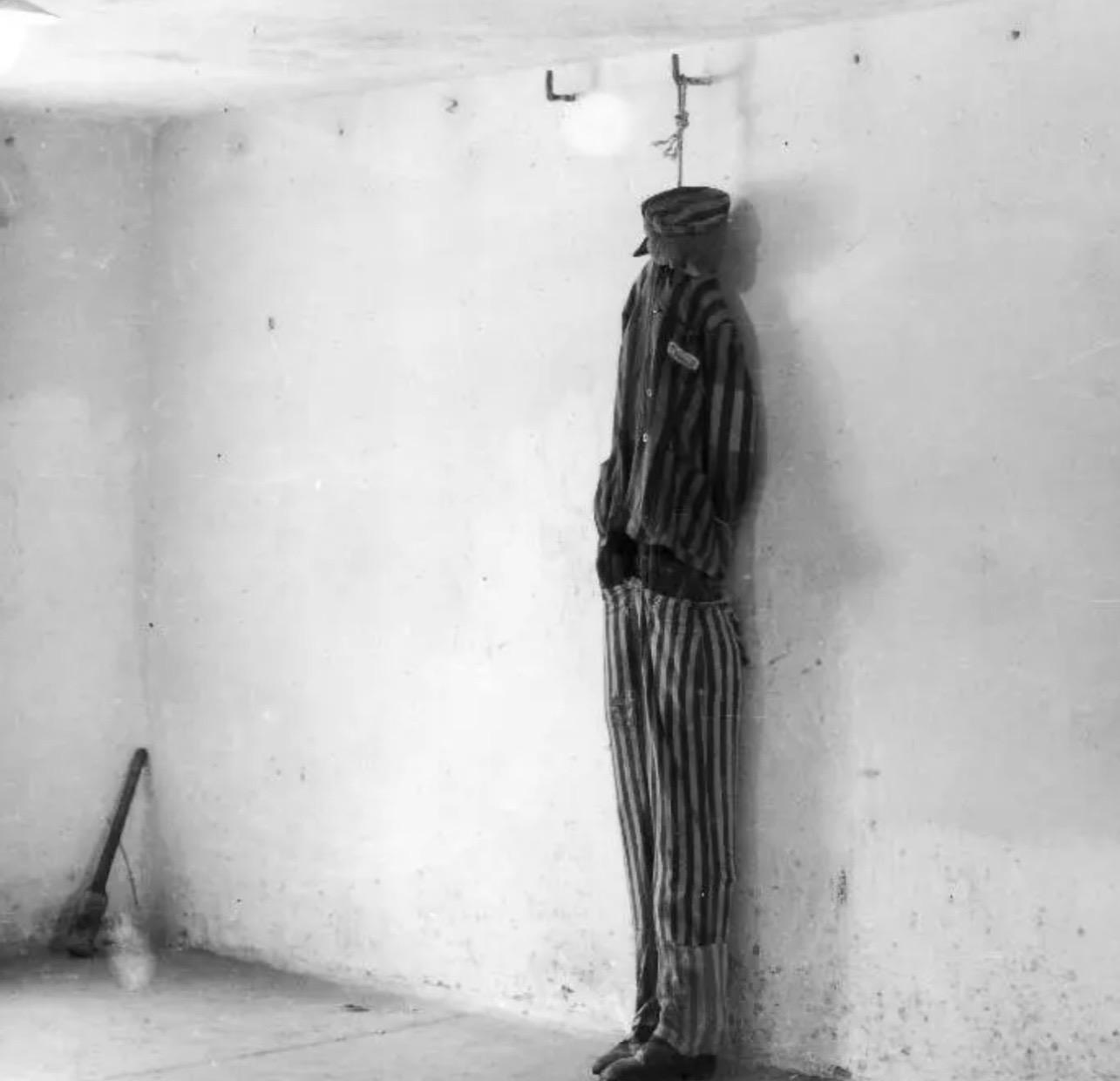
Unlike extermination camps equipped with large gas chambers, Buchenwald relied on a combination of shootings, hangings, lethal injections, exhaustion through labor, deliberate neglect, and starvation. A crematorium was installed to dispose of the dead, and the constant smoke and smell became a grim feature of camp life. Children were imprisoned there as well, especially toward the end of the war, and many did not survive.
Between 1937 and 1945, approximately 250,000 prisoners passed through Buchenwald and its extensive network of subcamps. It is estimated that at least 56,000 people died there, though the true number may be higher due to incomplete records and unregistered killings. As the Allied armies advanced in 1945, death marches evacuated tens of thousands of prisoners, claiming countless additional lives.
Buchenwald was liberated on 11 April 1945 by U.S. Army forces. By that time, the remaining prisoners were emaciated, diseased, and traumatized, surrounded by evidence of mass death. The camp’s liberation revealed to the world the scale and bureaucratic nature of Nazi crimes, including the cold, industrialized methods of killing such as the shooting apparatus disguised as a measuring device.
Today, the site of Buchenwald stands as a memorial and place of historical documentation. It serves as a stark reminder that the camp’s main role was not only imprisonment but the systematic destruction of human dignity and life through terror, deception, and routine violence, carried out in the name of an ideology that reduced people to expendable objects.