On this day in military history…
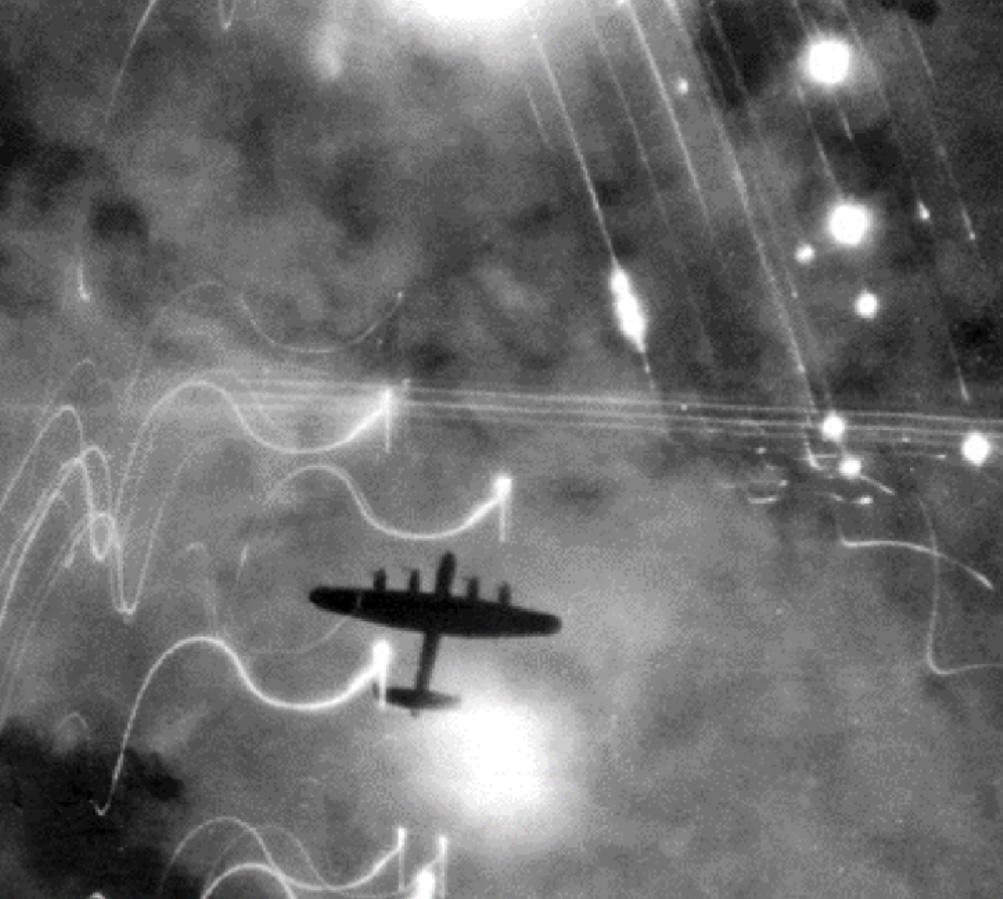
On the night of 30/31 January 1943 the RAF mounted a major attack on Hamburg in which the Pathfinder Force introduced a new and decisive aid to navigation and target marking. The raid involved around 148 aircraft drawn from Bomber Command, made up mainly of Stirling, Halifax and Wellington bombers, with a small but growing number of Lancasters also taking part. From this force, crews of No. 7 Squadron and No. 35 Squadron were tasked with the crucial Pathfinder role, flying ahead of the main stream to locate the target and mark it for the following bombers. In total, roughly 450 tons of high explosive and incendiary bombs were dropped during the attack, aimed at Hamburg’s docks, industrial areas and surrounding urban districts.
The raid took place against a background of serious concern about bombing accuracy. Earlier night operations had shown that even large forces could miss their intended targets by miles, especially when cloud, haze or blackout conditions obscured visual landmarks. This problem was not simply wasteful; it undermined the strategic aim of damaging Germany’s industrial capacity and transport system. Hamburg, as one of Germany’s most important ports and industrial centres, was a particularly significant objective, and improving accuracy over such targets was central to the RAF’s wider war effort.
What distinguished this raid was the operational debut of H2S, the first airborne ground-mapping radar to be used in combat. H2S was fitted to a limited number of Pathfinder aircraft, primarily Stirlings and Halifaxes from No. 7 and No. 35 Squadrons, whose crews had received specialist training in its use. The equipment transmitted radar pulses downward from the aircraft and displayed the returning echoes on a circular screen, producing a moving picture of the ground below. Coastlines, rivers, estuaries and dense built-up areas could be recognised by their distinctive radar signatures, allowing navigators to confirm their position even when nothing could be seen outside the cockpit.
During the Hamburg raid, Pathfinder crews used H2S to identify the broad outline of the city and its relationship to major features such as the River Elbe. This was particularly valuable on the run-in to the target, where small navigational errors could previously compound into major mistakes. Instead of relying on fleeting visual cues or uncertain dead reckoning, the crews could cross-check their route using the radar picture and guide their aircraft to the planned marking point with far greater confidence. Once over the target area, the Pathfinders dropped flares and markers that the rest of the bomber force could see and aim at.
The effect of this was to tighten the concentration of bombing. Although RAF policy at the time focused on area bombing rather than precision attacks on individual factories, concentration still mattered greatly. When bombs fell within the correct urban-industrial area, they were far more likely to damage docks, shipyards, power supplies, transport links and housing associated with war production. On this raid, the combination of Pathfinder marking and the weight of the main force meant that several hundred tons of bombs were delivered into Hamburg itself rather than scattered across the surrounding countryside.
The broader significance of this operation lay in what it demonstrated. Even though only a fraction of the 148 aircraft carried H2S, their ability to guide the rest of the force showed how advanced electronics could multiply the effectiveness of existing aircraft and crews. Losses on night raids remained heavy, but the introduction of radar-guided marking meant that those losses were increasingly tied to real and measurable damage to Germany’s war economy. Over time, this helped Bomber Command sustain pressure on key targets and justify the enormous resources devoted to the strategic bombing campaign.
The H2S system itself was the product of a major scientific and engineering effort. Its crucial enabling component was the cavity magnetron, invented in 1940 by John Randall and Harry Boot, which allowed powerful microwave radar to be carried in aircraft. Building on this breakthrough, the system was developed at the Telecommunications Research Establishment under the leadership of Bernard Lovell, where laboratory research was turned into rugged operational equipment that could be fitted to heavy bombers and used under combat conditions.
The Hamburg raid of 31 January 1943 did not end the problem of bombing accuracy overnight, nor did it represent the full destructive power later seen in attacks on the city. However, it marked an important turning point. By integrating H2S-equipped Pathfinder aircraft into a large bomber force, the RAF showed that technology could significantly reduce the uncertainty of night operations. In doing so, it strengthened the effectiveness of the bombing campaign and underlined the growing role of radar and electronic warfare in shaping the outcome of the air war over Europe.