On this day in military history…
The Tet Offensive was a coordinated series of large-scale attacks launched across South Vietnam at the end of January 1968 during the Vietnam War, and it became one of the most important turning points of the conflict. It took place during Tet, the Vietnamese Lunar New Year, a period traditionally observed as a ceasefire, which made the offensive especially shocking to both South Vietnamese and American forces. The campaign was planned and executed by the communist forces of North Vietnam and the National Liberation Front, commonly known in the West as the Viet Cong, with the strategic direction coming from the leadership in Hanoi, including General Vo Nguyen Giap.
At the time, the United States government and military leadership had been publicly claiming that the war was being won and that communist forces were close to collapse. American troop levels had reached over half a million, and US forces, alongside the Army of the Republic of Vietnam, believed they had the upper hand after years of attritional fighting. The Tet Offensive was designed to contradict this narrative dramatically. The North Vietnamese strategy was not simply military victory on the battlefield but psychological and political impact. They hoped to trigger a general uprising among the South Vietnamese population, undermine confidence in the South Vietnamese government, and weaken American public support for the war.
The offensive began in the early hours of 30 January 1968, when communist forces launched near-simultaneous attacks on more than 100 cities, towns, and military installations throughout South Vietnam. Major targets included Saigon, the capital, and Hue, the former imperial capital. In Saigon, Viet Cong commandos penetrated deep into the city, attacking key locations such as the presidential palace, the national radio station, Tan Son Nhut air base, and the US Embassy. Although the embassy compound was briefly breached, the attackers were killed or captured, but the symbolism of the attack had enormous impact, as images of fighting at what was supposed to be the most secure American site in South Vietnam were broadcast worldwide.
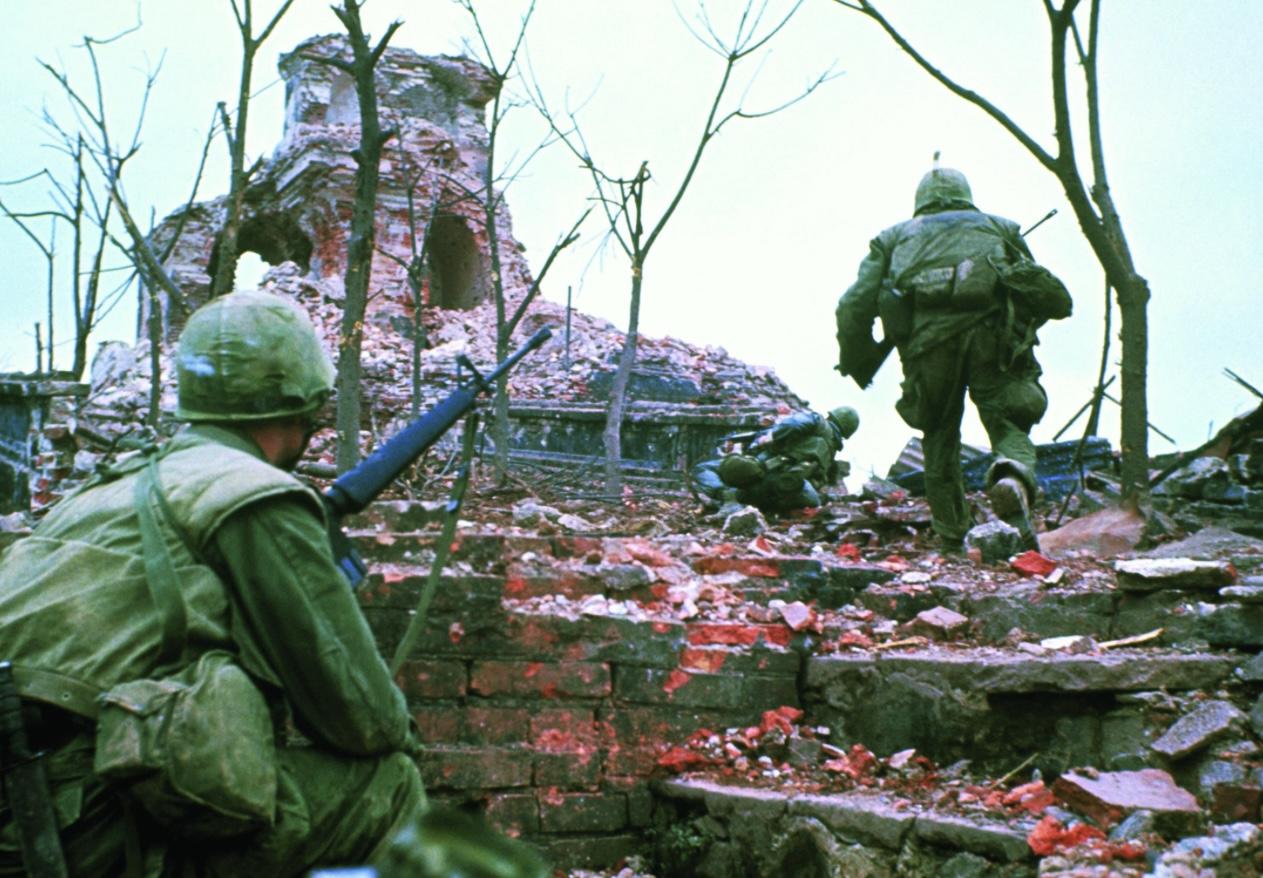
In Hue, the offensive was especially intense and prolonged. Communist forces captured most of the city and held it for nearly a month, leading to some of the bloodiest urban combat of the war. US Marines and South Vietnamese troops eventually retook Hue after fierce house-to-house fighting that caused extensive destruction. During the communist occupation, thousands of civilians were executed in what later became known as the Hue Massacre, with victims including government officials, teachers, religious leaders, and others considered enemies of the revolution. This aspect of the Tet Offensive remains one of its most controversial and grim legacies.
Militarily, the Tet Offensive was a disaster for the Viet Cong. They suffered enormous casualties, estimated at tens of thousands killed, and many of their underground networks in South Vietnam were exposed and destroyed. The hoped-for popular uprising did not occur, and South Vietnamese forces did not collapse. From a purely tactical perspective, US and South Vietnamese troops successfully repelled the attacks and retained control of all major cities. However, the psychological impact of the offensive outweighed these battlefield outcomes.
In the United States, public reaction was swift and profound. Media coverage played a crucial role, particularly graphic television footage that showed intense fighting and contradicted official claims of progress. Influential journalists such as Walter Cronkite publicly questioned the possibility of victory, helping to shift mainstream opinion. The credibility gap between what the US government said and what Americans saw on their screens widened dramatically. President Lyndon B. Johnson, facing growing anti-war protests and political pressure, soon announced that he would not seek re-election and ordered a partial halt to the bombing of North Vietnam.
The Tet Offensive also marked a shift in North Vietnamese strategy. Although the Viet Cong were badly weakened, North Vietnam increasingly relied on its regular army, the People’s Army of Vietnam, to continue the war. Over time, Hanoi demonstrated that it could absorb heavy losses and continue fighting, reinforcing the perception that the war would be long, costly, and possibly unwinnable for the United States.
Internationally, the offensive influenced global opinion about the conflict and increased pressure for negotiations. It directly contributed to the opening of peace talks in Paris later in 1968, which eventually led to the Paris Peace Accords several years later. While the fighting continued for years after Tet, the offensive fundamentally changed how the war was perceived and prosecuted.