On this day in military history…
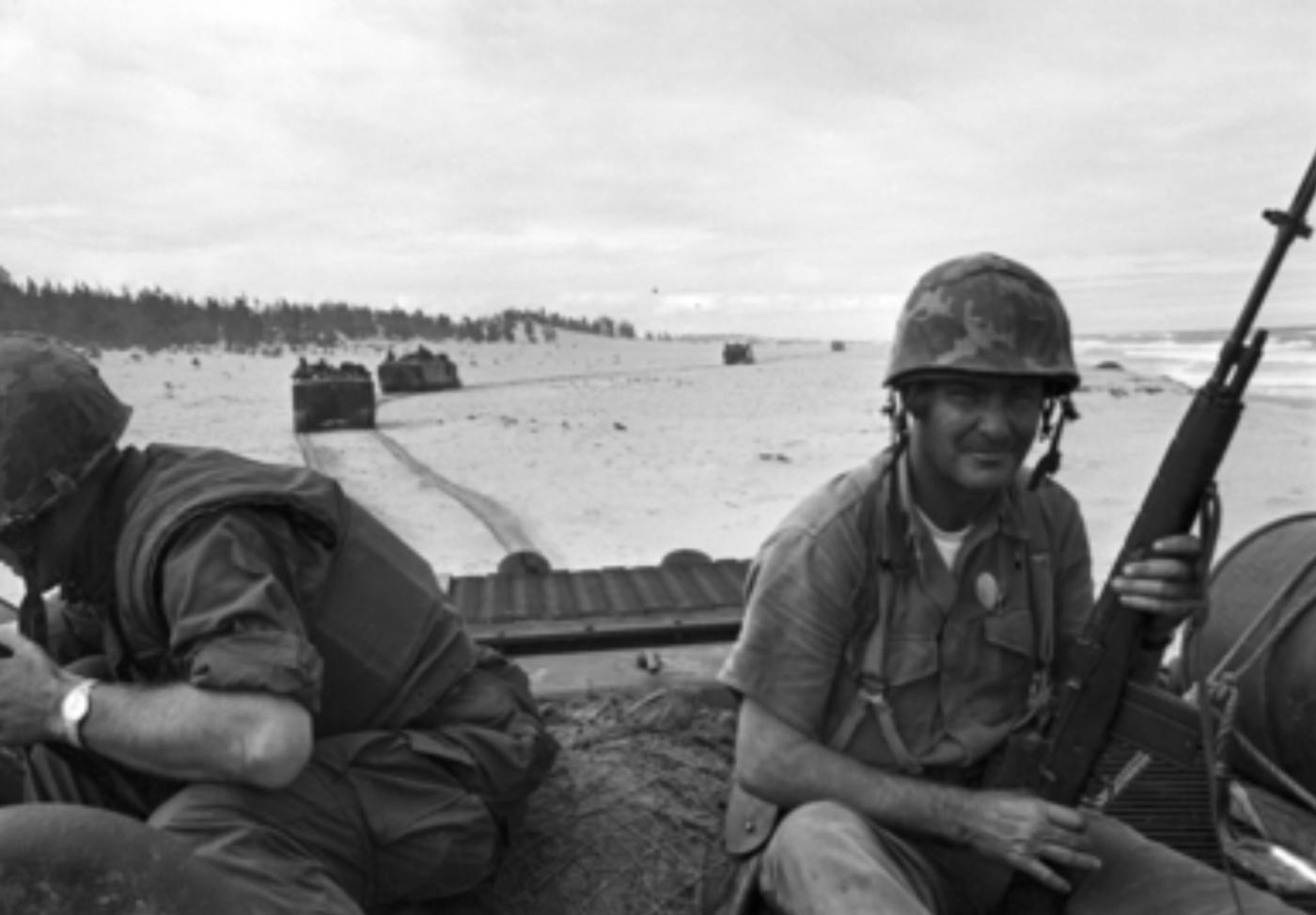
Operation Double Eagle was one of the most ambitious U.S. military actions of the early Vietnam War and is remembered as the largest amphibious landing carried out during that conflict, as well as the biggest such operation since the Korean War. It took place at a time when American commanders believed that large enemy formations were operating along South Vietnam’s central coast and could be brought to battle through a powerful, coordinated assault from the sea and air.
The operation began on 28 January 1966 in Quảng Ngãi Province, south of the major U.S. Marine base at Chu Lai. It was planned as a combined U.S. and South Vietnamese effort to strike Viet Cong and North Vietnamese Army forces thought to be concentrated in the coastal lowlands and nearby foothills. Overall direction came from General William Westmoreland, the commander of U.S. forces in Vietnam, who wanted to use superior mobility and firepower to force the enemy into a decisive engagement.
The amphibious landing itself was carried out primarily by units of the 1st Marine Division. Around 4,000 U.S. Marines went ashore in the opening waves, supported by naval gunfire, aircraft, and helicopters lifting additional troops inland. As the operation developed, more Marine battalions were committed, along with several thousand soldiers from the Army of the Republic of Vietnam, mainly elements of the ARVN 2nd Division. In total, well over 7,000 allied troops took part across the different phases of the operation.
Command on the ground was held by Brigadier General Jonas M. Platt, a senior Marine officer who led the combined force often referred to as Task Force Delta. His key objectives were to secure the beachhead, push inland to sweep suspected enemy base areas, and destroy Viet Cong and North Vietnamese Army units believed to be operating in strength in the region. Intelligence estimates suggested that as many as 6,000 enemy troops might be present, making this an opportunity, in Allied thinking, to inflict heavy losses.
Once ashore, Marine and South Vietnamese units advanced through rice paddies, villages, and difficult terrain, carrying out search-and-destroy missions and attempting to block likely enemy escape routes. Despite the scale of the landing and the heavy preparatory fire, the large enemy formations expected by planners were rarely encountered. Instead, fighting consisted mainly of brief engagements and scattered skirmishes. The enemy proved highly mobile and often withdrew before U.S. units could bring their full firepower to bear.
By mid-February 1966, when the main phase of Operation Double Eagle came to an end, Allied forces reported several hundred enemy killed and small numbers captured, along with weapons and supplies seized. U.S. Marine casualties included dozens killed and many more wounded. From a tactical point of view, the operation demonstrated that American forces could successfully launch and sustain a major amphibious assault in Vietnam and rapidly move large numbers of troops inland.
Strategically, the results were less clear-cut. While Operation Double Eagle disrupted enemy activity in the coastal region and showcased Allied strength, it failed to produce the decisive battle commanders had hoped for. Most of the Viet Cong and North Vietnamese Army units avoided destruction, slipping away to fight another day. In this way, Double Eagle became an early example of a pattern that would repeat throughout the Vietnam War, where massive conventional power was applied against an enemy whose strength lay in mobility, concealment, and avoidance rather than direct confrontation.