On this day in military history…
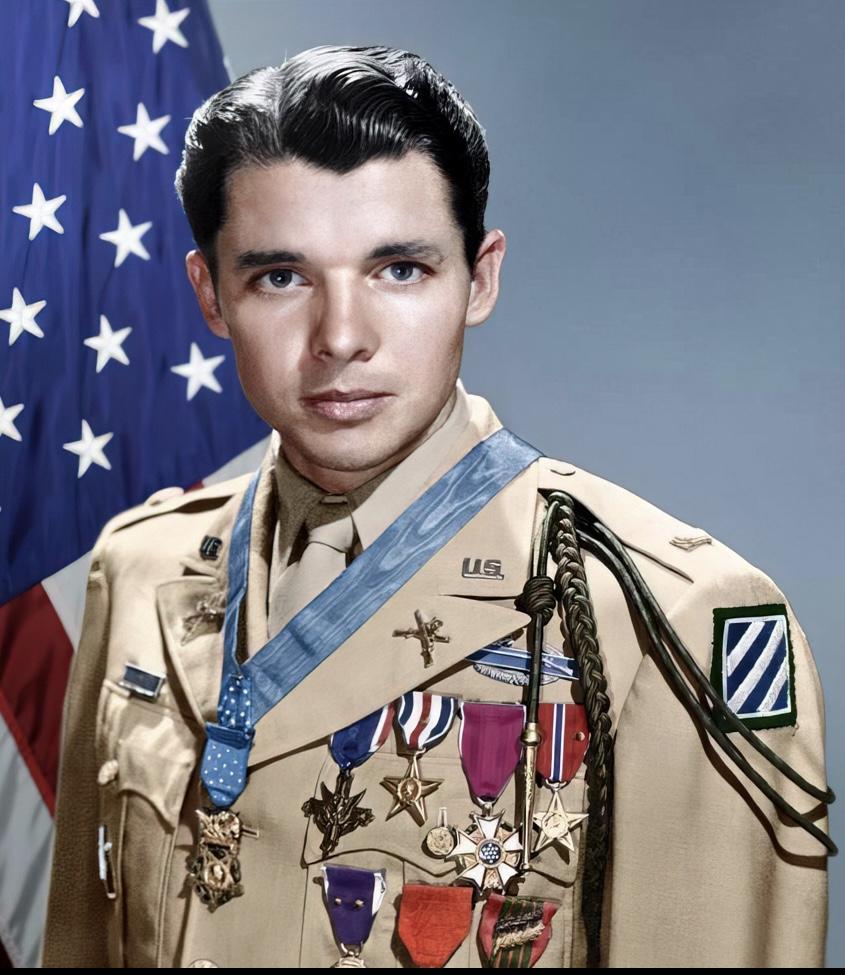
On 26 January 1945, in the bitter winter fighting of World War II, a young American soldier named Audie Murphy carried out one of the most extraordinary individual actions of the war, an act of defiance and courage that would earn him the United States’ highest military decoration, the Medal of Honor.
The event took place near the village of Holtzwihr in eastern France, during the Allied push through Alsace. At the time, Murphy was a 19-year-old second lieutenant commanding a company of the 15th Infantry Regiment, 3rd Infantry Division. His unit was badly understrength after weeks of intense fighting, and on that freezing January day they were ordered to hold their position against a determined German counterattack supported by tanks.
As German infantry advanced with armored vehicles behind them, Murphy realized his small force was in danger of being overrun. He ordered his men to withdraw to safer positions in the nearby woods while he remained behind to direct artillery fire by radio. Nearby stood a disabled American tank destroyer that had already been hit and set ablaze. Ammunition inside the vehicle was exploding, flames were rising, and smoke filled the air. Despite the obvious danger, Murphy climbed onto the burning vehicle and manned its .50-caliber machine gun.
From this exposed position, alone and fully visible to the enemy, he opened fire on the advancing German infantry, cutting them down at close range. At the same time, he calmly continued to call in artillery strikes, adjusting the fire so precisely that shells fell among the German troops and halted their momentum. German tanks attempted to advance, but the combined effect of Murphy’s machine-gun fire and the artillery barrage forced them to pull back. He was wounded in the leg during the action, yet he refused to leave his position.
For nearly an hour, Murphy held off the enemy attack by himself. When his ammunition was finally exhausted and the German assault had broken, he climbed down from the burning vehicle and limped back to his men. He then organized a counterattack, leading his soldiers forward to reclaim the ground they had just abandoned. What could have been a disastrous breakthrough for German forces instead became a decisive American stand, achieved largely through the actions of one man.
By the end of World War II, Murphy had become the most decorated American combat soldier of the conflict, receiving every U.S. Army award for valor available at the time, along with decorations from France and Belgium. Despite national fame and public praise, returning to civilian life proved extremely difficult for him. Like many veterans, he suffered from what was then called battle fatigue, now recognized as post-traumatic stress disorder. He was plagued by nightmares, insomnia, and episodes of depression, and for a time he slept with a loaded pistol under his pillow, convinced he was still in combat.
Rather than hiding these struggles, Murphy later spoke openly about the psychological toll of war, helping to draw attention to the lasting effects of combat on soldiers long before such discussions were common. With encouragement from friends, he turned to acting and writing as a way to cope. He went on to become a successful Hollywood film actor in the late 1940s and 1950s, often appearing in Westerns and war films. In 1955, he portrayed himself in the movie adaptation of his autobiography, To Hell and Back, which became one of the most successful war films of its era.
Despite his fame, Murphy remained closely connected to the military community. He continued to advocate for veterans’ issues, especially improved treatment for those suffering from psychological trauma. He also served in the Texas Army National Guard, eventually reaching the rank of major, showing that his sense of duty did not end with the war.
Audie Murphy died in 1971 at the age of 45 in a plane crash in Virginia. He was buried at Arlington National Cemetery, where his grave, marked by a simple white headstone, remains one of the most visited.