On this day in military history…
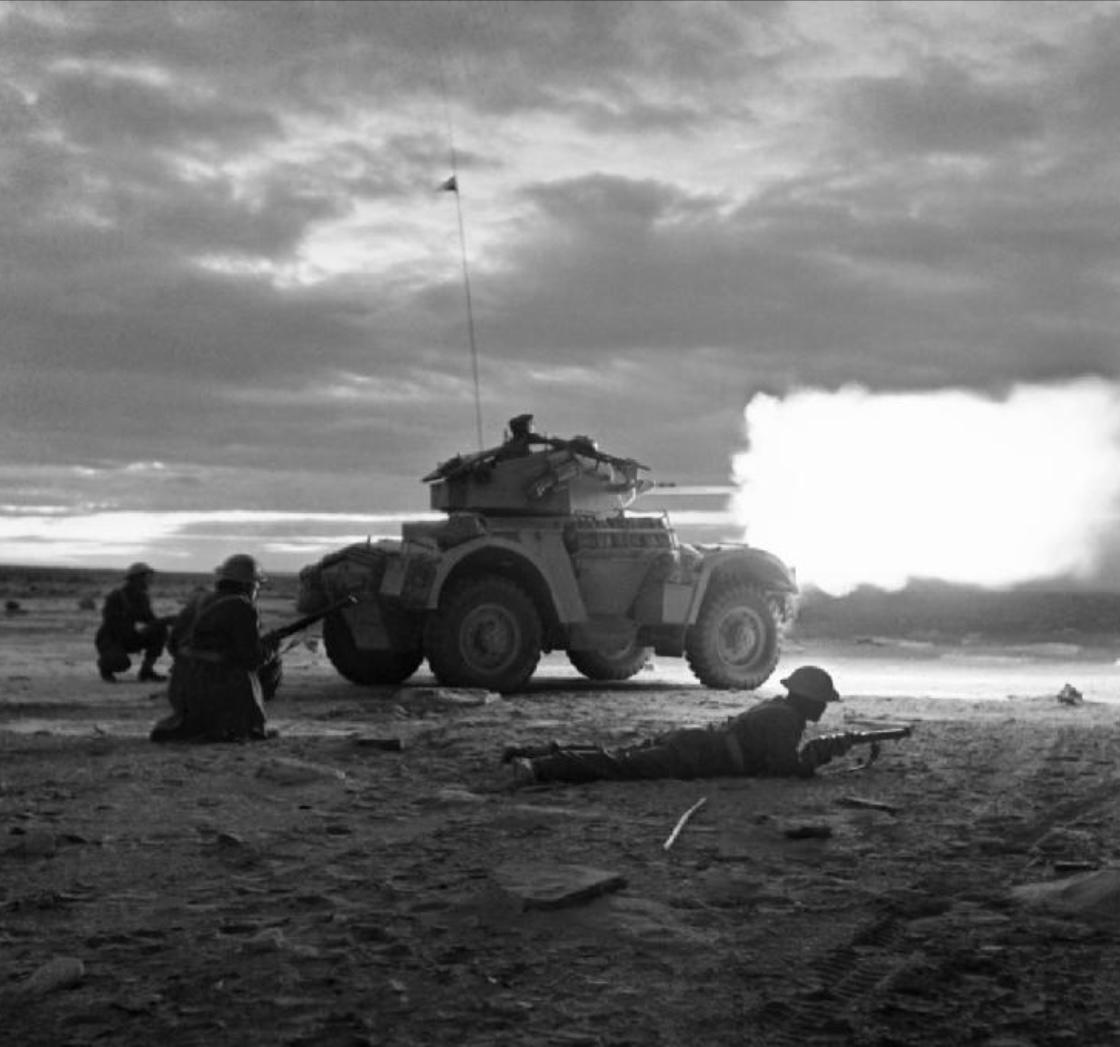
The capture of Tripoli on 23 January 1943 marked the dramatic end of the long North African campaign that had begun with Italian expansionism in 1940 and had turned into a vast, grinding struggle between the Axis and Allied armies across the deserts of Libya and Egypt. By the winter of 1942–43 the British Eighth Army, commanded by General Bernard Montgomery, had already driven Field Marshal Erwin Rommel’s Afrika Korps and its Italian allies out of Egypt and across the whole of Cyrenaica after the decisive victory at El Alamein. What followed was a relentless pursuit westward, over hundreds of miles of desert, as Montgomery refused to allow the defeated Axis forces any chance to recover.
After El Alamein in November 1942, Rommel’s army was badly battered. It had lost huge quantities of tanks, guns, and transport, and even more critically it was starved of fuel and supplies. Allied air power and naval control of the Mediterranean made it extremely difficult for the Axis to bring reinforcements and supplies into North Africa. As the Eighth Army advanced, it was constantly supported by the Royal Air Force and by well-organised logistics that allowed Montgomery to keep his troops supplied despite the vast distances involved. The Axis forces were forced to retreat in stages, fighting delaying actions at places such as Mersa Matruh, Tobruk, and Benghazi, but each stand only slowed the British advance for a short time.
By early January 1943 Rommel’s army had fallen back to Tripolitania, the western region of Libya, with Tripoli as its main port and administrative centre. Tripoli was by far the most important city in Libya, with excellent harbour facilities, warehouses, and roads linking it to Tunisia. For the Axis it was vital, because it was one of the last ports through which supplies could reach their forces. For Montgomery, capturing Tripoli would be a political and military triumph, demonstrating that the British had completely expelled the Axis from Libya after years of setbacks and defeats earlier in the war.
The defenders of Tripoli were in a poor state by this point. Rommel had already been ordered by Hitler to move toward Tunisia, where German and Italian forces were trying to form a new defensive line with troops arriving from Europe. As a result, Tripoli was not meant to be defended to the last man. The garrison was made up mostly of Italian units, with a smaller number of German troops acting as rearguards. These troops were exhausted, short of ammunition and fuel, and increasingly demoralised. Their task was to delay the British advance long enough to allow the main Axis forces to escape westward into Tunisia.
Montgomery approached Tripoli carefully but confidently. He had learned earlier in the desert war that rushing headlong into a city or port could lead to costly mistakes, but he also knew that Rommel could not afford a major stand. British armoured and infantry units advanced along the coast road while other formations moved inland to outflank any defensive positions. The RAF constantly attacked retreating columns and supply dumps, further weakening the Axis defenders.
On 23 January 1943 the Eighth Army entered Tripoli. There was no major battle for the city itself. The Axis rear guards withdrew during the night, blowing up some installations and attempting to sabotage port facilities, but they lacked the time and resources to carry out large-scale destruction. When British troops arrived, they found much of the harbour intact, which was a huge advantage for the Allies because it allowed supplies to be landed close to the front line almost immediately. The Union Jack was raised over government buildings, and Tripoli, the last major Axis stronghold in Libya, was now firmly in Allied hands.
The fate of the defenders was mixed. Some Italian troops were left behind and were taken prisoner in and around the city, while others retreated with German units toward Tunisia. Many of the Italians were relieved to be captured, as they were weary of a war that had brought them little but hardship. German units, more disciplined and determined, generally escaped westward, though they too had suffered heavy losses during the long retreat. The surviving Axis forces would soon dig in along the Mareth Line in southern Tunisia, where they would continue to fight the British and, soon, American troops for several more months.
Montgomery regarded the capture of Tripoli as one of the proudest moments of the campaign. He understood its enormous symbolic importance. Tripoli had been an Italian colony since 1911, and its loss marked the complete collapse of Italy’s North African empire. To celebrate the achievement and to boost morale after months of hard marching and fighting, Montgomery ordered a huge party. It was an unusual event for a frontline army, but Montgomery believed that victory should be marked and that the men deserved a moment of relief and pride.
The celebration took place in and around the city, with soldiers from many units invited. There was food, drink, and music, and even some limited entertainment arranged from what could be found locally. For many of the troops it was the first real chance to relax since El Alamein. Montgomery himself made a point of appearing, speaking to soldiers and officers, and emphasizing how far they had come since the dark days of 1941 and 1942. He told them that they had not only defeated Rommel but had driven him out of an entire country, something few armies in history could claim.
Strategically, the fall of Tripoli had enormous consequences. It allowed the Eighth Army to shorten its supply lines dramatically and prepare for the next phase of the war in Tunisia. It also linked up the British advance from the east with the Allied landings in Algeria and Morocco carried out during Operation Torch in November 1942. The Axis forces were now trapped in Tunisia, with the sea behind them and two Allied armies closing in from east and west.
The capture of Tripoli on 23 January 1943 therefore represented far more than the taking of a city. It was the culmination of a long, hard campaign across the deserts of North Africa, the destruction of Italy’s African empire, and a decisive step toward the final defeat of the Axis in Africa.