Zeitzunder
The German Second World War Zeitzünder für Sprengbüchse, often translated as a time fuze for demolition or explosive charges, was one of the many ingenious but often overlooked components of the Wehrmacht’s vast munitions and engineering system. Rather than being a weapon in its own right, it served as a precision timing device used to detonate explosive charges after a predetermined delay. These devices were employed in demolition work, sabotage, delayed-action explosive traps, and in the destruction of equipment or infrastructure during retreats. Their function was simple in principle but complex in design, reflecting Germany’s advanced wartime engineering and emphasis on controlled explosive deployment.
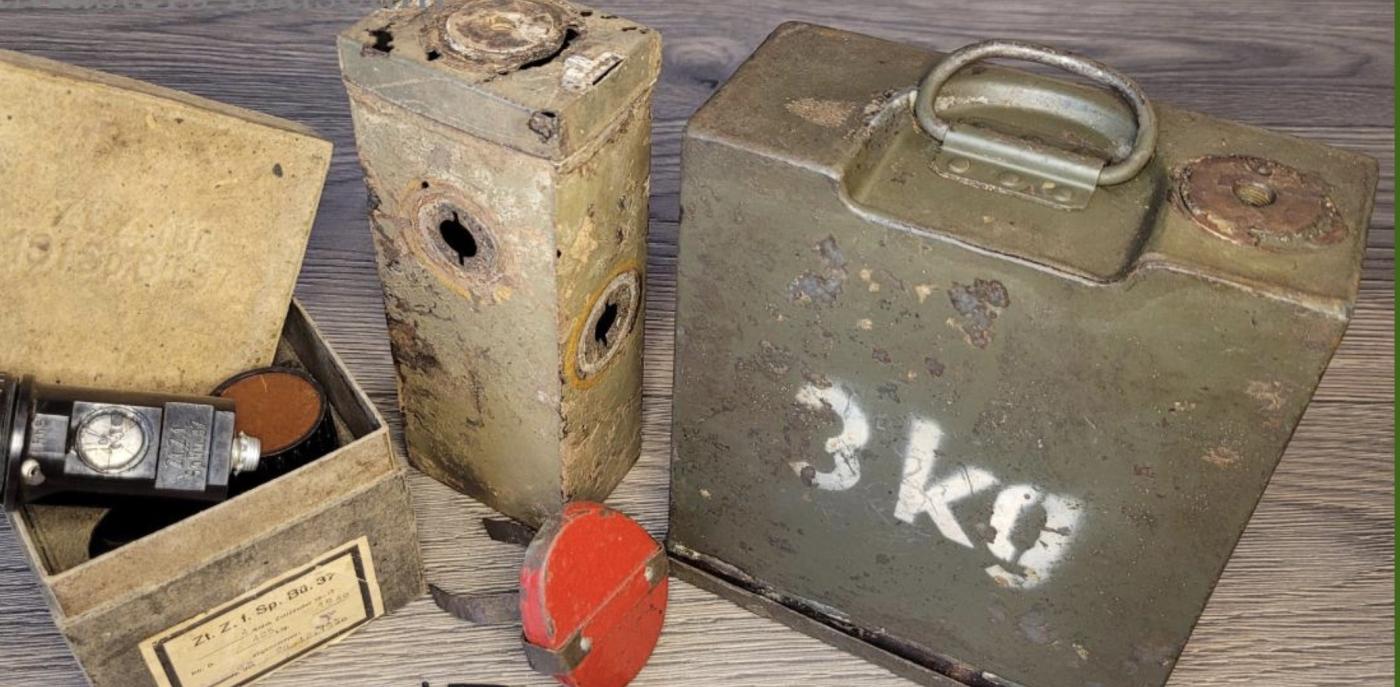
The Zeitzünder für Sprengbüchse typically consisted of a mechanical time fuze housed in a compact metal casing that could be attached to or inserted into an explosive charge container known as a Sprengbüchse, or demolition box. The fuze allowed engineers or sabotage units to set a delay ranging from minutes to hours, depending on the model. Once activated, the internal timing mechanism would count down before triggering a detonator, which in turn initiated the main explosive charge. These time fuzes were essential for operations where personnel needed to withdraw safely before detonation or where a delayed explosion was tactically advantageous, such as destroying bridges after enemy use or sabotaging captured equipment.
Mechanically, these devices often relied on clockwork or chemical delay mechanisms. Clockwork fuzes used wound springs and gear trains similar to those found in watches or mechanical timers. When armed, the mechanism would slowly unwind until a firing pin was released, striking a percussion cap that initiated the detonator. Chemical delay versions used slow-burning compositions or corrosion-based triggers that gradually weakened a retaining wire or barrier until the firing pin was freed. German engineers produced multiple variants to suit different conditions, including waterproofed models for maritime or amphibious operations and cold-resistant versions for use on the Eastern Front.
The manufacturing of Zeitzünder für Sprengbüchse and similar German time fuzes involved several companies within the German armaments industry. Among the most significant were Rheinmetall-Borsig, WASAG (Westfälisch-Anhaltische Sprengstoff AG), and Dynamit Nobel. These firms had extensive experience in explosives and munitions production long before the war and were integrated into the wartime production system under the direction of the German Army Ordnance Office. Smaller subcontractors also contributed by producing components such as springs, gears, and casings. Many of these factories were dispersed across Germany and occupied territories to reduce vulnerability to Allied bombing, and by the later war years production had increasingly shifted to underground facilities or dispersed workshops.
German time fuzes for demolition charges were used by several branches of the Wehrmacht, including the army engineers (Pioniere), the Luftwaffe’s ground demolition units, and the Kriegsmarine for naval sabotage and scuttling operations. Special operations forces such as the Brandenburgers and various Abwehr sabotage teams also employed these devices in covert missions. They allowed operatives to place charges and withdraw without immediate detection, making them useful for behind-the-lines sabotage. For example, demolition teams could set charges on rail lines or bridges with a timed delay so that the explosion would occur when a train was passing or after enemy troops had begun using a captured structure.
An interesting aspect of these fuzes is their use in booby traps and delayed-action mines. German forces frequently rigged abandoned equipment, ammunition dumps, and even buildings with time fuzes attached to explosive charges. When Allied troops moved into captured areas, these delayed explosions could cause casualties and disrupt operations. Some time fuzes were designed with anti-tamper features so that attempts to disarm them would trigger detonation. Others were combined with pressure or tripwire devices to create complex traps. This use of delayed demolition devices became especially common during German retreats from occupied territories, where scorched-earth tactics were employed.
The engineering quality of German time fuzes was generally high, reflecting the country’s precision manufacturing traditions. However, as the war progressed and resources became scarce, production quality sometimes declined. Substitute materials were used, and simplified designs were introduced to speed manufacture. Despite these challenges, many examples recovered after the war were still functional, demonstrating the durability of the mechanisms. Allied forces studied captured German fuzes extensively, and some design elements influenced postwar demolition equipment in various countries.
Collectors and historians today find the Zeitzünder für Sprengbüchse particularly interesting because it illustrates the complexity behind seemingly simple demolition operations. Surviving examples are often marked with manufacturer codes, date stamps, and Waffenamt inspection marks that help identify where and when they were produced. These markings provide insight into the German wartime production network and allow researchers to trace the movement of munitions across different theaters of war. The devices also highlight the role of engineers and support units in modern warfare, where the ability to destroy infrastructure at the right moment could be as strategically important as direct combat.
Another noteworthy detail is the German emphasis on standardization and compatibility. Many time fuzes were designed to fit a range of explosive containers and detonators, allowing engineers to adapt quickly to different missions. This modular approach meant that a single type of time fuze could be used with various explosives, from TNT blocks to specialized demolition charges. Training manuals of the period included detailed instructions on setting and deploying these fuzes, reflecting their importance in both offensive and defensive operations.
Today, original examples of the Zeitzünder für Sprengbüchse are primarily found in museum collections, ordnance study groups, and private military relic collections. They are valued not only as artifacts of German wartime engineering but also as reminders of the technical sophistication and logistical complexity that underpinned military operations during the Second World War. Their legacy lies in the broader development of timed detonation technology, which continues to play a role in both military and civilian demolition work.