On this day in military history…
On the night of 9–10 March 1945, the United States Army Air Forces carried out one of the most destructive air raids in history against Tokyo, an operation that would devastate the Japanese capital and kill an estimated 97,000 people in a single night. The attack, known as Operation Meetinghouse, marked a turning point in the strategic bombing campaign against Japan and demonstrated a brutal new approach to aerial warfare in the Pacific.
The mission was led by Curtis LeMay, the hard-driving commander of the XXI Bomber Command. LeMay had recently taken charge of American long-range bombing operations from bases in the Mariana Islands and was under pressure to produce results against Japan. Earlier high-altitude daylight bombing raids had proven ineffective because of strong jet stream winds, persistent cloud cover, and dispersed Japanese industry. LeMay decided to change tactics dramatically, shifting to low-altitude nighttime attacks using incendiary bombs designed to ignite the largely wooden urban landscape of Japanese cities.
The aircraft used for the raid were the B-29 Superfortress, the most advanced heavy bomber of the Second World War. These large, long-range aircraft had been specially designed for operations across the vast Pacific Ocean. The bombers flew from airfields on the Mariana Islands, particularly from bases on Tinian, Saipan, and Guam. These islands, captured from Japan in 1944, provided the United States with launch points within range of the Japanese home islands.
On the afternoon and evening of 9 March 1945, more than 330 B-29 bombers began taking off from the Marianas and heading north across the Pacific. To maximize bomb load and range, many of the bombers had their defensive guns and gunners removed, leaving only tail guns for minimal protection. This unusual step reflected LeMay’s confidence that Japanese night fighter defenses were weak and his determination to deliver the maximum possible quantity of incendiary bombs.
The bombers flew at relatively low altitudes, some as low as 5,000 to 9,000 feet, far below the typical high-altitude bombing runs earlier in the war. This made navigation easier and improved bombing accuracy but also exposed the aircraft to anti-aircraft fire. The first pathfinder aircraft reached Tokyo shortly after midnight and began dropping incendiaries to mark the target area in the eastern part of the city. They used clusters of napalm-filled bombs designed to ignite fires quickly across residential and industrial districts.
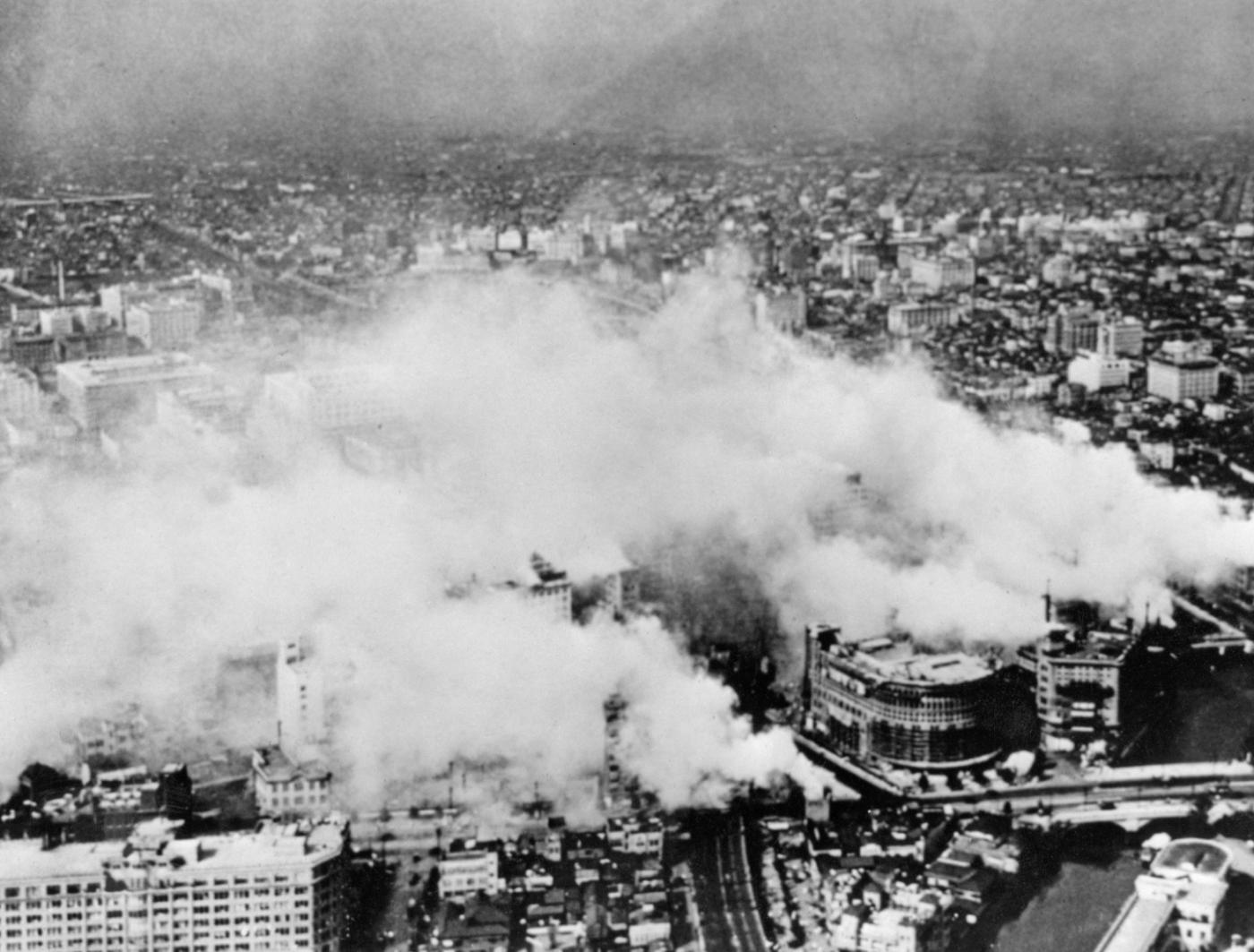
Once the pathfinders had marked the target, wave after wave of B-29s arrived over the city. They dropped nearly 1,700 tons of incendiary bombs in patterns intended to create a firestorm. Tokyo at the time was densely packed with wooden houses, narrow streets, and small workshops that supported Japan’s war effort. When the bombs ignited, thousands of small fires rapidly merged into a massive inferno. High winds and the heat generated by the flames created a firestorm that swept through entire neighborhoods.
Temperatures rose so high that asphalt melted and people were suffocated by smoke or burned alive. Many residents fled toward canals and rivers, only to find themselves trapped as the firestorm consumed bridges and waterfront areas. Emergency services and firefighting units were overwhelmed. By the time the raid ended in the early hours of 10 March, approximately 16 square miles of Tokyo had been destroyed. Estimates of the dead vary, but around 97,000 people were killed, more than a million were left homeless, and vast areas of the city lay in ruins.
Japanese air defenses proved largely ineffective against the low-flying nighttime bombers. Some anti-aircraft guns fired, and a small number of Japanese night fighters attempted interceptions, but they struggled to locate and engage the incoming aircraft in the darkness and smoke. Despite the danger of flying through intense heat and turbulence from the firestorm below, American losses were relatively light. Around 14 B-29 bombers were lost during the mission, some to anti-aircraft fire, others to mechanical failures or crashes on return flights. Considering the scale of the operation and the number of aircraft involved, this was regarded by US commanders as an acceptable loss.
The outcome of the raid had profound effects on both sides. For the United States, the success of the Tokyo firebombing demonstrated that low-altitude incendiary attacks could inflict enormous damage on Japanese cities and industry. It led to a series of similar raids on other urban centers across Japan in the following months. Entire cities such as Osaka, Nagoya, and Kobe were subjected to devastating firebombing campaigns that destroyed large portions of urban Japan.
For Japan, the destruction of Tokyo and the heavy civilian casualties shocked the government and population. The raid exposed the vulnerability of the home islands to sustained aerial attack and contributed to a growing sense that the war was being lost. Industrial production in Tokyo was severely disrupted, and the need to rebuild and care for millions of displaced civilians strained Japan’s already overstretched resources.
Operation Meetinghouse remains one of the deadliest air raids in history and a stark example of total war in the twentieth century. It demonstrated the destructive potential of strategic bombing and raised enduring questions about the targeting of cities and civilian populations. The raid on Tokyo in March 1945 foreshadowed the final months of the war in the Pacific, when American air power would continue to batter Japan until its surrender later that year.