On this day in military history…
Operation Ranch Hand began on 10 January 1962 during the early escalation of the Vietnam War and officially ended in February 1971, making it an operation that lasted just over nine years. It was the United States Air Force’s large-scale aerial herbicide program in Southeast Asia and represented the most extensive chemical warfare–related environmental modification campaign in history.
The fundamental purpose of Operation Ranch Hand was to alter the physical environment of South Vietnam in ways that would disadvantage Viet Cong and North Vietnamese forces. Dense jungle and forest cover gave guerrilla units concealment for movement, supply routes, base camps, and ambush positions. By stripping away foliage, U.S. planners hoped to expose enemy forces, reduce surprise attacks, and make air and ground surveillance more effective. A second major objective was crop destruction. Certain rural areas were believed to be producing food for enemy units, and by killing rice fields and other crops, U.S. commanders intended to reduce the enemy’s ability to sustain itself locally and force reliance on longer, more vulnerable supply lines. A third objective was defensive in nature: clearing vegetation along roads, canals, railways, and around U.S. and South Vietnamese bases to improve visibility and reduce the risk of ambush.
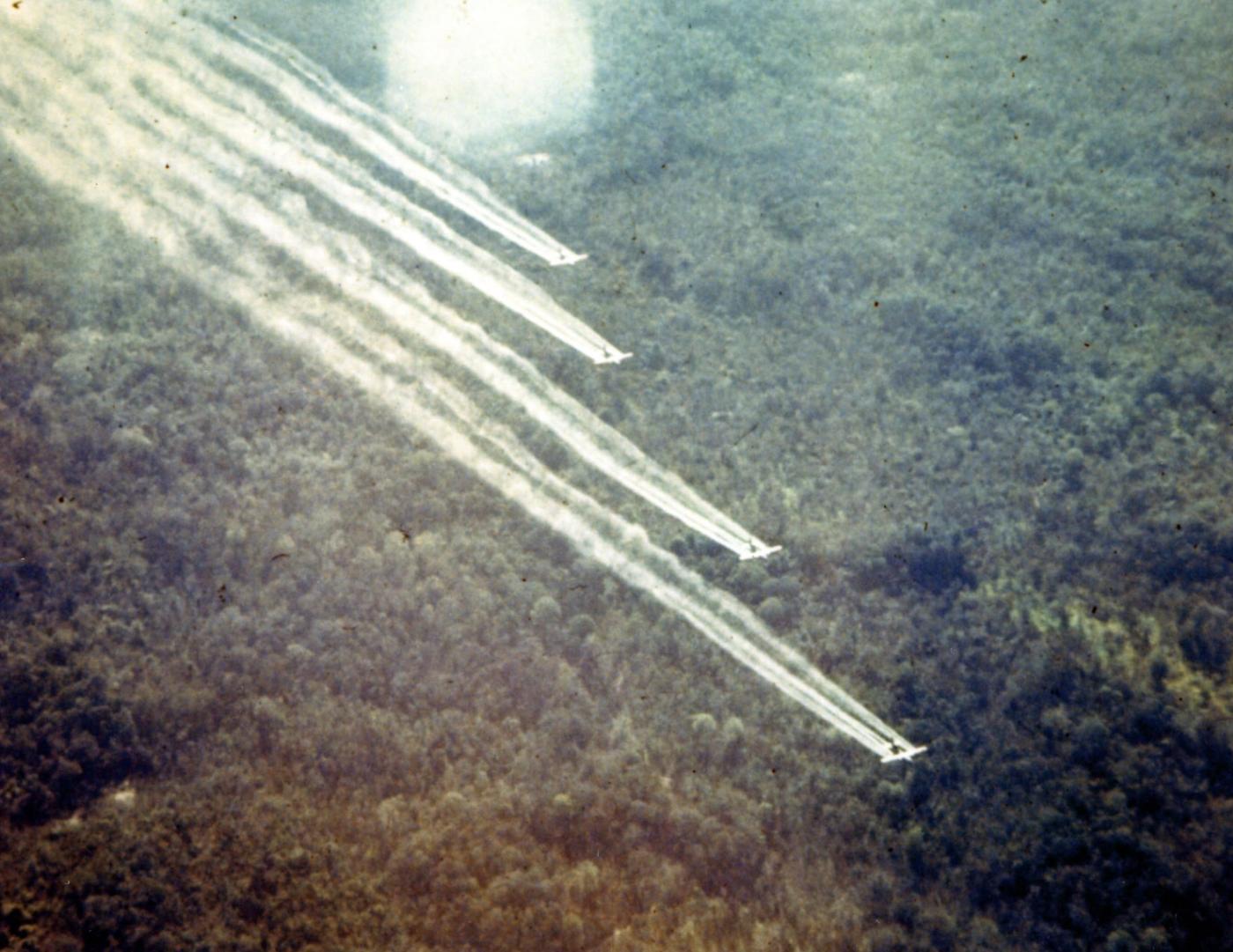
The aircraft most closely associated with Ranch Hand were modified Fairchild C-123 Provider transport planes, designated UC-123s for the spraying role. These aircraft were equipped with internal tanks holding roughly 1,000 gallons of herbicide and fitted with the MC-1 “Hourglass” spray system, which pumped chemicals through booms and nozzles mounted along the wings and fuselage. Missions were typically flown at low altitude and steady speed to ensure an even swath of coverage, which made the aircraft highly vulnerable to ground fire. Ranch Hand crews were among the most frequently shot-at aircrews in the war. While the UC-123 carried out the vast majority of spraying, other platforms and methods were also used in the wider herbicide program, including helicopters, trucks, boats, and backpack sprayers, particularly for clearing base perimeters and nearby lines of communication. Earlier in the program, some C-47 aircraft were also employed in defoliation roles.
The chemicals used were known collectively as the “rainbow herbicides,” named after the colored stripes painted on the storage drums. The most widely used was Agent Orange, a mixture of the herbicides 2,4-D and 2,4,5-T, and it accounted for the largest share of the total sprayed. Agent Orange later became infamous because the manufacturing process for 2,4,5-T resulted in contamination with TCDD, a highly toxic dioxin. Other major chemicals included Agent White, a mixture of 2,4-D and picloram that became more prominent when Agent Orange supplies were restricted, and Agent Blue, an arsenic-based herbicide used primarily to destroy food crops such as rice. Earlier in the program, Agents Pink, Purple, and Green were also used, but these were phased out as operations continued.
In total, approximately 19 million U.S. gallons of herbicides were sprayed over Vietnam by Ranch Hand aircraft between 1962 and 1971, with roughly 11 million gallons of that total being Agent Orange. Additional millions of gallons were applied by non–fixed-wing methods, meaning the overall volume of herbicides released in Vietnam was even higher when ground and helicopter spraying is included. Agent White alone accounted for several million gallons over the course of the program.
The environmental impact was enormous. Millions of acres of land were sprayed at least once, and many areas were sprayed repeatedly. By the end of the program, chemicals had been applied to an estimated one-fifth of South Vietnam’s jungle and forested areas and more than one-third of its mangrove forests. Mangroves were particularly hard hit, as repeated defoliation often killed the trees outright and caused long-term collapse of entire ecosystems. When described in broader terms, estimates commonly state that roughly 10 to 20 percent of Vietnam’s land area was affected by herbicide spraying, with additional areas in neighboring Laos and Cambodia also impacted, especially along infiltration routes.
Assessing whether Operation Ranch Hand was successful depends on how success is defined. From a purely technical standpoint, it achieved its immediate physical goals: vegetation died, forest cover was stripped away, and crops were destroyed over vast areas. However, in strategic and military terms, its effectiveness was far more limited. Viet Cong and North Vietnamese forces adapted by changing routes, timing, and tactics, and defoliation did not prevent them from continuing operations. Crop destruction missions were especially controversial, as they risked harming civilian populations and increasing local resentment. By the late 1960s, growing scientific concern, political opposition, and ethical criticism led to restrictions and, ultimately, the termination of the program in 1971.
Several major air bases were central to Ranch Hand operations. Early missions operated out of Tan Son Nhut Air Base near Saigon, but Bien Hoa Air Base became one of the primary hubs for spraying operations for much of the war. Da Nang Air Base supported missions in the northern and central regions, while other bases such as Nha Trang, Phan Rang, and Phù Cát were used as the operation expanded and shifted geographically. These bases were not only launch points for missions but also sites where herbicides were stored, mixed, loaded, and where aircraft were washed down, which later contributed to severe local contamination.
Among the more striking cultural details of the operation was the unofficial Ranch Hand motto, “Only you can prevent a forest,” a darkly ironic twist on a well-known American wildfire-prevention slogan. The combination of low-level flying, constant exposure to ground fire, and the sheer scale of environmental change made Operation Ranch Hand one of the most distinctive and controversial air operations of the Vietnam War, with consequences that extended far beyond its nine-year operational lifespan.