On this day in military history…
Operation Dexterity was the Allied amphibious offensive conducted along the north coast of New Guinea in late 1943 and early 1944, designed to bypass strong Japanese positions and cut off large enemy forces rather than destroy them head-on. The sailor who exercised overall control of the amphibious phase was Vice Admiral Daniel E. Barbey of the United States Navy, commander of the Seventh Fleet’s Amphibious Force. Barbey was not only the senior naval officer responsible for putting troops ashore but also one of the most experienced practitioners of amphibious warfare in the Southwest Pacific, having refined rapid, surprise landings using shallow-draft ships, preloaded assault waves, and tightly coordinated naval gunfire and air support. His ability to move Army formations quickly along hostile coastlines was central to General Douglas MacArthur’s island-hopping strategy.
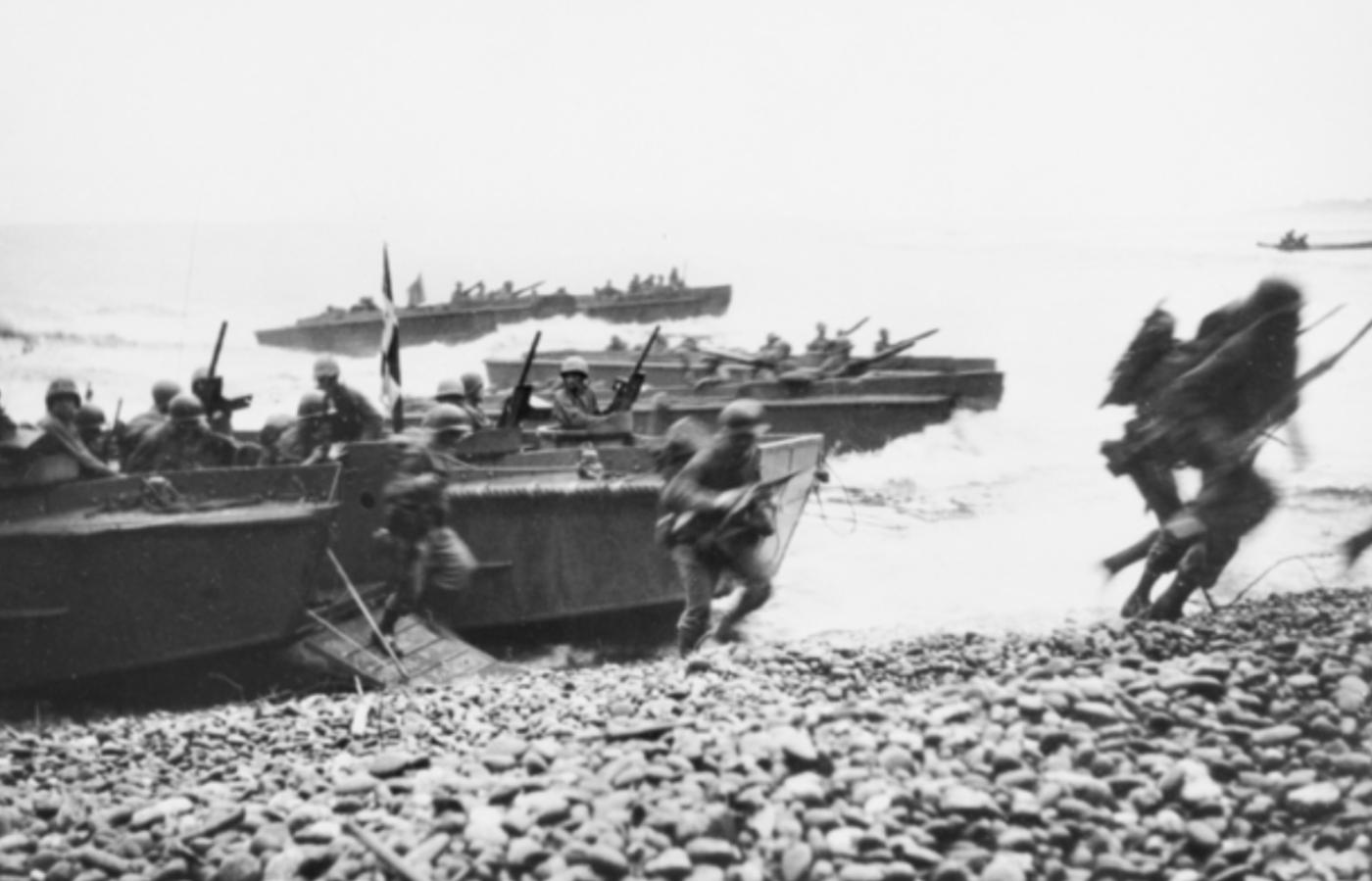
The most important landing under Operation Dexterity took place at Saidor on 2 January 1944. The primary ground force was the U.S. Army’s 32nd Infantry Division, commanded by Major General William H. Gill, with the initial assault carried out by elements of the 126th and 128th Infantry Regiments. Supporting units included divisional artillery, combat engineers, medical detachments, and antiaircraft batteries, all of which had to be landed over open beaches with no developed port facilities. Barbey’s amphibious task force used a mix of attack transports, destroyers, tank landing ships, and landing craft, many of them veterans of earlier New Guinea operations. Escorting destroyers and cruisers provided naval gunfire support, while Allied aircraft dominated the skies, sharply limiting Japanese interference from the air.
When the first waves went ashore, they encountered far less immediate resistance than had been expected from earlier campaigns such as Buna or Salamaua. The Japanese had no large, prepared beach defenses at Saidor because the area had not been intended as a major base. Enemy forces in the region consisted mainly of scattered elements of the Japanese 20th Infantry Division and other units of Lieutenant General Hatazō Adachi’s 18th Army, numbering roughly 3,000 to 5,000 troops in the broader area. Most of these soldiers were already weakened by disease, shortages of food, and the effects of constant Allied air attacks while retreating eastward from earlier defeats. Instead of meeting the Americans at the waterline, Japanese units attempted to avoid direct confrontation, slipping inland into the jungle or moving along narrow coastal tracks.
Although opposition at the beaches was light, the Americans soon discovered that the environment itself was a formidable enemy. Dense jungle, swamps, heavy rainfall, and oppressive heat slowed movement and complicated supply. Japanese resistance took the form of ambushes, sniper fire, and small delaying actions, often conducted by platoon- or company-sized groups familiar with the terrain. These encounters were rarely large battles but were dangerous and exhausting, especially as the Japanese attempted to break through American lines while retreating westward. The 32nd Division engaged in a series of patrol clashes and skirmishes rather than set-piece engagements, gradually tightening control of the area around Saidor and its newly built airstrip.
An interesting aspect of Operation Dexterity was how completely it demonstrated the maturity of Allied joint operations in the Pacific by early 1944. Barbey’s sailors unloaded men, vehicles, artillery, and supplies with remarkable speed, often completing landings in a matter of hours. Naval construction battalions and Army engineers quickly turned muddy clearings into functional airfields, allowing Allied aircraft to operate from Saidor within days. This rapid build-up effectively sealed the fate of Japanese forces farther east at Wewak, which were left isolated, short of supplies, and unable to maneuver.
By the time organized fighting around Saidor subsided, the Japanese had suffered significant losses through combat, starvation, and illness, while the Allies achieved their objective at relatively low cost. Operation Dexterity did not become famous for dramatic beach assaults or massive battles, but it was a textbook example of strategic amphibious warfare. Under Barbey’s naval leadership, the landings showed how control of the sea and air could render enemy ground forces irrelevant, turning geography itself into a weapon and accelerating the Allied advance toward the Philippines.