
On this day in military history…
The Christmas Truce of 1914 remains one of the most remarkable and unexpected moments of humanity during the First World War. It took place during the first winter of the conflict, in December 1914, when the war was still young and the realities of prolonged trench warfare had not yet hardened soldiers on all sides. Although not universal along the Western Front, several stretches of the line fell silent as British, French, and German troops spontaneously laid down their arms, stepped out of their trenches, and met in the frozen landscape of no man’s land.
In many areas, the truce began on Christmas Eve. German units decorated their trenches with candles, lanterns, and small Christmas trees sent from home. They sang carols that drifted across the frosty air—among them Stille Nacht, which the British troops recognized as Silent Night. Soon, Allied soldiers responded with their own songs. What began as distant voices sharing familiar tunes turned into shouted greetings, offers of cigarettes, and a cautious wave of hands above the parapets.
Despite explicit orders from higher command on both sides forbidding fraternization, officers close to the front often found themselves unable or unwilling to stop the men. Many soldiers had endured the same miserable conditions—mud, cold, lice, and the constant threat of death. The chance, even for a short time, to act like ordinary human beings rather than enemies was too powerful to ignore.
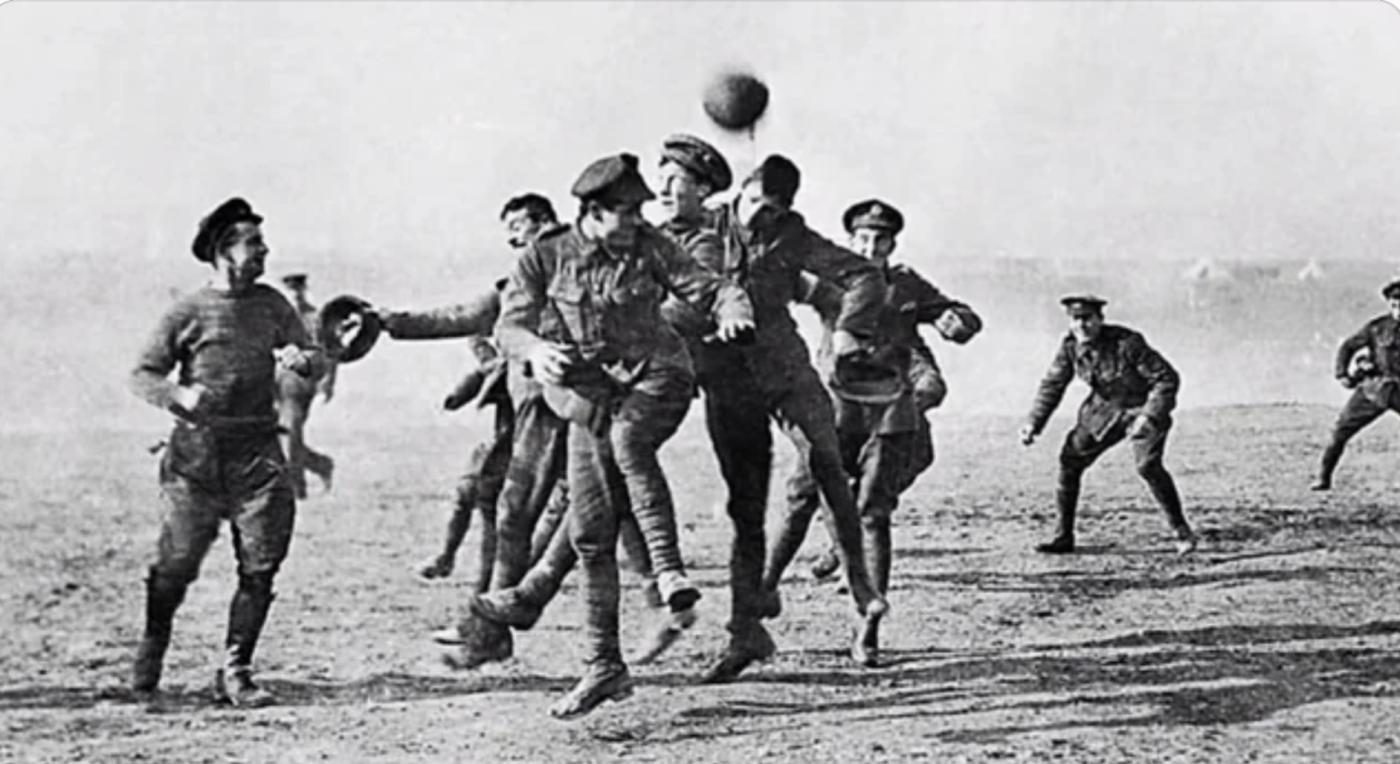
By Christmas morning, men climbed out into no man’s land. They shook hands, exchanged food, chocolate, tobacco, and small gifts. Some units used the lull to retrieve and bury the dead who had lain between the trenches for weeks. Others posed for photographs, a rare and astonishing record of peace in the middle of a brutal war.
One of the most famous stories from the truce is the football matches that took place. While accounts differ—some describing informal kickabouts and others claiming more organized games—there is little doubt that footballs were produced and that soldiers played on the churned, icy ground. The Germans were often noted as strong players, and the British units joked afterward that they lost more goals than they cared to admit. Though not every section of the front participated, these matches have become lasting symbols of the moment.
The truce did not last long. By December 26th in most areas, officers had reasserted command and artillery fire resumed. In some quieter sectors, the friendly behavior lingered for a few days, but the high commands of all nations quickly issued strict orders to prevent anything similar from happening again. As the war progressed and the fighting grew far more bitter, nothing like the Christmas Truce of 1914 occurred again on such a scale.
Among the interesting details recorded in letters and diaries is the observation that many soldiers recognized the absurdity of the conflict when standing face-to-face with men their own age who had families, jobs, and dreams very much like their own. Some wrote home describing the Germans as polite, curious, and weary of war, just as they themselves were. A few even exchanged addresses, hoping to write after the war ended.
The Christmas Truce of 1914 has since become a powerful reminder of the shared humanity that can persist even in the darkest circumstances. Although it changed nothing about the course of the war, its memory endures as one of the most extraordinary events of the First World War, revealing that for a brief moment in the winter of 1914, peace managed to find its way into the trenches.