On this day in military history…
On 19 December 1944, three days after the Germans launched their surprise Ardennes offensive known as the Battle of the Bulge, General Dwight D. Eisenhower convened a critical commanders’ conference to determine how to halt the rapidly unfolding crisis. The meeting took place at the headquarters of the 21st Army Group in a small schoolhouse in Verdun, France. The location had been chosen for its relative centrality to the northern and southern Allied commands, and because the speed of the German advance demanded an urgent, face-to-face discussion among the highest-ranking Allied leaders in the European Theater.
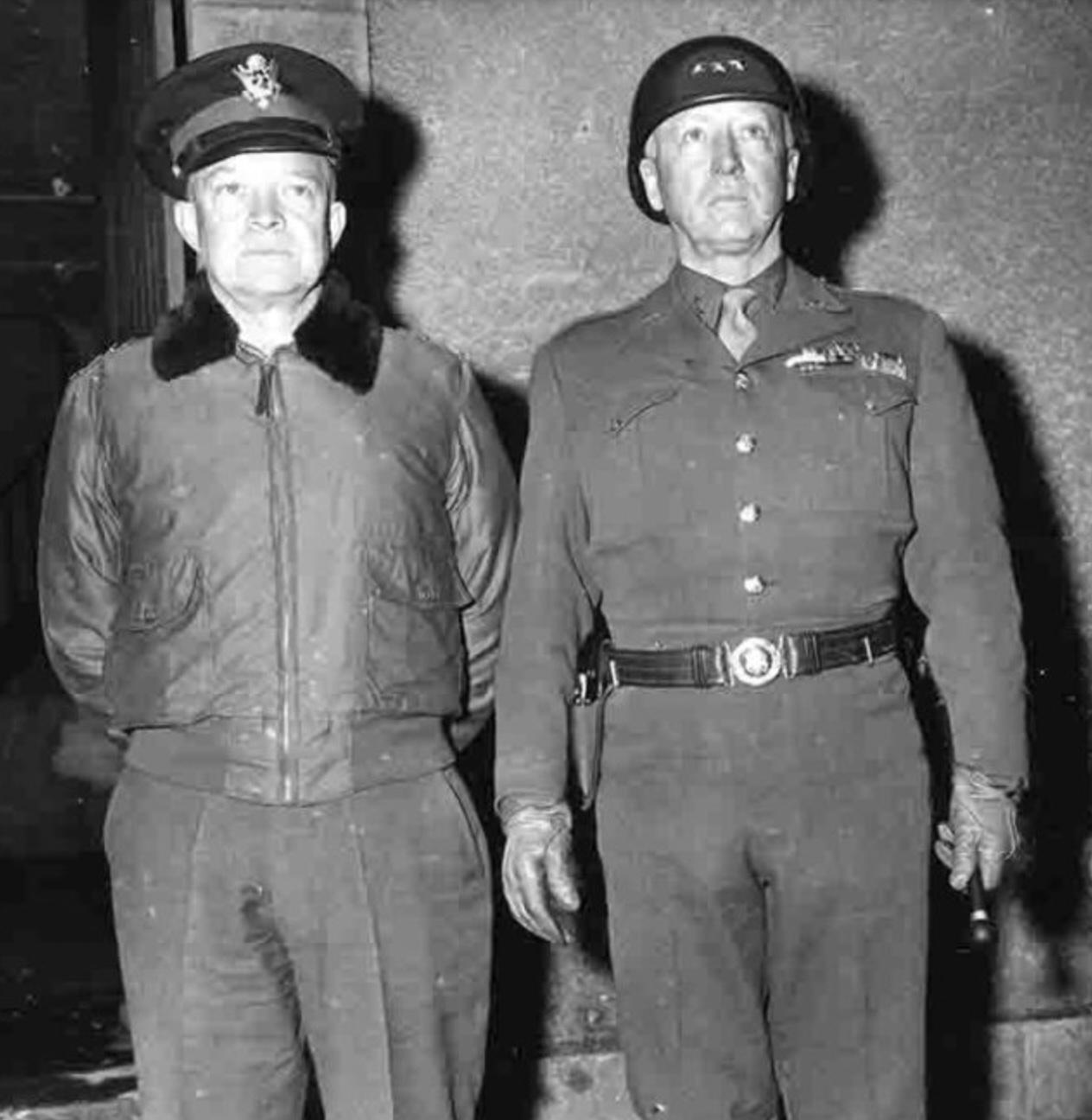
Present at the meeting were several of Eisenhower’s most important senior commanders. These included General Omar Bradley of the 12th Army Group, whose forces had been directly struck by the German attack; Field Marshal Bernard Montgomery, commanding the 21st Army Group in the north; Lieutenant General Courtney Hodges, commander of the U.S. First Army; Lieutenant General William Simpson of the U.S. Ninth Army; and Lieutenant General George S. Patton, who commanded the U.S. Third Army to the south. Also in attendance were key staff officers such as Eisenhower’s chief of staff, Lieutenant General Walter Bedell Smith.
At the time of the meeting, the Germans had succeeded in creating a deep bulge in the Allied lines, rupturing the American front and driving west toward the Meuse River. Eisenhower’s commanders initially offered differing assessments of how to respond. Bradley was concerned about the severity of the penetration and the impact on the First Army, and he emphasized the need to stabilize the front before any large-scale maneuver could begin. Patton, on the other hand, arrived with the secret knowledge that his staff had already prepared contingency plans that would allow the Third Army to pivot north toward the Ardennes with extraordinary speed. Montgomery, whose forces on the northern flank were also threatened, argued for a coordinated, measured counterstroke that ensured the Allies retained control of their supply organization and avoided being drawn into hasty, piecemeal actions.
An interesting detail often noted by eyewitnesses is the atmosphere in the room—calm, analytical, and not marked by panic. Eisenhower, despite the surprise and severity of the German attack, projected confidence. He reminded his commanders that the German offensive, although dangerous, required tremendous resources the enemy could no longer easily replace. If the Allies could contain the bulge and then counterattack from both north and south, the Germans would exhaust themselves.
During the meeting, Eisenhower made the key decision to shift operational control of the U.S. First and Ninth Armies temporarily to Montgomery’s command. This was a practical move based on the fact that the German attack had severed communications between Bradley’s 12th Army Group headquarters and Hodges’s First Army. Montgomery’s command post, located further north, had more reliable communication with the threatened units, making centralized control and coordination feasible during the crisis.
Patton then detailed his readiness to wheel the Third Army ninety degrees northward, a maneuver that was unprecedented in speed for such a large formation. Eisenhower approved Patton’s proposal, recognizing that a rapid relief of the besieged town of Bastogne would be essential. Hodges agreed to hold the northern shoulder of the German advance with the First Army while Patton attacked from the south. Simpson’s Ninth Army would help secure the northern flank in cooperation with Montgomery’s forces. This created a plan for a classic pincer movement, designed to absorb the German blow and then collapse the bulge from both sides.
By the end of the conference, the commanders had accepted a unified strategy: hold firm on the shoulders of the enemy penetration, preserve the integrity of the Allied lines, and launch coordinated counteroffensives once the German momentum stalled. The meeting also confirmed Eisenhower’s belief that the German offensive, though initially successful, had overextended itself and could be turned into an Allied opportunity.
The decisions made in the schoolhouse at Verdun on 19 December proved decisive. Patton’s rapid maneuver succeeded, the northern flank held under Montgomery, and the German advance was ultimately halted, exhausted, and rolled back. What emerged from the meeting was not only a coordinated military response but a demonstration of how Allied leaders, despite different personalities and operational styles, could unite in the face of sudden crisis to produce a coherent and successful plan.