On this day in military history…
Operation Linebacker II, often called the Christmas Bombings, was an eleven-day strategic air campaign conducted by the United States in December 1972. It was ordered by President Richard Nixon to force North Vietnam back into serious negotiations after talks in Paris had stalled. It became the most concentrated and intense use of heavy bombers since the Second World War and remains one of the most scrutinised air operations in modern history.
The centrepiece of the campaign was the B-52 Stratofortress, a long-range strategic bomber normally assigned to nuclear deterrence missions. During Linebacker II, 207 B-52s were deployed from Andersen Air Base on Guam and U Tapao in Thailand. Across the operation they flew more than 700 sorties against heavily defended targets in the Hanoi and Haiphong regions, dropping around 15,000 tons of bombs. The raids targeted rail networks, power stations, military storage areas, command centres, airfields, and surface-to-air missile sites, striking at the essential infrastructure that sustained North Vietnam’s war effort.
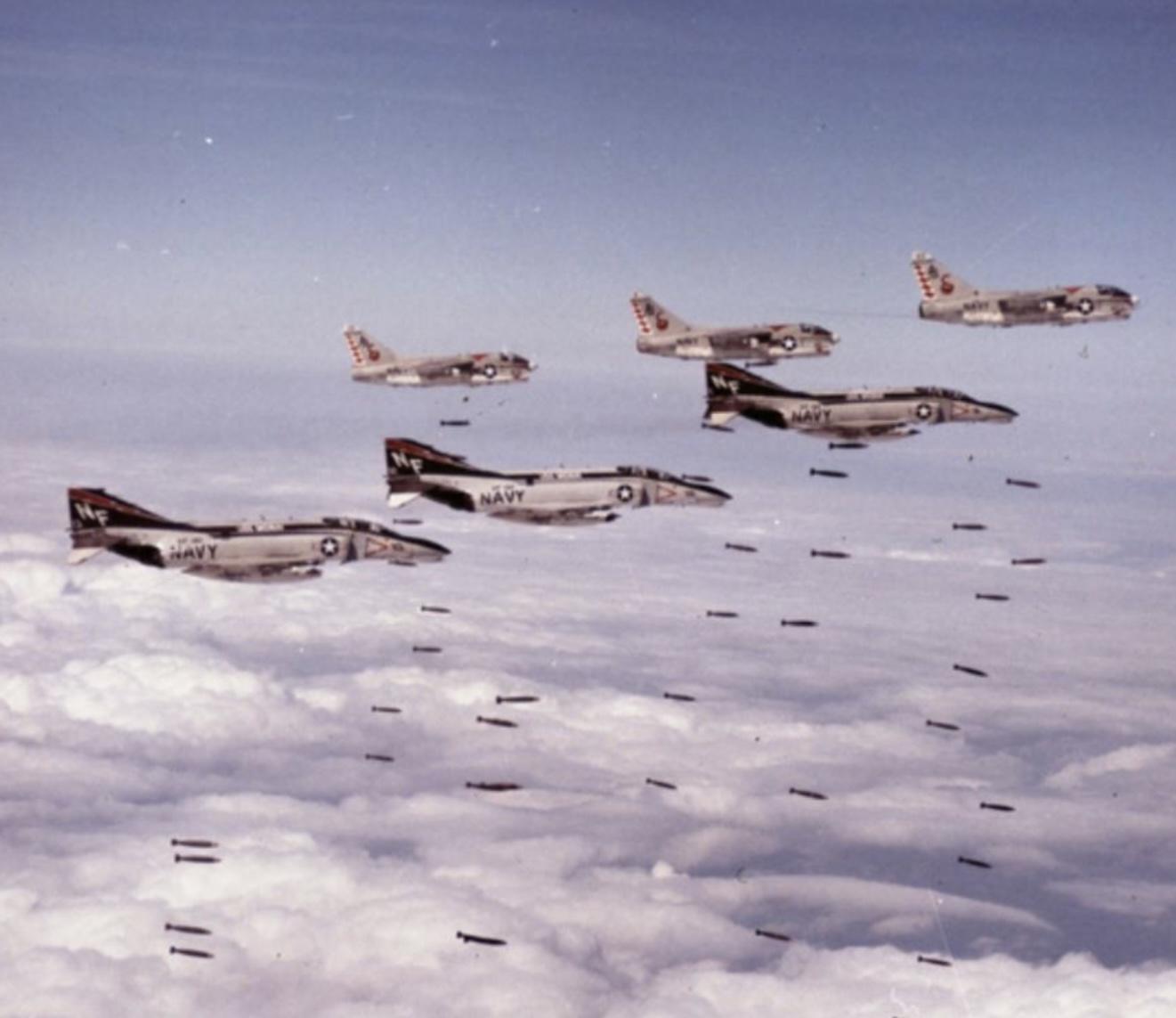
Supporting aircraft were a vital part of the operation. F-4 Phantom IIs escorted bomber formations and conducted additional bombing and air-to-air missions. F-105G Wild Weasel squadrons performed dangerous suppression missions against missile batteries. Navy A-6 Intruders and A-7 Corsairs carried out night attacks from carriers in the Gulf of Tonkin. Electronic warfare aircraft such as EB-66s disrupted enemy radar, and KC-135 tankers maintained continuous refuelling support for bombers travelling from long-distance bases.
North Vietnam’s air-defence network was one of the most sophisticated in the world at the time, built with extensive Soviet assistance. It included a wide array of SA-2 Guideline missiles, thousands of anti-aircraft guns, and a coordinated radar and command system designed to target high-altitude bombers. During the first three nights of Linebacker II, U.S. bomber formations followed predictable routes, altitudes, and timing, and this allowed North Vietnamese crews to achieve notable success. Nine B-52s were shot down in the opening phase; by the end of the campaign, a total of 15 B-52s had been lost. Around 33 American crewmen were killed or went missing, while many others were captured or rescued after ejecting.
The bombings inflicted significant destruction across northern Vietnam. Rail lines linking Hanoi to China were severely disrupted, storage depots and communication centres were heavily damaged, and several key power-generating sites were rendered inoperative. Civilian casualties remain difficult to establish precisely, with Western estimates ranging from roughly 1,000 to 1,600 deaths, while North Vietnam later reported lower but still substantial numbers. Large areas of industrial districts in Hanoi sustained major damage.
After the initial losses, U.S. planners changed tactics to reduce the predictability of the bomber formations. Routes, altitudes, timing, and electronic-jamming methods were varied more aggressively, making it harder for missile crews to anticipate attacks. Once these modifications were implemented, B-52 losses dropped sharply. During the final seven nights of the operation, only two B-52s were shot down despite continued large-scale bombing.
The strategic aim of Linebacker II was to pressure North Vietnam into returning to the negotiating table. In that respect it succeeded. Hanoi returned to Paris in early January 1973 and agreed to terms similar to those offered before the bombings. This led directly to the Paris Peace Accords, the withdrawal of U.S. forces from Vietnam, and the release of American prisoners of war. However, the campaign did not change the long-term course of the conflict, and South Vietnam fell in 1975.
General John C. Meyer, commander of Strategic Air Command, played a central role in overseeing the B-52 operations. Accounts from aircrew describe the extraordinary intensity of the missions, flying into one of the most heavily defended airspaces ever encountered while dropping thousands of tons of bombs in tightly coordinated waves. Many crew members later recalled the horizon glowing with the flashes of multiple bomb impacts, a sight both unforgettable and sobering.