On this day in military history…
The capture of El Agheila in December 1942 marked one of the most important turning points in the North African campaign, showcasing the revitalised strength of the British Eighth Army under General Bernard Montgomery. Though sometimes overshadowed by the more dramatic battles at El Alamein, the operation at El Agheila was a carefully planned and well-executed maneuver that forced the Axis armies into a long retreat across Libya, setting the stage for the final battles in Tunisia.
The plan to take El Agheila was conceived by Montgomery soon after the Eighth Army’s victory in the Second Battle of El Alamein, which ended on 4 November 1942. The Axis forces under Field Marshal Erwin Rommel had withdrawn westward in haste, falling back along the Libyan coast. El Agheila, located on the southern edge of the Gulf of Sidra, had always served as one of Rommel’s favoured defensive positions. Its geography, with narrow coastal bottlenecks and desert expanses difficult for tanks to maneuver through, provided natural protection. Rommel had used it successfully in early 1942 during his advance into Libya, and he intended to do so again.
Montgomery, however, understood that a straightforward frontal assault on El Agheila would be costly and slow. Instead, he planned a wide outflanking movement using the desert to the south, a maneuver designed to encircle Rommel’s weakened army and cut off its escape route. This plan was based on intelligence reports showing the Axis forces were short on fuel, supplies, and reinforcements. Montgomery waited deliberately, building up supplies and reorganizing his units throughout November 1942. By early December the Eighth Army was ready.
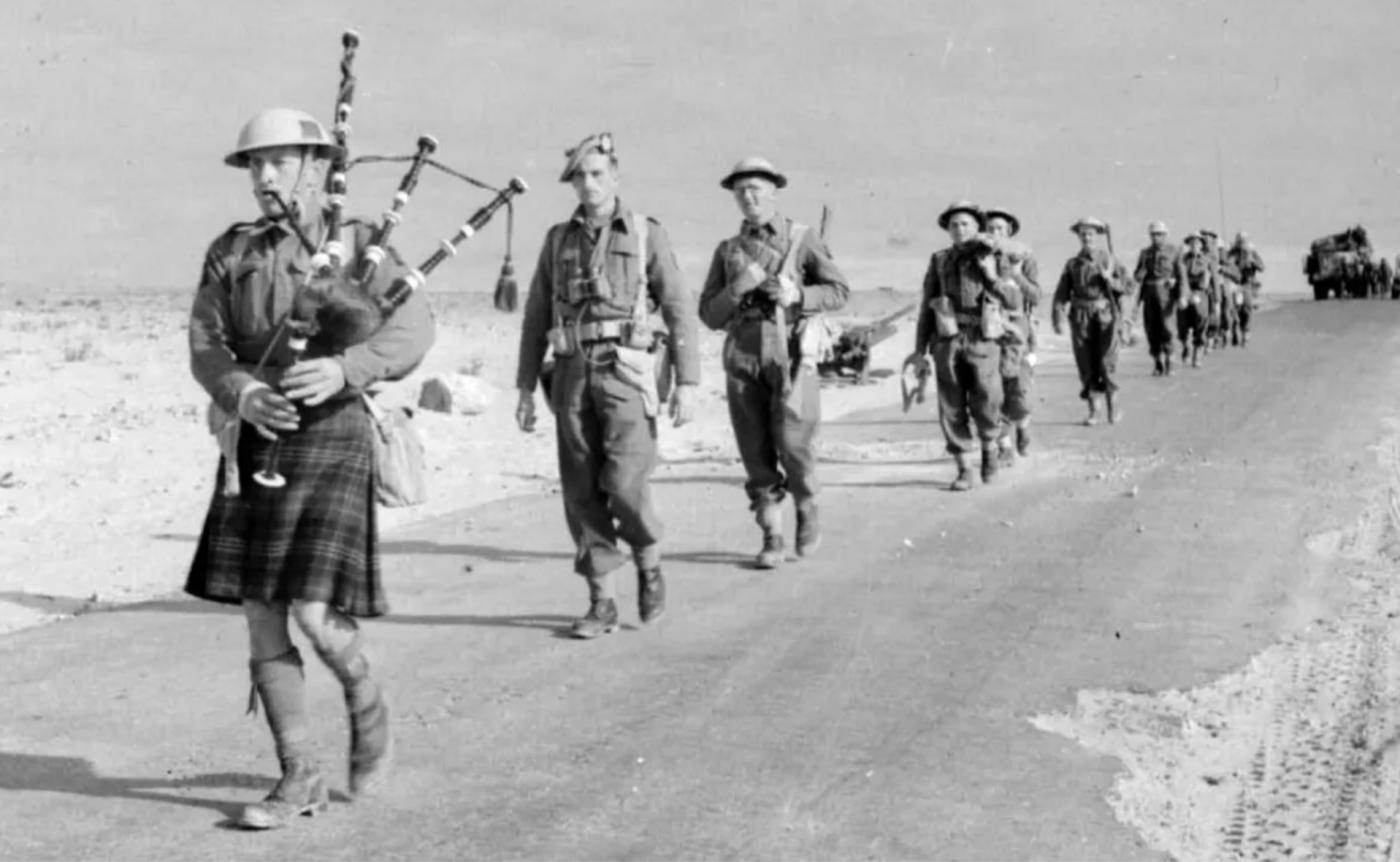
The operation began on 11 December 1942. The main body of the Eighth Army advanced cautiously along the coast, creating the impression of a frontal attack. Meanwhile, the New Zealand 2nd Division, supported by British armoured brigades, executed the bold southern sweep. They moved far into the open desert, looping around Rommel’s right flank with the goal of cutting the main road west of El Agheila at a point near Marble Arch. This movement covered difficult terrain and required careful navigation, but the troops had been intensely trained in desert warfare by this stage of the campaign.
Rommel, despite being ill and awaiting reinforcements that never arrived, was not ignorant of the threat. German and Italian reconnaissance detected the wide sweep to the south, and Rommel quickly recognized the risk of encirclement. The Afrika Korps and Italian units attempted to delay the Eighth Army with rearguard actions, mines, and booby traps. However, their ability to slow the British advance was limited by chronic shortages of fuel and transport. Rommel even ordered some of his remaining panzers to conduct small counterattacks to confuse the British, but these efforts were largely symbolic. By mid-December, with the New Zealanders closing in behind him, Rommel decided that holding El Agheila was impossible. On 15 December 1942 he withdrew again, this time toward Buerat and Tripoli.
The Eighth Army entered El Agheila on late evening of 16 December into morning of 17th with surprisingly little resistance, finding that Rommel had slipped away just in time. Although the British encirclement was not completed as tightly as Montgomery had hoped, the operation was nonetheless a strategic success. It demonstrated the increasing mobility and coordination of the Eighth Army while highlighting the deteriorating state of the Axis forces in North Africa. Rommel himself wrote later that the retreat from El Agheila convinced him the war in Africa was unwinnable without major reinforcements.
Readers may find it interesting that the desert sweep used at El Agheila was one of the largest such maneuvers attempted in the North African campaign, involving long-range navigation across areas with no roads and few landmarks. Another detail worth noting is that Montgomery’s insistence on rebuilding logistical stockpiles before launching the attack, sometimes criticized at the time, proved crucial; without steady fuel and water supplies the outflanking force could not have operated so deep in the desert.
The fall of El Agheila ended Rommel’s last credible chance to stabilize the front in Libya. From this point onward the Eighth Army maintained pressure all the way to Tripoli, capturing the city in January 1943. The success of the operation illustrated the shift in momentum in North Africa, from a campaign once dominated by the swift maneuvers of the Afrika Korps to one in which Allied superiority in planning, supply, and manpower was firmly established.