On this day in military history…
Operation Wintergewitter, known as Operation Winter Storm, was the German attempt in December 1942 to break the Soviet encirclement of the German 6th Army trapped in Stalingrad. It was led by Colonel General Hermann Hoth, commander of the 4th Panzer Army, who had been ordered by Field Marshal Erich von Manstein’s Army Group Don to advance from the southwest, cut through Soviet lines, and open a corridor to General Paulus’s encircled forces.
The main striking force was the LVII Panzer Corps under General Friedrich Kirchner. Its operational backbone consisted of the newly arrived 6th Panzer Division, transferred urgently from France, supported by the 23rd Panzer Division and the 17th Panzer Division, along with elements of the 15th Luftwaffe Field Division covering flanks. The 6th Panzer Division brought some of the best equipment available: roughly 150–170 tanks on arrival (primarily Panzer III and IV models, including long-barrel variants), more than 30 armored cars, around 50 self-propelled guns, and well over 100 pieces of field artillery and anti-tank guns. The 23rd and 17th Panzer Divisions were considerably weaker, many of their tanks worn down by months of fighting on the Don and Caucasus fronts. Altogether, the offensive fielded roughly 50,000–55,000 men, around 250–300 operational tanks across the participating divisions, and several hundred artillery pieces, though exact figures fluctuated daily due to breakdowns and fuel shortages.
Manpower was only part of the challenge; fuel and ammunition were just as decisive. The Germans were forced to concentrate scarce supplies for this single thrust despite the enormous logistical strain across the southern front. Even the 6th Panzer Division, rushed from Western Europe by rail, arrived without its full complement of vehicles. Winter temperatures plunged to –20°C and below, slowing engines, freezing lubricants, and making weapons maintenance difficult. Luftwaffe support was limited because much of its air fleet was committed to the doomed airlift into Stalingrad, one of the most overstretched air operations of the war.
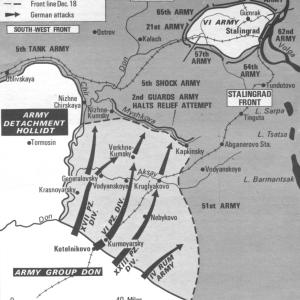
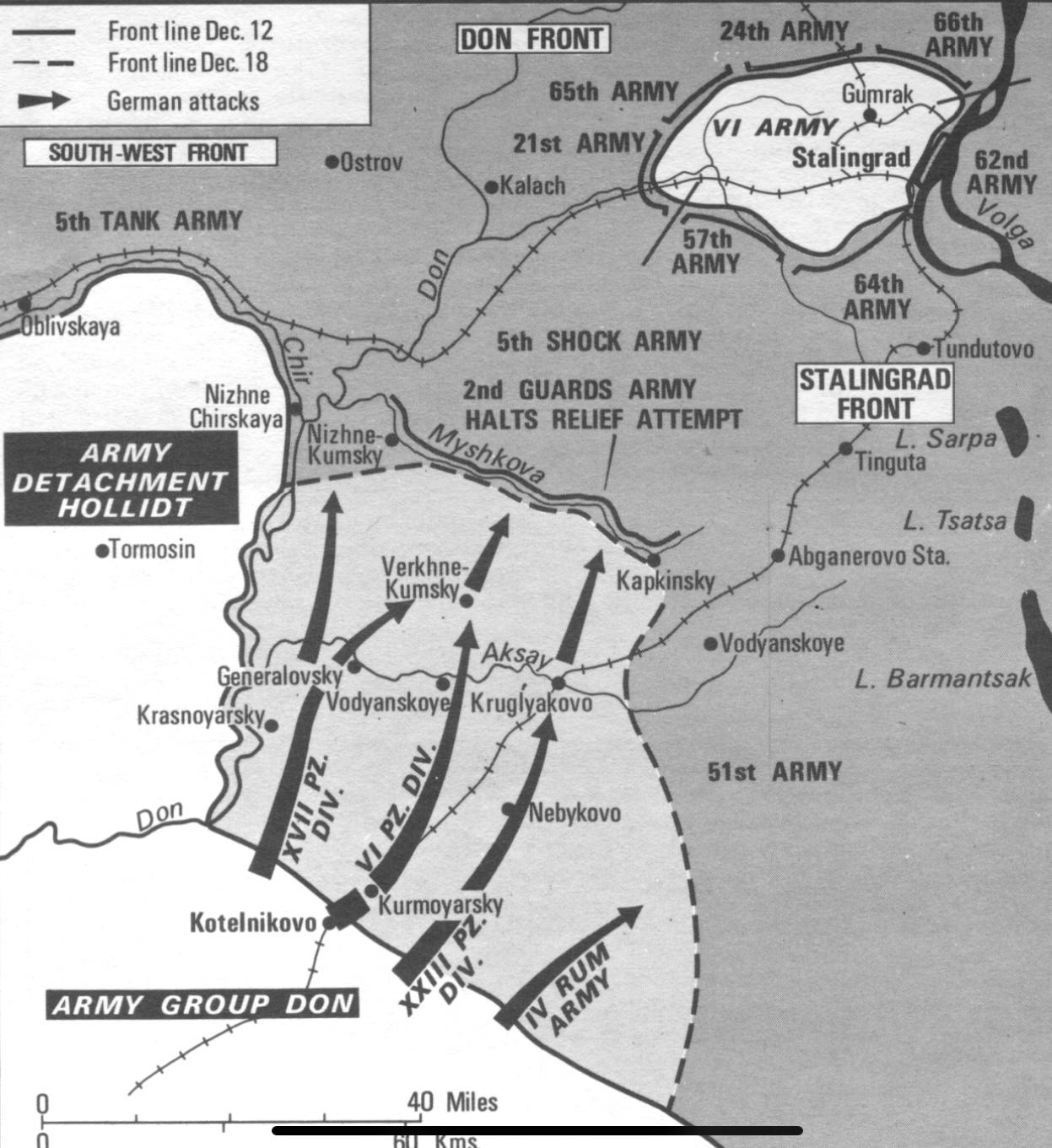
The operation’s purpose was clear: advance along the Chir and Aksay Rivers, break through Soviet 51st and 57th Armies, and reach the outer ring of the Stalingrad encirclement at the Myshkova River. Once there, Paulus was expected to execute Operation Thunderclap, a breakout to meet Hoth’s panzers halfway. However, Paulus refused to move without Hitler’s explicit order, and Hitler insisted the 6th Army hold Stalingrad as a “fortress.” As a result, Hoth’s spearheads were advancing toward a stationary objective rather than a coordinated link-up.
The offensive began on 12 December 1942, achieving rapid initial successes. The 6th Panzer Division smashed through Soviet forward defensive belts, retaking towns such as Verkhne-Kumsky after brutal fighting. At several points, the Germans were less than 50 kilometers from Stalingrad’s pocket. Soviet command, however, shifted reserves quickly. The 2nd Guards Army under Rodion Malinovsky, newly arrived and better equipped, struck back at the Myshkova River line. Its fresh infantry, T-34 brigades, and strong artillery presence gradually halted the German momentum. By 23–24 December, Hoth’s advance stalled. Facing possible encirclement of their own, Manstein ordered a withdrawal. Operation Winter Storm officially ended with the German troops falling back to their starting positions by 27 December.
The effort failed for several interlocking reasons. The German force, though elite in parts, was too small to break through the increasingly reinforced Soviet defenses. Logistics, especially fuel supply, were insufficient for sustained offensive action. Most decisive was the lack of coordinated movement from Stalingrad itself; Paulus’s immobile army, starving and exhausted, could not participate in a breakout even if ordered. Soviet command also reacted far more quickly than the Germans anticipated, committing entire armies to stop the relief attempt.
Interesting historical notes include the fact that 6th Panzer Division’s commander, Erhard Raus, later wrote detailed accounts describing the fighting around Verkhne-Kumsky as some of the most brutal close-quarters armor battles he had experienced. Another often forgotten detail is that Soviet cavalry units played a surprisingly large role in the counterattacks along the open steppe, exploiting mobility that German mechanized units lacked due to fuel shortages. Winter Storm also revealed a striking contrast: the freshly equipped Soviet 2nd Guards Army possessed more tanks and artillery than the entire German relief force, a sign of the rapidly shifting balance on the Eastern Front.
The end of Winter Storm sealed the fate of the 6th Army. With no possibility of rescue, its eventual surrender on 2 February 1943 marked one of the most decisive turning points of World War II, symbolizing the end of large-scale German strategic offensives in the east and the beginning of a long, relentless Soviet advance westward.