On this day in military history…
The sequence of events that led Germany and Italy to declare war on the United States unfolded rapidly in December 1941, in the tense days following the Japanese attack on Pearl Harbor. Although Japan struck first, the decisions made in Berlin and Rome were neither automatic nor inevitable. They were shaped by prior commitments, ideological calculations, diplomatic misjudgments, and the personal choices of individual leaders. The American response, in turn, transformed what had been largely a European conflict into a fully global war.
On December 7, 1941, as news of the destruction at Pearl Harbor reached Europe, Adolf Hitler was in his headquarters, the Wolfsschanze in East Prussia. Germany was bound to Japan through the Tripartite Pact of 1940, but the pact required assistance only if one member was attacked, not if it initiated hostilities. Japan had attacked first, so Hitler faced no legal obligation to join the war against the United States. Still, the German leadership interpreted the moment through a mixture of strategic hope and ideological certainty. Hitler believed the United States was already acting as a de facto belligerent due to its support for Britain through Lend-Lease, its naval patrols in the Atlantic, and the undeclared naval conflict already underway between German U-boats and American escort vessels. To him, formal war merely recognized a reality he thought would soon escalate regardless.
In Rome, Benito Mussolini followed developments from Palazzo Venezia. Italy’s military position in North Africa was deteriorating, and Mussolini viewed an American entry into the war on Britain’s side as an eventual certainty. He had no desire to appear as though Italy were being dragged reluctantly behind German decisions. The Italian leadership also hoped that honoring its alliance with Germany would ensure continued German military and economic support, which Italy increasingly depended on.
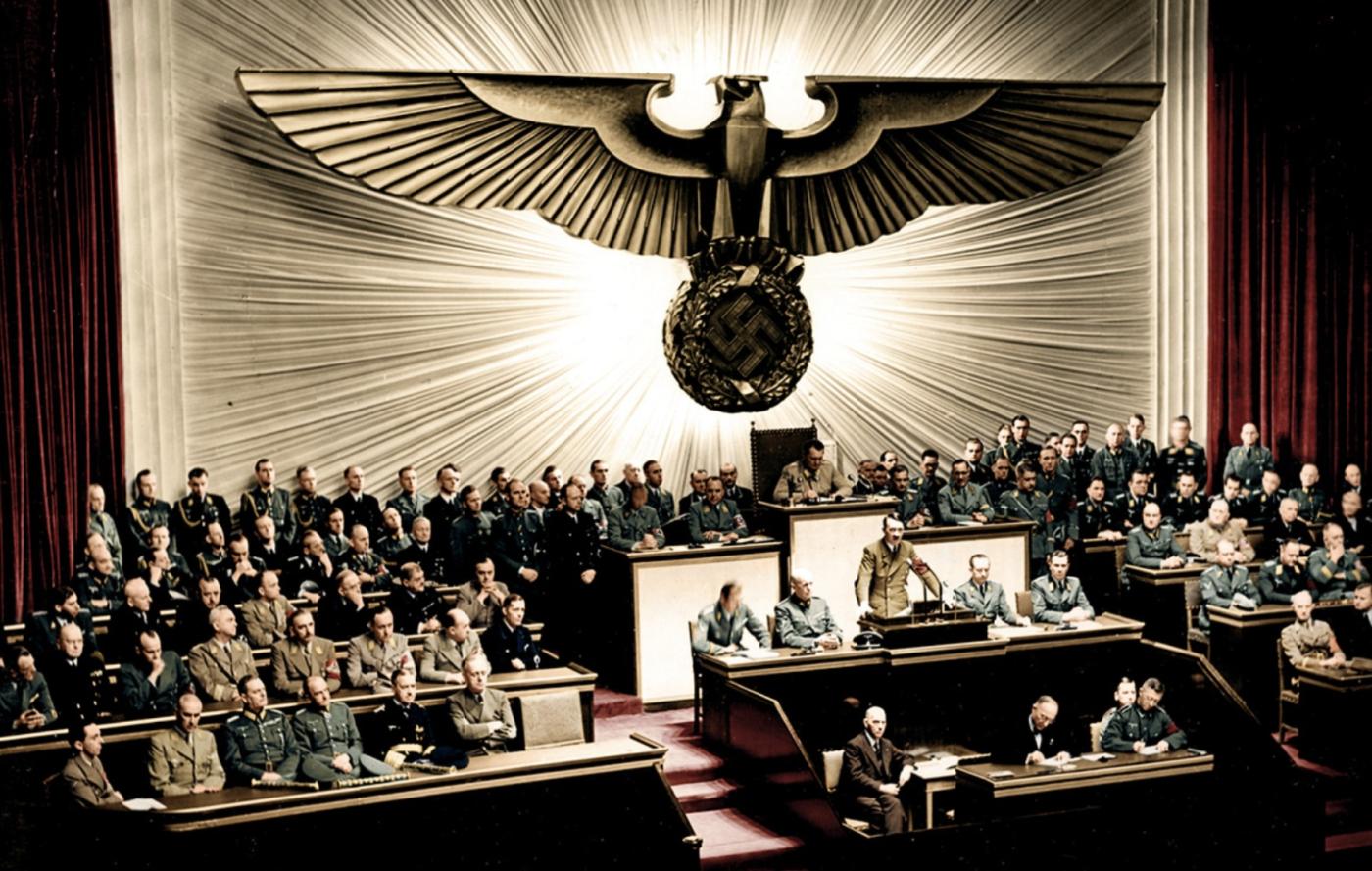
Hitler made his decision before Mussolini. On December 11, 1941, Foreign Minister Joachim von Ribbentrop stood before the Reichstag in Berlin and read Germany’s declaration of war on the United States. The declaration claimed that Franklin D. Roosevelt had repeatedly violated international law through American naval actions in the Atlantic and accused the United States of provoking Germany for months. The speech was broadcast across the country, presented as a necessary response to American aggression, although the strategic reality was that Germany had just opened itself to another massive industrial opponent.
Within hours, Mussolini issued Italy’s own declaration. The announcement was made from Rome by Dino Alfieri, the Italian ambassador to Berlin, with Mussolini later addressing the Italian public. Italy echoed German accusations that the United States had taken the side of Britain long before Pearl Harbor. Unlike Germany’s carefully staged presentation, Italy’s declaration carried a tone of compelled inevitability rather than nationalist triumph. The Italian leadership understood their limited capacity to wage war against a distant industrial superpower but followed Germany to preserve the alliance.
In Washington, DC, the American response was swift and unified. President Franklin D. Roosevelt sent a message to Congress asking for a declaration of war on Germany and Italy, emphasizing that the Axis powers had chosen to widen the conflict unprovoked. Congress acted the same day, December 11, 1941, approving both declarations with minimal dissent. This mirrored the unity seen after the Pearl Harbor attack, but now extended the conflict to the European theater explicitly and with overwhelming public support.
American retaliation came not as a single dramatic event but as an expanding war effort across multiple fronts. The United States Navy intensified its operations in the Atlantic, shifting from defensive escort actions to a full-scale anti-submarine campaign. American industrial mobilization accelerated, directing enormous resources toward supporting Britain and the Soviet Union while preparing for independent operations. Military planning, coordinated with British leaders in Washington and London, laid the groundwork for campaigns in North Africa, the Mediterranean, and eventually Western Europe.
The first direct American combat operations against Germany occurred not on the continent but in the North Atlantic, where U.S. naval forces began aggressive offensive patrols. Soon after, American troops arrived in Northern Ireland in early 1942, marking the first deployment of U.S. ground forces to Europe during the war. The eventual landings in North Africa in November 1942, conducted under American command as Operation Torch, became the first major American-led offensive against the Axis in the European-Mediterranean theater.
The declarations of war by Germany and Italy were made in the ceremonial halls of the Reichstag and the administrative offices of the Italian government, but their consequences were felt far beyond Berlin and Rome. These decisions transformed the strategic balance of the war. By formally entering into conflict with the United States, the Axis powers guaranteed that the world’s largest industrial economy would be fully mobilized against them. America’s response—speedy, coordinated, and massive—reshaped the war’s trajectory, ensuring that the conflict would become not just global in geography but global in economic and military scale.