On this day in military history…
The loss of HMS Prince of Wales and HMS Repulse on 10 December 1941, in the waters off the east coast of Malaya, stands as one of the most dramatic moments of the early Pacific War. Only three days after Japan struck Pearl Harbor, the two capital ships of the Royal Navy’s newly arrived Force Z were caught at sea without air cover and destroyed in a concentrated aerial assault that marked the end of the battleship era.
The British plan had been driven by urgency from the moment Force Z was assembled. Built around the modern battleship Prince of Wales under Captain John Leach and the older but swift battlecruiser Repulse commanded by Captain William Tennant, the force sailed from Singapore on 8 December 1941. Their aim was to intercept Japanese invasion convoys moving down the Malay Peninsula. Admiral Sir Tom Phillips, flying his flag in Prince of Wales, had great faith in surprise, speed, and luck, believing these might compensate for the total lack of friendly fighter cover. He misjudged both Japanese reconnaissance efficiency and the striking power of their land-based torpedo bombers.
Japanese planners had anticipated a British sortie from Singapore as soon as landings began in Malaya. Air units of the 22nd Air Flotilla, commanded by Vice Admiral Nishizo Tsukahara and operating from bases in southern Indochina, were placed on alert to strike any major Allied vessels detected in the area. The key attacking aircraft were Mitsubishi G3M “Nell” and G4M “Betty” bombers from the Mihoro, Kanoya, and Genzan Air Groups. These long-range bombers were highly trained in maritime strike missions and carried the Type 91 aerial torpedo, a weapon designed to run shallow, making it deadly in coastal waters where deeper-running torpedoes might have struck the seabed.
Shortly after dawn on 10 December, Japanese reconnaissance aircraft found Force Z heading south after the British realised the landings were already well protected by Japanese air power. By late morning, the attackers had moved into position. The first wave of high-level bombers targeted Repulse, scoring only near misses. It was the following waves of torpedo bombers that proved decisive. Attacking from several directions at once, they forced the British ships into constant evasive manoeuvres. Repulse, thanks to her speed and an exceptionally skilled crew, initially dodged numerous torpedoes, including an entire spread avoided by a perfectly timed turn ordered by Captain Tennant. But shortly after midday she was struck multiple times. The flooding quickly overwhelmed her and she capsized and sank around twenty minutes later.
Prince of Wales had been placed at a serious disadvantage early in the battle when a Japanese torpedo hit her port side and wrecked her outer propeller shaft. This caused severe flooding and reduced her ability to steer, making her far easier to target. Subsequent torpedoes and bomb hits left her listing heavily and struggling to stay afloat. Admiral Phillips and Captain Leach remained on the bridge as she finally rolled over and sank just after 1.20 p.m.
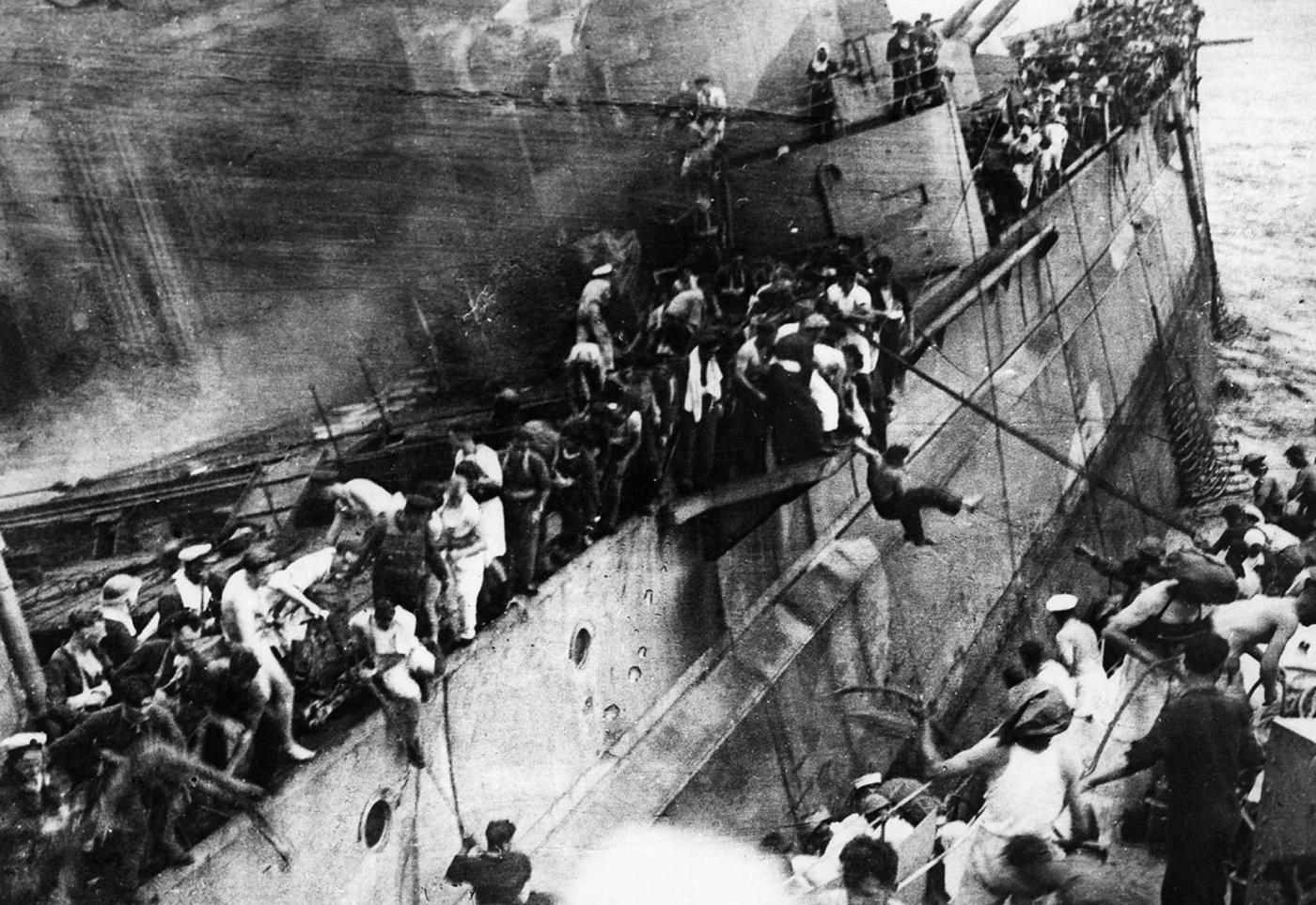
The human cost was severe. Prince of Wales lost more than 320 men, including Admiral Phillips and Captain Leach. Repulse lost about 510. Yet the destroyers HMS Express, Electra, and Vampire carried out a remarkable rescue effort, saving well over a thousand men between them. Japanese losses were minimal, with only a few aircraft failing to return.
One of the most striking aspects of the attack was the precision and coordination displayed by the Japanese aviators. Many had combat experience from China and had rigorously trained in anti-shipping tactics. Their method of launching torpedoes simultaneously from multiple directions trapped the British ships in a deadly cross-fire and prevented them from relying on manoeuvre alone. Their aircraft, though lightly built and vulnerable, were fast, had excellent range, and could deliver torpedoes with a level of accuracy that stunned the British observers and survivors.
The destruction of Prince of Wales and Repulse shocked Britain and the wider world. It proved beyond doubt that even the most powerful battleships were helpless without air cover, and it marked the first time in history that capital ships at sea and screened by escorts had been sunk solely by aircraft. It also left Singapore virtually undefended at sea at the exact moment Japan was driving rapidly south through Malaya. The sinking of Force Z foreshadowed the fall of Singapore two months later and demonstrated with brutal clarity how air power had come to dominate naval warfare by the early 1940s.