On this day in military history…
The morning after the attack on Pearl Harbor, Washington moved with a speed and unity rarely seen in its history. News of the destruction in Hawaii had reached the capital in fragments throughout December 7, leaving military officials, members of Congress, and the public stunned by the scale of the assault. By nightfall, it was clear that the United States could no longer avoid the war raging across the world, and preparations began immediately for President Franklin D. Roosevelt to address Congress the next day.
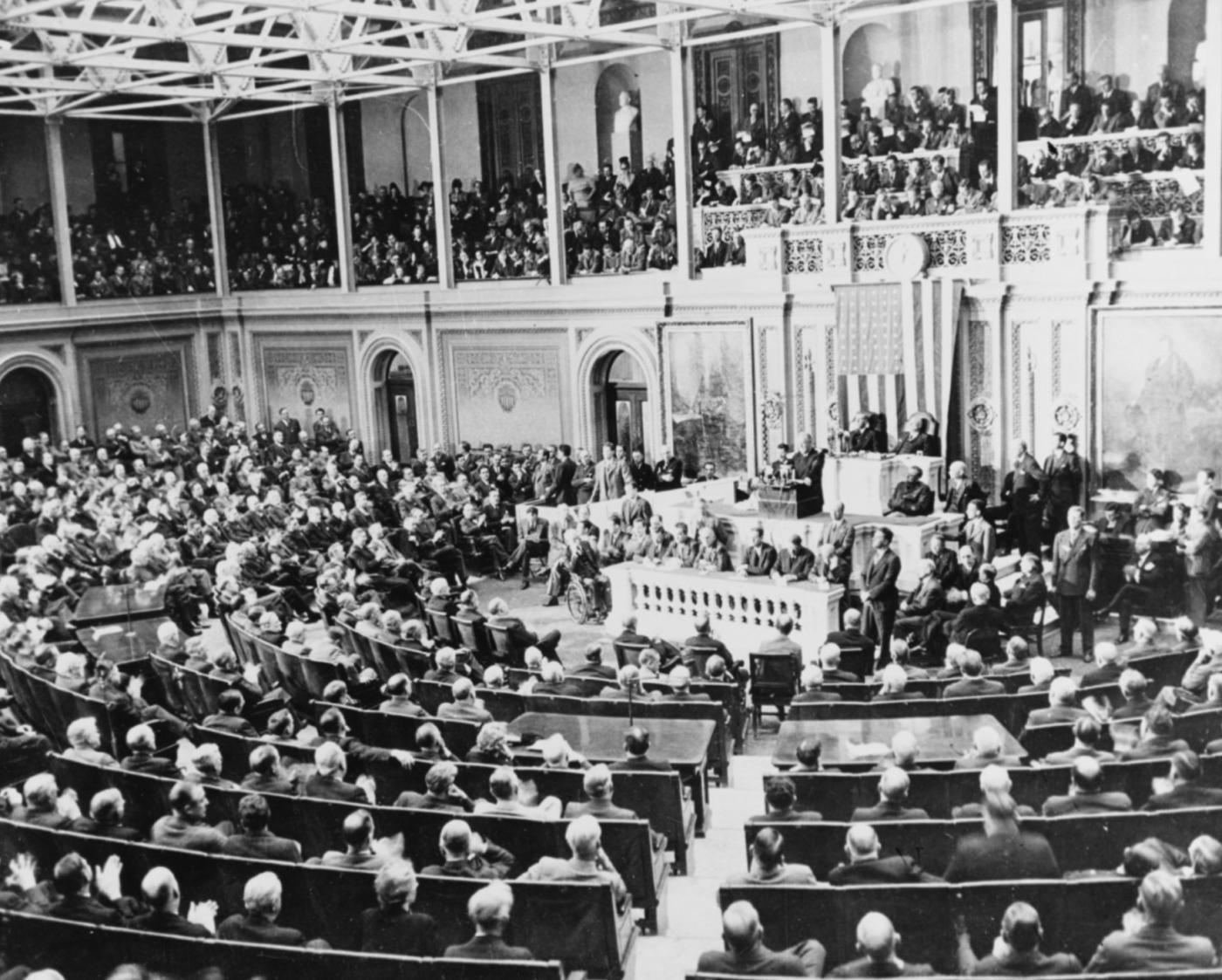
On December 8, 1941, Roosevelt was driven to the Capitol under unusually heavy security. The attack had exposed how vulnerable the nation truly was, and fears of sabotage or further strikes lingered across the capital. Despite the tension, huge crowds gathered outside, while millions listened over the radio as Roosevelt prepared to speak. Inside the House chamber, members of both chambers filled every available seat; reporters and photographers crowded into the galleries, aware that they were witnessing a moment that would shape the century.
Roosevelt’s speech lasted only about seven minutes, but it became one of the most recognizable addresses in American history. He opened with the now-famous phrase describing December 7 as “a date which will live in infamy,” a line he personally revised the night before. Initial drafts had described it as a date that “will live in world history,” but Roosevelt crossed that out by hand, choosing language that captured the shock and moral outrage of the American people.
He gave a concise summary of events, emphasizing that the United States had been engaged in peaceful negotiations with Japan and that the attack had been made without warning. Roosevelt listed not only Pearl Harbor but also Japanese strikes against Malaya, Hong Kong, the Philippines, Guam, Wake Island, and Midway, framing the assault as a coordinated attempt to dominate the Pacific. In doing so, he made clear that the conflict was far larger than a single attack and demanded an equally sweeping response.
Despite his calm tone, Roosevelt’s message left no room for doubt. He declared that hostilities existed and were continuing, and he asked Congress to recognize that a state of war had been forced upon the United States. The request was formal, brief, and delivered with the full expectation that Congress would approve it without delay. Roosevelt had already met with key congressional leaders earlier that morning, and the overwhelming sentiment was that the nation must respond decisively.
When Roosevelt finished speaking, the chamber erupted in applause. Members of Congress moved quickly to debate and vote on the resolution. The House and Senate proceeded with remarkable speed; the entire process took only a few hours. The most striking detail of the day was the overwhelming consensus: only one member of Congress, Representative Jeannette Rankin of Montana, stood against the declaration of war. A lifelong pacifist who had also voted against U.S. entry into World War I, she stated simply that she could not vote for war. Her lone dissent became a historical footnote against the backdrop of the near-unanimous national resolve.
Elsewhere in the capital, ordinary citizens stood in silence as church bells rang, flags were lowered to half-staff, and newspapers rushed to produce special editions. Across the country, military recruiting stations were filled with young men who had been lining up since dawn. Many believed, quite correctly, that the United States was now entering a prolonged and global conflict that would demand enormous sacrifice.
Later that day, Roosevelt signed the declaration of war, and the United States formally entered World War II. What began as a peaceful Sunday morning in Hawaii had turned, within twenty-four hours, into the beginning of a new and defining chapter in American and world history. The speed, unity, and gravity of Roosevelt’s address to Congress reflected not only the shock of Pearl Harbor but also the recognition that the nation now faced a struggle for survival on a scale it had never before confronted.