On this day in military history…
The attack on Pearl Harbor on 7 December 1941 was the result of months of planning, secrecy and misdirection by the Imperial Japanese Navy, culminating in one of the most dramatic and devastating surprises in military history. In the early hours of that Sunday morning, as most of the American Pacific Fleet lay at anchor in the calm waters of Oahu, Japan launched a blow intended to cripple US naval power long enough for Tokyo to seize territory across Southeast Asia and the Pacific without interference. What made the strike all the more shocking was that, only hours earlier, Japanese diplomats were still in discussions with American officials in Washington, giving the impression that negotiations to avoid war might yet continue. By the time the first Japanese aircraft broke through the clouds above Pearl Harbor, it was far too late for the United States to react.
The attack was conceived and directed by Admiral Isoroku Yamamoto, commander-in-chief of the Imperial Japanese Combined Fleet. Yamamoto, a former naval attaché to the United States and a man who understood American industrial might better than most of his colleagues, believed Japan could not win a long war against the United States. His plan was therefore built on the idea of a sudden, overwhelming first strike that would knock out or severely damage the US Navy’s battleships and aircraft carriers, buying Japan enough time to consolidate a defensive perimeter stretching from the Philippines to the Dutch East Indies. The operational commander who executed Yamamoto’s plan was Vice Admiral Chuichi Nagumo, who led the First Air Fleet, the most powerful carrier strike force in the world at that moment. This force, known as the Kido Butai, consisted of six fleet carriers: Akagi, Kaga, Soryu, Hiryu, Shokaku and Zuikaku. They sailed from the remote Kuril Islands in utmost secrecy, maintaining radio silence as they crossed the North Pacific.
Nagumo’s strike force launched its first wave shortly before dawn on 7 December. A total of 183 aircraft took off in the initial assault, including torpedo bombers, dive bombers, high-level bombers and fighter escorts. These were led by Commander Mitsuo Fuchida, who sent the now-famous coded message announcing total surprise. A second wave of 171 aircraft followed later in the morning, bringing the total number of attacking planes to 354. The Japanese used a mix of armour-piercing bombs designed to penetrate battleship decks and specially modified torpedoes fitted with wooden fins, allowing them to run shallow enough not to bury themselves in the soft mud of Pearl Harbor’s relatively shallow waters. These torpedoes caused some of the most catastrophic damage, tearing open the hulls of ships that had thought themselves safe from such a threat.
On the American side, command of the Pacific Fleet rested with Admiral Husband E. Kimmel, while the Army’s Hawaiian Department was led by Lieutenant General Walter Short. Both men had received warnings from Washington in the weeks before the attack, but the information was general, not specific, and Japanese forces could have struck anywhere from Southeast Asia to the Philippines. Hawaii did not seem the most likely target. As a result, the fleet remained moored in a neat row along Battleship Row, with aircraft parked wing-to-wing on airfields to guard against sabotage rather than aerial assault. The assumption was that any Japanese attack would come from the western Pacific and would be detected in time for a response. The reality was very different.
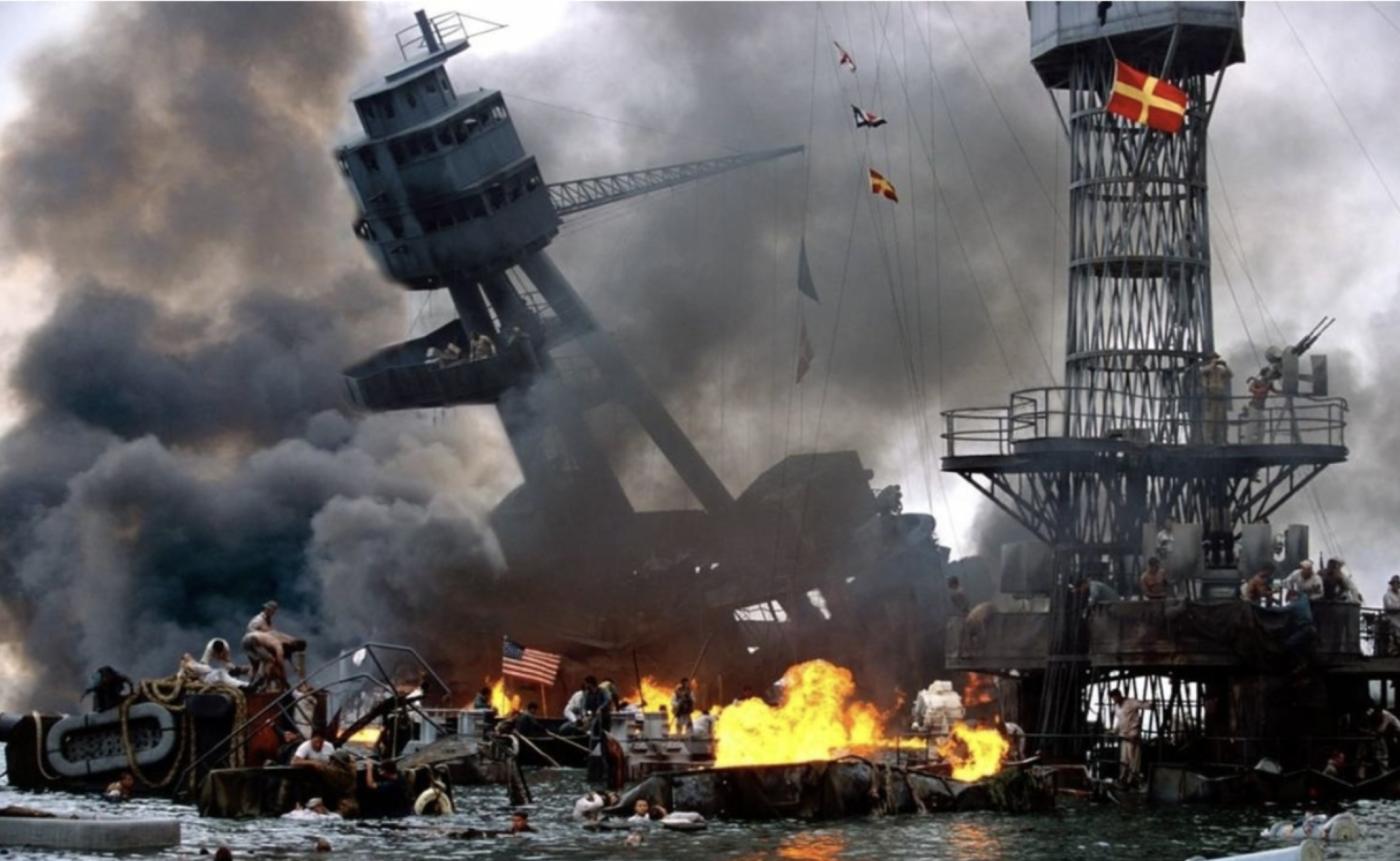
When the Japanese planes arrived over Pearl Harbor just before 8 a.m., they found the fleet almost perfectly exposed. Battleships such as USS Arizona, USS Oklahoma, USS California and USS West Virginia bore the brunt of the attack. Arizona suffered a spectacular magazine explosion that split the ship apart and killed over a thousand men instantly. Oklahoma capsized after multiple torpedo hits. Within minutes, the serene harbour was transformed into a scene of flames, collapsed superstructures, black smoke and oil-slicked water. Airfields at Hickam, Wheeler, Ford Island and Bellows were also struck, destroying or disabling hundreds of American aircraft on the ground before they could take off.
One of the few moments of resistance came from a handful of American pilots who managed to get airborne in P-40s and engage the attackers, shooting down several Japanese aircraft despite overwhelming odds. Anti-aircraft gunners, initially surprised and often firing with little coordination, eventually filled the sky with enough fire to force some Japanese planes down. But the damage had already been done.
By mid-morning the attack was over. Japan had sunk or severely damaged eight battleships, destroyed more than 180 American aircraft and killed over 2,400 service members and civilians. Crucially, however, the American aircraft carriers were not in port, a fact that would later shift the balance of power in the Pacific. Nagumo, cautious and concerned about the whereabouts of those carriers, decided not to launch a third wave that might have destroyed vital fuel depots and repair facilities. Those facilities would prove essential in rebuilding the Pacific Fleet far more quickly than Yamamoto had hoped.
News of the attack raced across the United States, producing a mixture of shock, anger and disbelief. President Franklin D. Roosevelt delivered his famous “day of infamy” speech the next day, and Congress almost unanimously approved a declaration of war against Japan. For many Americans, the attack marked the end of isolationism and the beginning of a national mobilisation unlike anything the country had ever known. On the Japanese side, initial reactions included celebration and a belief that the strike had given them the advantage they needed. Yet Yamamoto is said to have remarked that the attack had awakened a sleeping giant and filled him with a terrible resolve, a sentiment that proved prophetic as the war unfolded.
The attack on Pearl Harbor remains one of the most dramatic examples of strategic surprise, a combination of audacious planning, misjudged intelligence and the belief that diplomacy was still possible even as warships and aircraft were already in motion. It changed the course of world history in a matter of minutes and set the stage for a conflict that would reshape the twentieth century.